This free Texas general power of attorney form is a financial power of attorney. You, the principal, use it to name an agent, also called an attorney-in-fact, to handle the money matters you choose. The form below has five pages and 41 fillable fields and does not authorize health-care decisions. Fill it out online, or see all Texas power of attorney forms, including the limited and minor child forms.
Last Updated: October 2026. This guide is reviewed and updated regularly to reflect current Texas law. If you notice an error or outdated information, please contact us.
Create a free high quality Texas General Financial PoA online now!
Build Your Document
Answer a few simple questions to make your document in minutes
Save and Print
Save progress and finish on any device, download and print anytime
Sign and Use
Your valid, lawyer-approved document is ready
... or download your Texas General Financial Power of Attorney as a PDF file
What Is the Texas General Power of Attorney Form and What It Covers
The form is titled Texas Financial Power of Attorney. It lets your agent act for you in any lawful way on the subjects you initial. The notice at the top of page 1 says the powers are broad and do not include every power the law allows. It also says you may revoke the document later.
The form lists these powers, each on its own line to initial:
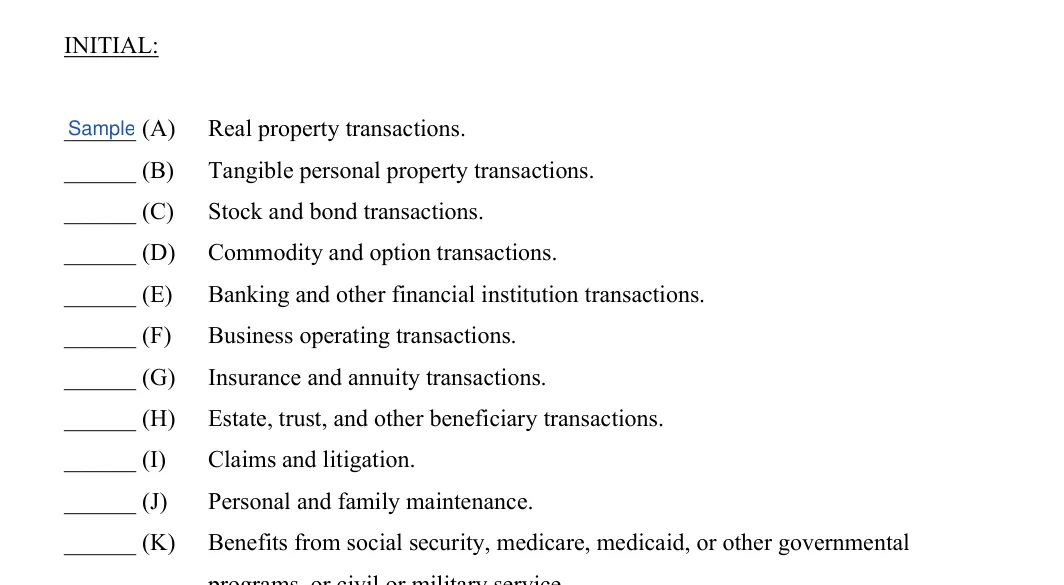
(A) Real property transactions
(B) Tangible personal property transactions
(C) Stock and bond transactions
(D) Commodity and option transactions
(E) Banking and other financial institution transactions
(F) Business operating transactions
(G) Insurance and annuity transactions
(H) Estate, trust, and other beneficiary transactions
(I) Claims and litigation
(J) Personal and family maintenance
(K) Benefits from Social Security, Medicare, Medicaid, or other governmental programs, or civil or military service
(L) Retirement plan transactions
(M) Tax matters
To grant every power, initial only line (N), which covers all of the powers listed above. To withhold a power, leave its line blank.
Pages 2 and 3 also print three special instructions. They cover medical claims and reimbursements, retirement and savings accounts, and digital assets such as email and social-network accounts. They are already part of the form, so there is nothing to fill in there.
The form does not authorize anyone to make medical or other health-care decisions for you. For that, use a Texas medical power of attorney. Our Texas durable power of attorney form is a separate document. Under Tex. Est. Code 751.0021, a Texas power of attorney is a durable power of attorney when it includes the chapter's durability language. A durable power of attorney continues through the principal's incapacity.[1.1]
Choose an agent you trust to handle your money carefully. Talk to that person first, and think about their experience with financial matters. People often use a general financial power of attorney when they cannot manage their money matters themselves, for example during a long trip.
Texas Signing Rules for a General Power of Attorney
Texas sets the signing rules for a durable power of attorney in Estates Code chapter 751. Two steps matter most. The principal signs the document, and the signature is then acknowledged before an officer such as a notary public.[1.1]
Texas law sets these two requirements:
The document must be signed by an adult principal, or signed in the principal’s conscious presence by another adult whom the principal directs to sign the principal’s name.[1.1]
The principal, or the other adult the principal directed to sign, must acknowledge the document before an officer. The officer must be authorized, under the laws of Texas or another state, to take acknowledgments to deeds of conveyance and to administer oaths.[1.1]
The form follows this order. Page 4 holds the principal’s signature, and page 5 holds the acknowledgment that the notary completes. The form has no witness lines. If you are unsure whether your situation calls for witnesses, ask a Texas lawyer.
The table below summarizes the key details of this Texas general power of attorney form.
County clerk of the county where the property is located, for real property transactions that need a recorded instrument
Pages
5
Avg. Time to Fill Out
10 minutes
# of Fillable Fields
41
Available Formats
Adobe PDF
Create a free high quality Texas General Financial PoA online now!
What a Texas Agent Must Do
An agent’s duties begin when the agent accepts the appointment. Unless the power of attorney says otherwise, a person accepts by exercising authority or performing duties as an agent, or by any other words or conduct showing acceptance.[1.2] The form has no line for the agent to sign.
Once a person accepts, that person is a fiduciary as to the principal, but only when acting as agent under the power of attorney. The agent also has a duty to inform and to account for actions taken under it.[1.3]
The law spells out two working duties:
The agent must timely inform the principal of each action taken under the power of attorney.[1.4]
The agent must maintain records of each action taken or decision made.[1.5]
A simple notebook or spreadsheet that logs each action and decision from day one makes the record-keeping duty easy to meet.
How to Fill Out the Texas General Power of Attorney Form
Fill in the form from top to bottom. It has five pages, and the steps below follow its order: your names, the powers, the dates, a successor, your signature and the notary’s acknowledgment. Use the form builder above to type your answers online, or download the PDF and write them by hand.
The screenshots under each step show the FormsPal Texas general power of attorney template filled with sample entries in blue, so you can see where each answer goes. The names, addresses, dates and amounts are examples only.
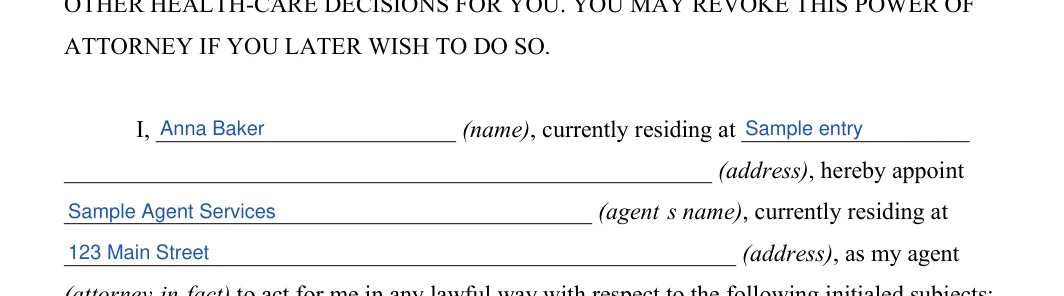
Name yourself and your agent On page 1, enter your name and address in the opening paragraph, then your agent’s name and address on the lines that follow. Read the notice above that paragraph first. It says the form does not authorize health-care decisions and that you may revoke it.Step 1: sample entries, not a real document.
Initial the powers you grant, (A) to (K) On page 2, put your initials on the line in front of each power you want your agent to have, from (A) real property transactions to (K) benefits from governmental programs. Leave a line blank to withhold that power. You may also cross it out.Step 2: sample entries, not a real document.
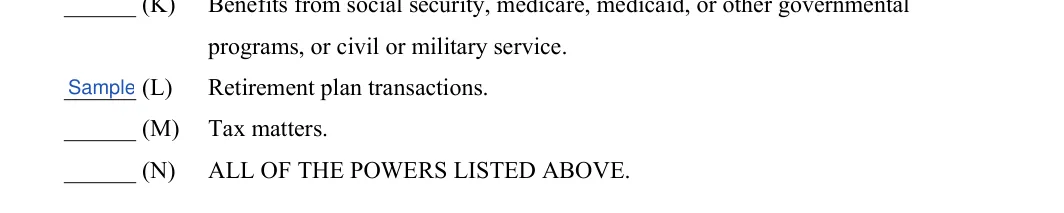
Finish the powers list with (L), (M) and (N) Initial (L) retirement plan transactions and (M) tax matters if you want your agent to have them. To grant every power, initial only (N), all of the powers listed above. The form says you need not initial any other line then. The special instructions printed below the list need no entries.Step 3: sample entries, not a real document.
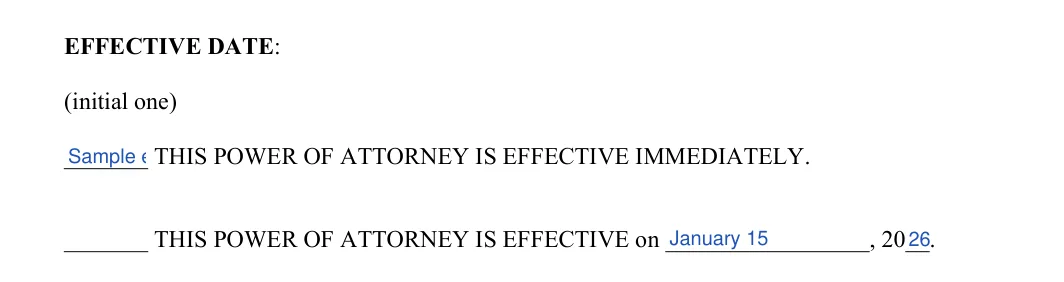
Effective date On page 3, initial one line under EFFECTIVE DATE. The first line makes the power of attorney effective immediately. The second line makes it effective on a date you write in, together with the year.Step 4: sample entries, not a real document.
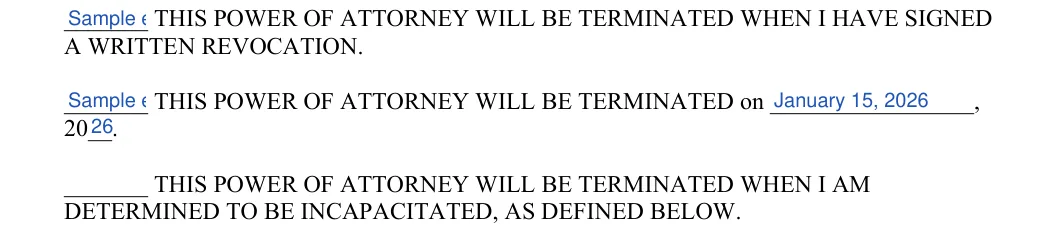
Termination date: written revocation Under TERMINATION DATE the form asks you to initial one line. Initial the first line if the power of attorney should end when you have signed a written revocation.Step 5: sample entries, not a real document.
Termination date: a set date or incapacity Instead, initial the second line to end the power of attorney on a date you write in, or the third line to end it when you are determined to be incapacitated. The form defines that word just below the lines: a court finding of incompetence, a court-appointed conservator or guardian, or written statements from two unrelated physicians.Step 6: sample entries, not a real document.
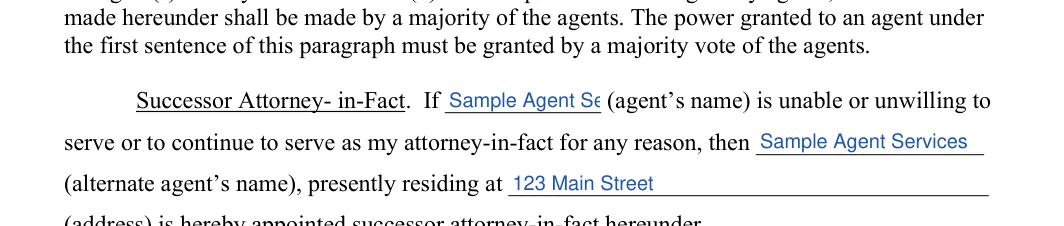
Successor attorney-in-fact On page 4, find the Successor Attorney-in-Fact paragraph. Enter your agent’s name, then the name and address of the alternate agent who takes over if your agent is unable or unwilling to serve.Step 7: sample entries, not a real document.
Date and sign the document At the bottom of page 4, fill in the day, month and year on the Signed this line, then sign and print your name. Sign in front of the notary, because the acknowledgment on page 5 says you appeared before the officer.Step 8: sample entries, not a real document.
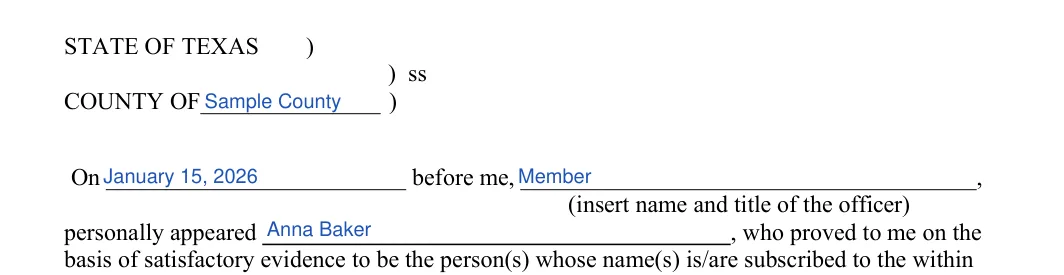
Acknowledgment: county, date and officer On page 5, the notary or other officer enters the county, the date, the officer’s name and title, and your name as the person who appeared. Your part is to appear before the officer and prove who you are.Step 9: sample entries, not a real document.
Officer signature and seal The officer signs on the Signature line and adds the seal. The form notes that the officer verifies only your identity, not that the document is truthful, accurate or valid.Step 10: sample entries, not a real document.
How to Sign and Use Your Power of Attorney
After you fill in the form, a few steps make it ready to use. Sign it before a notary, give copies to the people who will rely on it, and record it if it is used in a real property deal. Follow the steps in this order:
Read the whole form once more. Check that names are spelled the same way everywhere and that you initialed one line in each choice.
Sign and date the form on page 4 in front of the notary, who then completes the acknowledgment on page 5. Texas requires the signature to be acknowledged before an officer such as a notary public in Texas.[1.1]
Give a copy to your agent and to each bank or other institution that will deal with your agent.
If the power of attorney is used in a real property transaction that needs a recorded instrument, record it with the county clerk of the county where the property is located. The deadline is the 30th day after the date the instrument is filed for recording.[1.8]
Keep the original in a safe place and tell your agent where it is.
Frequently Asked Questions
These answers cover how a Texas power of attorney ends and how Texas defines incapacity. Each answer cites the Texas Estates Code, and the numbered sources are listed at the end of the page. Check the current law before you rely on any of it.
Does a Texas power of attorney end when the principal dies?
Yes. A durable power of attorney terminates when the principal dies.[1.6] The form on this page has no line about death, so this rule comes from the law and not from a choice you make on the form.
How can I cancel a Texas power of attorney?
The agent’s authority terminates when the principal revokes it.[1.6] Page 3 of the form lets you choose how the power of attorney ends. You initial one of these lines:
It ends when you have signed a written revocation.
It ends on a date you write in.
It ends when you are determined to be incapacitated, as the form defines it.
The agent’s authority terminates if the agent dies, becomes incapacitated, is no longer qualified, or resigns.[1.7] To plan for that, name a successor on page 4 of the form. The Successor Attorney-in-Fact paragraph covers an agent who is unable or unwilling to serve.
Does a Texas power of attorney expire over time?
Not by the passing of time alone. Unless the durable power of attorney says otherwise, an agent’s authority may be exercised until it terminates, even after a lapse of time since the power of attorney was signed.[1.6] You can set an end date yourself by initialing the date line under TERMINATION DATE on page 3.
How does Texas define incapacity for a power of attorney?
Unless the document defines it otherwise, the principal is considered disabled or incapacitated if a physician certifies it in writing. The certification must come after the date the document was signed. It must rest on the physician’s medical examination and state that the principal is mentally incapable of managing the principal’s financial affairs.[1.9]
This form defines the word itself on page 3. It counts any one of these:
A court finding that you are incompetent
A court appointment of a conservator or guardian for your estate
Written certification by two unrelated physicians that you are substantially unable to manage your financial resources or resist fraud or undue influence
General information, not legal or tax advice.
Sources
Each bracketed number in the text above points to one of these official Texas sources. Open the link to read the provision in full, and check the current text before you rely on it.
Mara has been practicing estate planning and trust law in California since 2003, taking pride in helping clients of all backgrounds and asset profiles form a complete and customized estate plan. Her specialties are: estate planning, wills and trusts, trust and probate administration.