Free Minnesota Medical Power of Attorney Form

A medical power of attorney is a written document in which you name an agent to make health care decisions for you if you cannot make them yourself. Minnesota law calls the broader paper a health care directive, and it can hold a health care power of attorney, health care instructions, or both.[1] The FormsPal Minnesota medical power of attorney form combines the two: Part I names your agent, and Part II records your wishes for end-of-life care.

Last Updated: October 2026. This guide is reviewed and updated regularly to reflect current Minnesota law. If you notice an error or outdated information, please contact us.

Minnesota medical power of attorney form preview

Create a free high-quality Minnesota Medical Power of Attorney online now!

Build Your Document

Answer a few simple questions to make your document in minutes

Save and Print

Save progress and finish on any device, download and print anytime

Sign and Use

Your valid, lawyer-approved document is ready

... or download your Minnesota Medical Power of Attorney (POA) Form as a  PDF file
Not sure this is the right choice? Learn how it differs in our guide to the medical power of attorney form for every state, or see all Minnesota power of attorney forms that FormsPal offers.

Minnesota Laws and Requirements

Under Minnesota law, a health care directive must be in writing, be dated, and state the principal's name. The principal is you, the person making the directive. You sign it, or you authorize another person to sign for you, and a notary public or witnesses then verify that signature.[1]

In plain words, a health care directive in this state needs all of these:

  • It is in writing.
  • It is dated.
  • It states the principal's name.
  • The principal signs it, or another person authorized by the principal signs on the principal's behalf.
  • A notary public or witnesses verify that signature, as Chapter 145C provides.
  • It includes a health care instruction, a health care power of attorney, or both.[1]
Page 7 of the template holds the notary block, and the template has no lines for witnesses. If you choose witnesses instead of a notary, read the witness rules in Chapter 145C before you sign.

Your health care agent, or an alternate health care agent, may not act as a witness or notary public when you sign the health care directive that appoints them.[1]

Minnesota Medical Power of Attorney Form Details

Document Name Minnesota Medical Power of Attorney Form
Legal Name Under State Law Health care directive
State Laws Minnesota Statutes, Chapter 145C
Signing Requirements Notary public or witnesses[1]
Avg. Time to Fill Out 8 minutes
# of Fillable Fields 21
Available Formats Adobe PDF

Filling Out the Form

This template has 21 fillable fields in five areas. Part I names your agent. Part II, your end-of-life wishes, and Part III, the general provisions, are printed text. You date and sign near the end, and a notary completes the last page.

The screenshots under each step show the FormsPal Minnesota medical power of attorney template filled with sample entries in blue, so you can see where each answer goes. The names, addresses, dates and amounts are examples only.
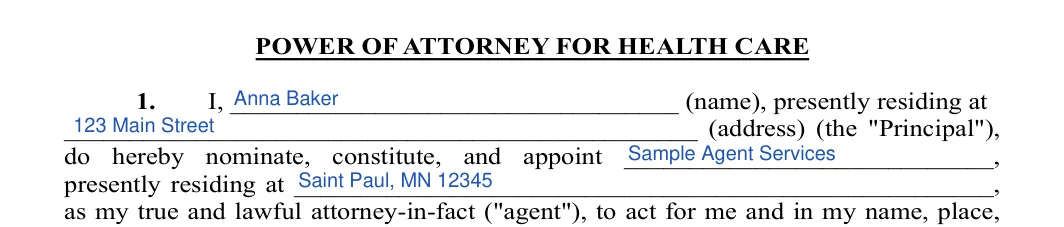
  1. Principal and agent. On page 1, enter your full name and address in the first paragraph, then the details of the person you appoint as your agent. The agent is your attorney-in-fact, the person who acts for you on health care matters.
    Minnesota medical power of attorney: POWER OF ATTORNEY FOR HEALTH CARE, filled with sample entries
    Step 1: sample entries, not a real document.
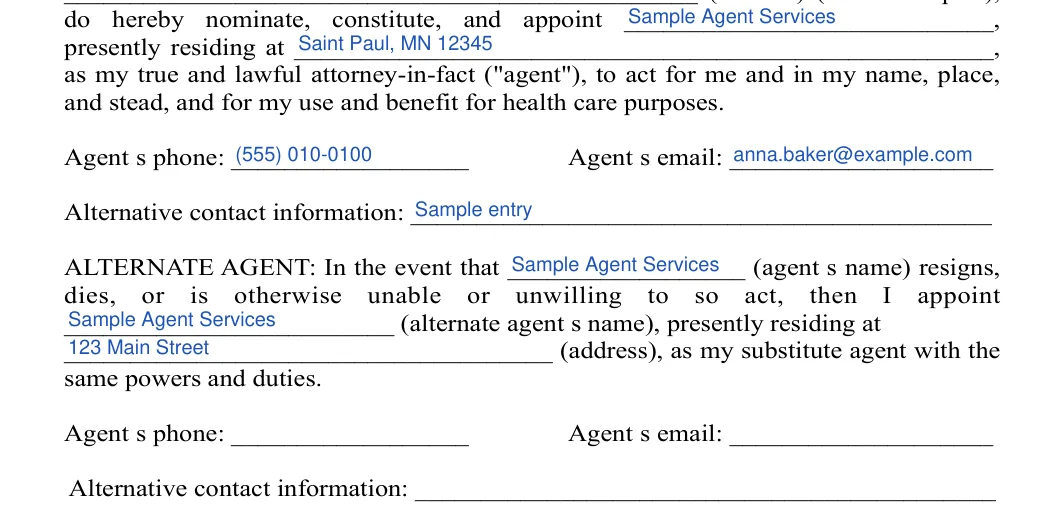
  2. Agent contact details and alternate agent. Add your agent's phone, email, and any alternative contact. In the ALTERNATE AGENT paragraph, repeat the agent's name, then fill in the alternate's address, phone, and email. The alternate steps in if your first agent resigns, dies, or cannot act.
    Minnesota medical power of attorney: Agent's phone, Agent's email and more, filled with sample entries
    Step 2: sample entries, not a real document.
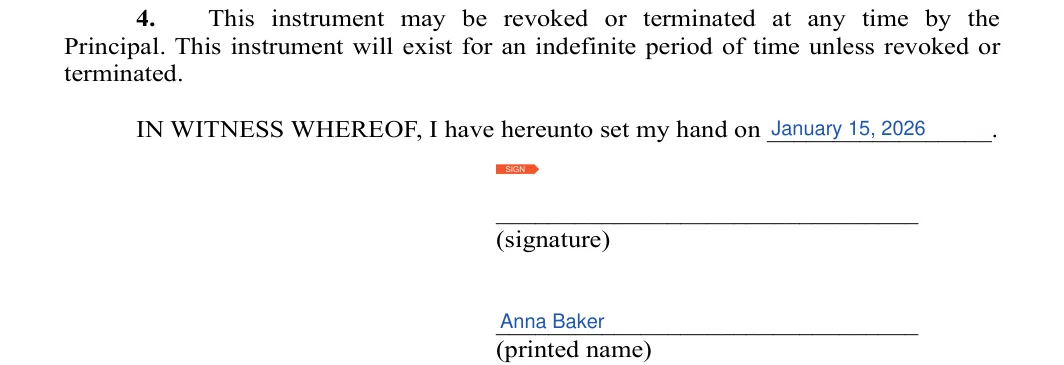
  3. Date and signature. On page 6, enter the date, sign on the signature line, and print your name. Pages 2 to 5 are printed text with nothing to fill in, so read them before you sign.
    Minnesota medical power of attorney: Date, Signature and more, filled with sample entries
    Step 3: sample entries, not a real document.
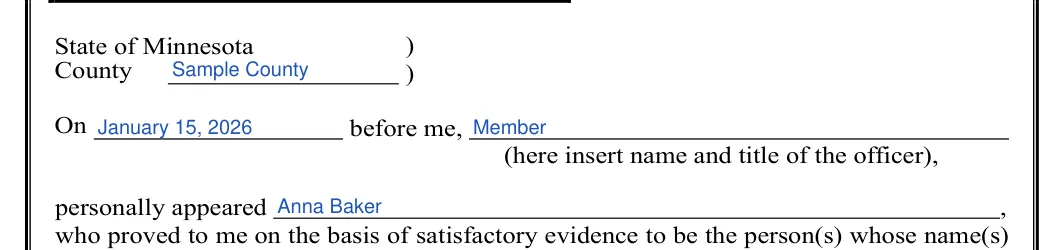
  4. Notary acknowledgment. On page 7, the notary enters the county, the date, their own name and title, and your name as the person who appeared.
    Minnesota medical power of attorney: County, Date and more, filled with sample entries
    Step 4: sample entries, not a real document.
  5. Notary signature and seal. The notary signs on the signature line and adds the seal at the end of page 7.
    Minnesota medical power of attorney: Signature, filled with sample entries
    Step 5: sample entries, not a real document.

How to Sign and Use Your Medical Power of Attorney

After you fill in the template, you still need to get it verified and put it to use. State law lets a notary public or witnesses verify your signature, and this template is built for a notary.[1] These steps cover getting the form, signing it, and sharing it.

  1. Get the template. Download the PDF from this page, or answer a few questions in the FormsPal online builder and let it fill the template for you.
  2. Read the whole form first. Pages 2 to 5 list what your agent can do, such as consenting to or refusing medical care, getting your medical records, and arranging organ donation and burial. Learn what each part says, and make sure you agree with every line.
  3. Sign the form yourself, or authorize another person to sign for you. Then have a notary public verify your signature. Instead of a notary, the law lets the principal sign before witnesses.[1] This template has lines only for a notary. Many notaries want to see you sign, so bring the form unsigned.
  4. Give copies to your agent, your alternate agent, your doctor, your family, and anyone else who may need to see it.
  5. Keep the signed original where your agent can find it. Read it again from time to time, and make a new one if your wishes change.

Frequently Asked Questions

Does a health care directive need to be notarized in Minnesota?

Not always. Minnesota law lets either a notary public or witnesses verify the principal's signature, as Chapter 145C provides. Instead of witnesses, the principal may sign before a notary public.[1] The FormsPal template has a notary block on page 7.

Can someone else sign my Minnesota health care directive for me?

Yes. The signature can be yours or that of another person you authorize to sign on your behalf. State law sets the conditions for a signature by another person.[1]

Does a Minnesota health care directive have to be in writing and dated?

Yes. It must be in writing and dated, and it must state the principal's name. The template has a line for your name on page 1 and a date line on page 6.[1]

seal of minnesota state
Other Minnesota Forms
Check out our document maker to customize any form found on FormsPal to your preferences. Here is a number of various other fillable Minnesota forms we provide.

Download a Free Minnesota Medical Power of Attorney Form

Download the template as a PDF, or fill it out online and print it. It has 21 fillable fields and a notary acknowledgment on its last page, so you can put your health care decisions in writing, sign, and take it to a notary with your family or agent beside you if you wish.

Looking for another document? FormsPal also offers a Minnesota living will form and a Minnesota durable power of attorney form, plus a Minnesota last will template. You can also browse every power of attorney form by state.

Template Preview
Create a free high-quality Minnesota Medical Power of Attorney online now!

General information, not legal or tax advice.

Sources

  1. Minn. Stat. § 145C.03.
Published: Aug 24, 2022
Mara Erlach
Mara Erlach
Writer & Attorney
Mara has been practicing estate planning and trust law in California since 2003, taking pride in helping clients of all backgrounds and asset profiles form a complete and customized estate plan. Her specialties are: estate planning, wills and trusts, trust and probate administration.