
A New Jersey medical power of attorney is a written document in which you, the principal, name an agent to make health care decisions for you if you cannot. You may also hear this person called a health care proxy. The document covers medical care only, not money or property. Browse more New Jersey power of attorney forms, or read about the medical power of attorney form in general.
Last Updated: October 2026. This guide is reviewed and updated regularly to reflect current New Jersey law. If you notice an error or outdated information, please contact us.
Build Your Document
Answer a few simple questions to make your document in minutes
Save and Print
Save progress and finish on any device, download and print anytime
Sign and Use
Your valid, lawyer-approved document is ready
A medical power of attorney lets you choose who speaks for you on health care if illness or injury leaves you unable to decide. It covers health care only, not money or property. The New Jersey statute calls your agent the health care representative.[1] Three terms appear throughout this page and the form:
New Jersey sets rules for how an advance directive is signed and for who may serve as your health care representative. The FormsPal template includes an advance directive in Part II, so both sets of rules matter. The sections below put each rule in plain words, so you can check them before you sign.
The advance directive must be signed and dated by the principal, or by another person at the principal's direction. This is the statute's wording for signing before witnesses:
The advance directive shall be signed and dated by, or at the direction of, the declarant in the presence of two subscribing adult witnesses, who shall attest that the declarant is of sound mind and free of duress and undue influence.
The declarant is you, the principal. If you sign before witnesses, these points apply:
State law restricts who may serve as your agent. An operator, administrator, or employee of a health care institution where you are a patient or resident may not serve as your health care representative. The exception is a person related to you by blood, marriage, domestic partnership, civil union, or adoption.[2]
Beyond this rule, it is common practice to name someone you trust and to talk with them before you name them.
| Document Name | New Jersey Medical Power of Attorney Form |
| Relevant Law | New Jersey Statutes, sections 26:2H-56 and 26:2H-58(a)(2)[1][2] |
| Signing Requirements | Two adult witnesses, or acknowledgment before a notary public or another person authorized to administer oaths[1] |
| Who Can't Be the Agent? | Operators, administrators and employees of a health care institution where you are a patient or resident, unless related to you by blood, marriage, domestic partnership, civil union or adoption[2] |
| Who Can't Be the Witness? | Your designated health care representative[1] |
| Avg. Time to Fill Out | 8 minutes |
| # of Fillable Fields | 21 |
| Available Formats | Adobe PDF |
Popular Local Medical POA Forms
Medical POA forms are used in every single state. Browse several other sample MPOA forms frequently searched for by people.
The FormsPal template is titled Medical Power of Attorney with Advance Directive. It has three numbered parts and a notary page. What each part says comes from the printed text of the form, not from New Jersey law, so read all of it before you sign.
Part II is a serious statement about end-of-life care. If it does not match what you want, talk to a lawyer or your doctor before you sign.
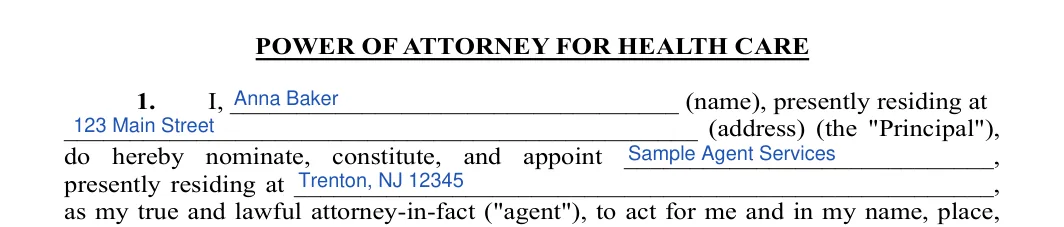
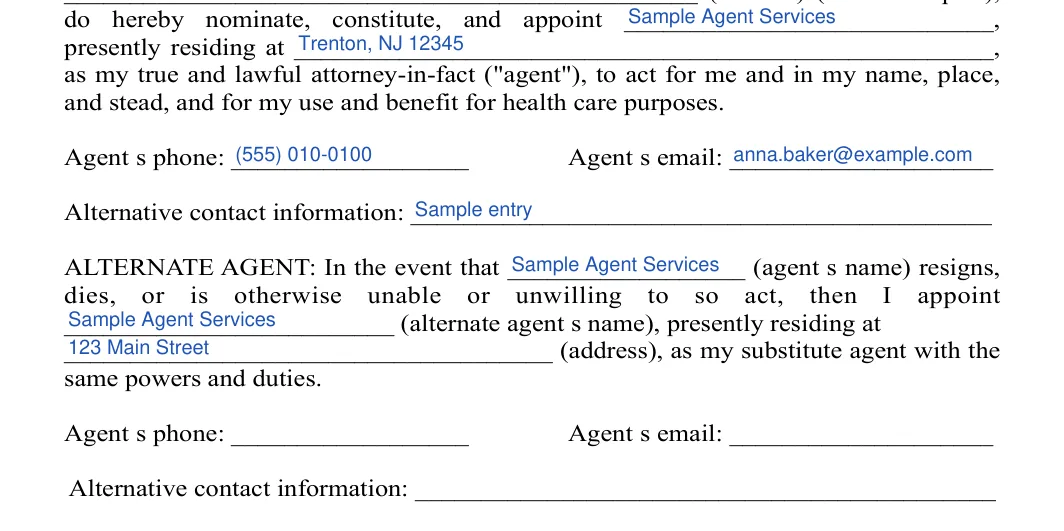
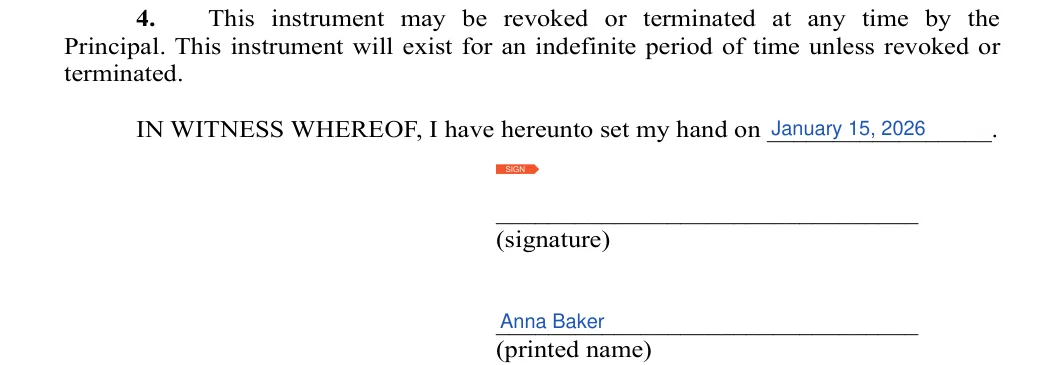
The form has 21 fillable fields, and the five steps below follow it from page 1 to page 7. Each step names the part of the form it covers. The notary completes the last two parts, so leave those fields for the notary.
The screenshots under each step show the FormsPal New Jersey medical power of attorney template filled with sample entries in blue, so you can see where each answer goes. The names, addresses, dates and amounts are examples only.
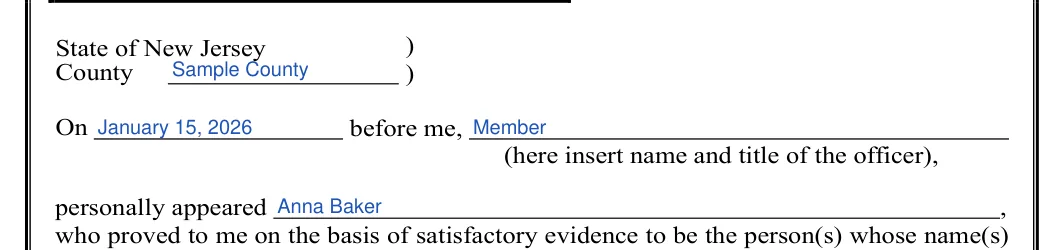

Filling in the blanks is only part of the job. The steps below cover what happens around the form, from getting it to handing out copies. The signing and witness rules above decide how you sign.
These answers come from the New Jersey advance directive statute, as summarized in the requirements above. They cover witnesses, notarization, who may witness, who may serve as your agent, and signing at your direction.
It does if you do not use a notary. An advance directive that is witnessed rather than acknowledged needs two subscribing adult witnesses, who attest that you are of sound mind and free of duress and undue influence.[1]
Notarizing is one of two ways to complete it. Instead of signing before witnesses, you may sign and date the document and acknowledge it before a notary public, an attorney at law, or another person authorized to administer oaths.[1]
Your designated health care representative, the agent, may not act as a witness to the execution of an advance directive.[1]
An operator, administrator, or employee of a health care institution where you are a patient or resident may not serve as your health care representative.[2] The exception is a person related to you in one of these ways:
Yes, but only at your direction. The advance directive may be signed and dated by another person at your direction. State law sets the conditions for that signature, so ask a lawyer before you rely on it.[1]

You can build this medical power of attorney online and print it, or download the PDF with its 21 fillable fields. Either way, you still need to complete the signing step that New Jersey requires, either two adult witnesses or an acknowledgment before a notary public.[1]
General information, not legal or tax advice.
