
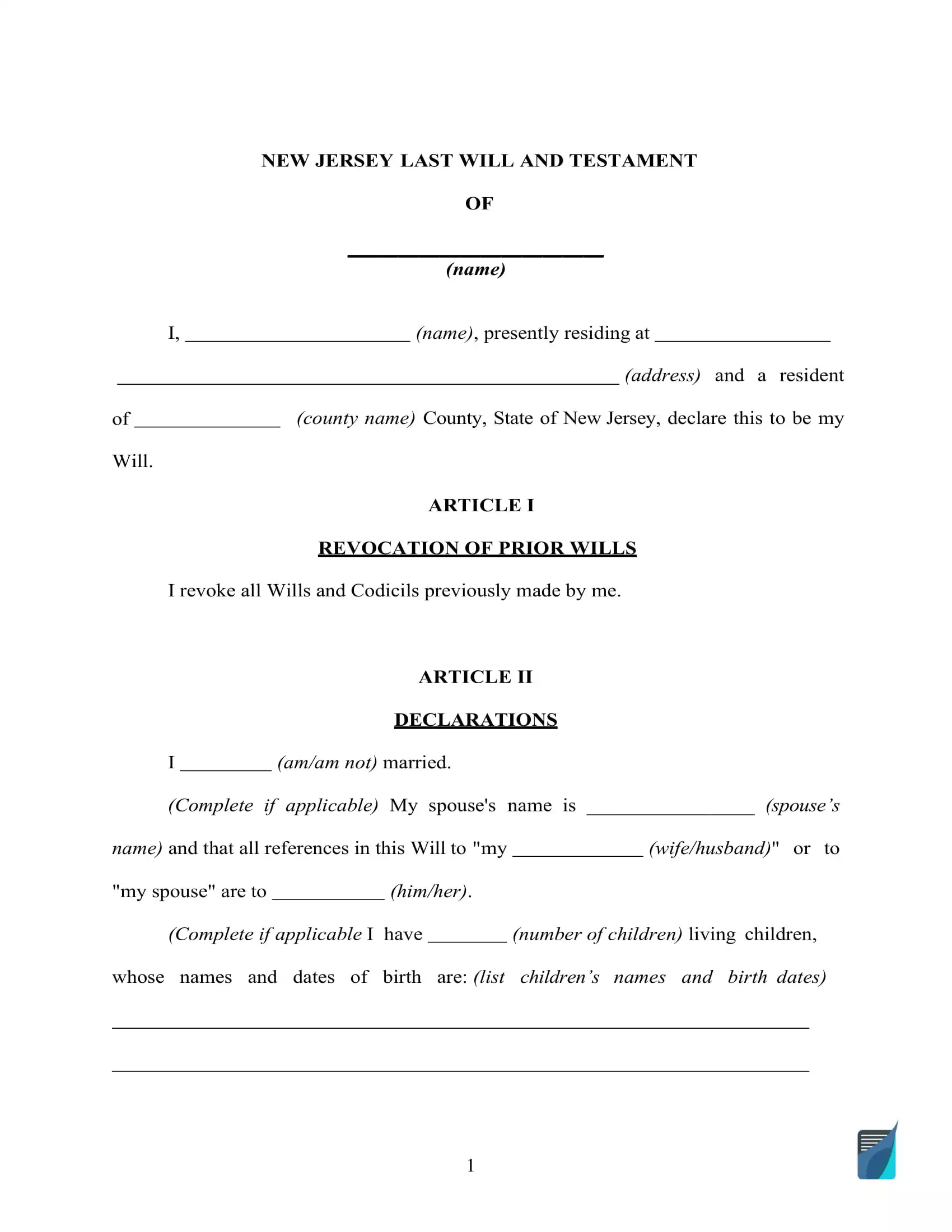
A New Jersey last will and testament is an essential estate planning document that represents the final wishes of a testator with regard to their private property and in what way they would want it to get distributed among their chosen heirs. To be valid a will in this state must be attested and signed by two competent witnesses.
Last Updated: September 2026. This guide is reviewed and updated regularly to reflect current New Jersey law. If you notice an error or outdated information, please contact us.
Build Your Document
Answer a few simple questions to make your document in minutes
Save and Print
Save progress and finish on any device, download and print anytime
Sign and Use
Your valid, lawyer-approved document is ready
Download and use our NJ will template provided in PDF and Word formats that you can fill out yourself. We also offer essential guidelines for writing a last will and answer common questions related to this document.
New Jersey law requires a will to be in writing. It must be signed by the testator, or by someone else in the testator’s name and at the testator’s direction, in the testator’s presence. At least two witnesses must watch that signing or hear the testator acknowledge it, then sign the will themselves within a reasonable time and in the testator’s presence.[2] The testator must be 18 or more years of age.[1.1]
A will executed on or after September 1, 1978 may be made self-proved. The testator and witnesses sign affidavits before an authorized officer, which lets the court accept the will without calling the witnesses to testify.[1.2] New Jersey also lets a testator file a completed will with the New Jersey will registry for a modest fee, so an executor can find it after the testator’s death and start the probate process without delay.
In short, a valid New Jersey last will and testament must meet these requirements:
Careful estate planning protects your assets and your beneficiaries. Many New Jersey residents pair their last will with other estate planning documents, such as a durable power of attorney or a living trust, so their executor has clear legal authority over every asset and every account during probate. Listing your specific assets, from real property to bank accounts, helps the probate process move faster for your family and your beneficiaries.
A New Jersey last will and testament is also called a last will, a will, or an estate plan for your assets. Filing it with the New Jersey will registry does not replace probate. It only helps your family locate the original document.
| Requirements | State laws | |
| Statutes | Title 3B – Administration of Estates – Decedents and Others | |
| Definitions | 3B:1-1 Definitions A to H | 3B:1-2 Definitions I to Z | |
| Signing requirement | Two witnesses | 3B:3-2. Execution; witnessed wills; writings intended as wills |
| Age of testator | 18 or older and of sound mind | 3B:3-1. Individuals competent to make a will and appoint a testamentary guardian |
| Self-proving wills | Allowed | 3B:3-4. Making will self-proved at time of execution |
| Handwritten wills | Recognized if meeting certain conditions | 3B:3-2. Execution; witnessed wills; writings intended as wills |
| Oral wills | Not recognized | |
| Holographic wills | Recognized if meeting certain conditions | |
| Registering a will | Possible with the New Jersey Secretary of State’s Office for a modest fee | 3B:3-2.1. Creation, maintenance of will registry; fees |
Step 1. Consider your options first. Determine whether you would like to create your will by handwriting it all, filling out a last will and testament form, or using a step-by-step document creator we provide. It might also make sense to consult an attorney if you have a lot of assets.
Please, familiarize yourself with all will requirements and laws related to will-making in New Jersey before getting started.
Step 2. Specify your information (as the testator). The first step is establishing the testator by writing their full legal name at the very top, as well as their residential information (street, city, county, and state). After that, make sure it’s all correct by going over the information you’ve just entered and the remainder of the section.

Step 3. Choose the executor (personal representative). In this passage, you choose who’s going to carry out your last will and testament by filling in their full name, together with their street address, city, county, and state of residence.
In New Jersey, a nonresident executor must post a bond unless your will says that no security is required of the executor (N.J.S.A. 3B:15-1(e)).[1.3] Because of this, many people choose an executor who lives in the same state they do.
As a precaution, you may choose an alternative executor of your last will and testament. That way, you’ll be able to make sure that, even if the initially chosen executor is unable to carry out their obligations, there’s another trustworthy person you can rely on.

Step 4. Indicate the guardian for minors (optional). In case you have underage or dependent children and don’t wish the court to pick a guardian for them when you are no longer here, you can appoint a friend or a relative as a legal guardian for your children. Be specific about which relative or friend you want as guardian, and name a backup. Your wishes for your children’s care carry more weight when you finish this planning step and put it in writing.

Step 5. Establish your beneficiaries. Now, indicate people to whom you want to pass down your assets, that is, your beneficiaries. Fill in their full names, places of residence, and your relationship to them (e.g., spouse, child, friend). Naming specific beneficiaries by their full legal name reduces confusion during probate and helps your executor carry out your wishes without delay. If your family includes children from a prior relationship, name each child individually rather than using a general term such as my children.
Step 6. Outline property distribution. List your property and explain the way you want to distribute it to your beneficiaries if it’s not dividing the property commensurately. You can include money for arrearage, realty, stocks, business ownership, cash, as well as any physical items of monetary worth that count among your possessions. However, shared and living trust property and assets, along with your life insurance, can’t be put into your will.

Being specific about your assets and your estate makes the distribution process easier for your executor and your beneficiaries, including any children who inherit under the will. List account numbers, addresses, and other identifying details for major assets such as real estate, vehicles, and business interests, and update the list whenever your estate changes significantly.
Step 7. Have your witnesses sign at the end of the document. Under New Jersey law, a will is valid only if at least two witnesses sign it. They must do so either after watching you sign or after you acknowledge your signature to them, within a reasonable time and in your presence.[2] New Jersey sets no minimum age for witnesses: any individual generally competent to be a witness may sign (N.J.S.A. 3B:3-7). A beneficiary may witness without invalidating the will or any provision of it (3B:3-8), though disinterested witnesses avoid later disputes.[1.4]
You and your two witnesses should all sign after filling in your full legal names and addresses. Check every paragraph carefully before you finalize the will.


Yes. New Jersey recognizes a handwritten, or holographic, will even without witnesses if the signature and the material portions of the document are in the testator’s own handwriting.[2] A will that does not meet the standard witnessed-will rules can still be valid this way, as long as the handwriting requirement is met.
Yes, New Jersey law affirms that a will is valid without having a notary public authorize it.
To be able to make your will in NJ and change it (to be testamentary capable), you must be of sound mind and at least 18 years of age. Being of sound mind means that you don’t have any kind of mental illnesses (dementia, senility, insanity, Alzheimer’s, etc.) that don’t allow you to have an understanding of what your property is, who’s going to get it, what a will does, and how it all is connected.
You can, but it will not bar them from getting some part (about one-third) of your property through the elective share right regardless of what’s in your will unless they agree to waive this right themselves.
Yes, you’re allowed to adjust it. In New Jersey, in case you haven’t entered into a contract that mentions the opposite, you can revoke or modify your will whenever you want.
It will be a wise decision to amend your last will when a major event comes about in your life. These include but aren’t limited to:
Use a codicil to will for minor changes and create a new will for major ones.
In New Jersey, you can probate a misplaced will, but it’s not as simple as probating the original because you have to prove that it was lost after the testator’s death and that the testator didn’t intend to revoke it. Yet, it is possible, and here’s an example of such a case – In the Matter of the Estate of Harold Becker.
As indicated by the New Jersey Notary Public Manual (under Requirement for Individuals Unable to Sign), it’ll be possible for another person to sign the testator’s last will, considering that it is your (as a testator) directive and in your presence, followed by notarization with specific wording.
| Related documents | Times when you might want to create one |
| Codicil | Your last will needs one or several minor changes. |
| Self-proving affidavit | You would like to expedite the probate in the future. |
| Living will | You want to declare your wishes regarding the end-of-life treatment and life-prolonging procedures. |
| Living trust | You would like to consider an alternative to a last will. |
General information, not legal or tax advice.
