
A New Jersey promissory note is a written document that records a loan, the interest rate and how the borrower will repay it. This free New Jersey promissory note template is a three-page PDF with 28 fillable fields, and you can complete it online, then download and print it. New Jersey law caps the interest a note can charge.[2]
Last Updated: October 2026. This guide is reviewed and updated regularly to reflect current New Jersey law. If you notice an error or outdated information, please contact us.
Build Your Document
Answer a few simple questions to make your document in minutes
Save and Print
Save progress and finish on any device, download and print anytime
Sign and Use
Your valid, lawyer-approved document is ready
Usury laws limit how much interest a lender can charge. In New Jersey, N.J.S.A. § 31:1-1(a) caps interest at $16 for every $100 borrowed for a year, or 16%, when a written contract states the rate.[2] Without a written contract that fixes a rate, the cap is $6 for every $100 for a year, or 6%.[1]
Except as herein and otherwise provided by law, no person shall, upon contract, take, directly or indirectly for loan of any money, wares, merchandise, goods and chattels, above the value of $6.00 for the forbearance of $100.00 for a year, or when there is a written contract specifying a rate of interest, no person shall take above the value of $16.00 for the forbearance of $100.00 for a year.
For your note, that gives you two clear cases:
Put the rate in writing. Page 1 of the template has a line for the yearly interest rate, so the rate you agree on sits in the signed note.
Under N.J.S.A. § 46:10B-2, prepayment of a mortgage loan may be made by or on behalf of a mortgagor at any time without penalty.[3] In plain terms, a person who owes a mortgage loan, or someone paying for that person, can pay it off early and owe no penalty. This rule covers mortgage loans.
The FormsPal template is a promissory note, not a mortgage. Its own printed terms let the borrower prepay at any time without penalty.
| Document Name | New Jersey Promissory Note Form |
| Other Name | NJ Promissory Note |
| Max. Rate | 16% a year if a written contract states the rate[2] 6% a year if no written contract fixes a rate[1] |
| Relevant Laws | New Jersey Statutes, Section 31:1-1 |
| Avg. Time to Fill Out | 10 minutes |
| # of Fillable Fields | 28 |
| Available Formats | Adobe PDF |
Popular Local Promissory Note Forms
Whenever lending or borrowing money, consider signing a promissory note form. It is a useful legally binding document largely drafted by companies and individuals in many US states. Listed below are the local promissory note documents our users read about most often.
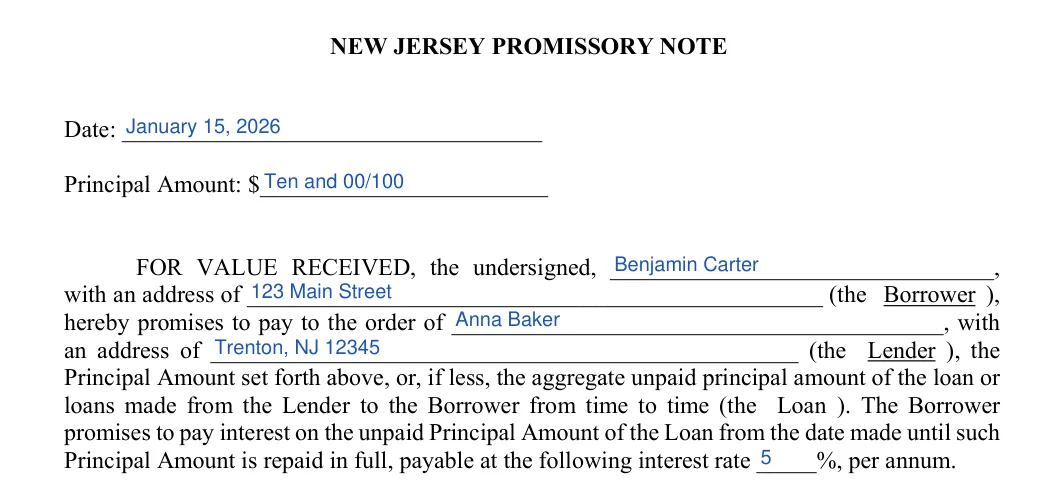
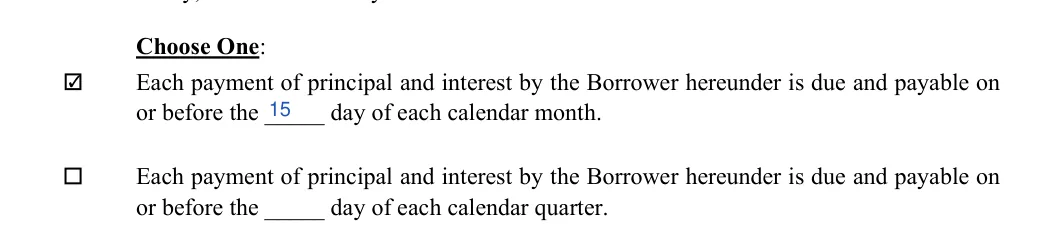
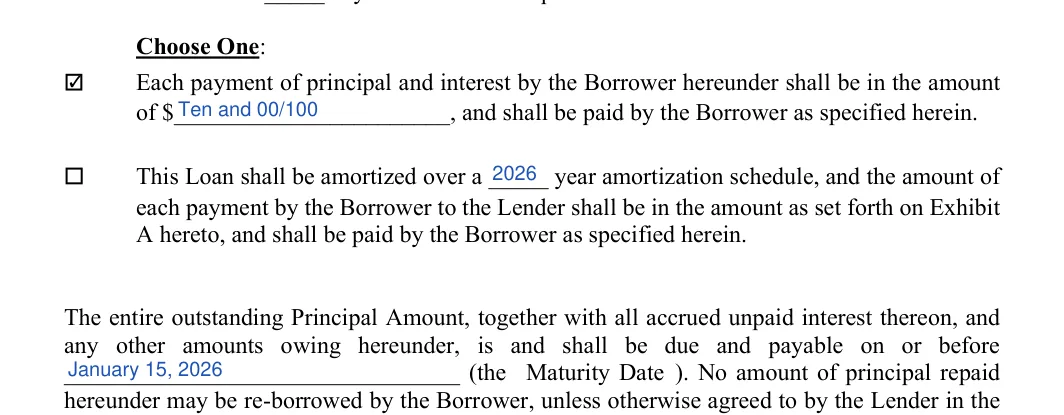
The FormsPal New Jersey promissory note template is three pages long and has 28 fillable fields. Pages 1 and 2 hold the loan terms and the choices for payment and security. Page 3 holds the borrower and lender signature blocks. The six steps below follow the form in its own order.
The screenshots under each step show the FormsPal New Jersey promissory note template filled with sample entries in blue, so you can see where each answer goes. The names, addresses, dates and amounts are examples only.
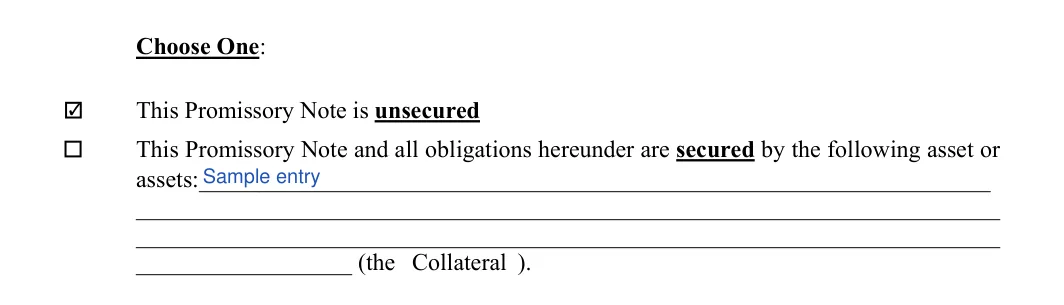
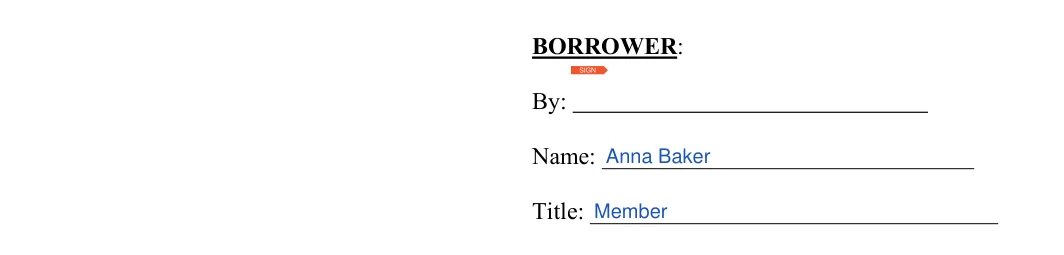
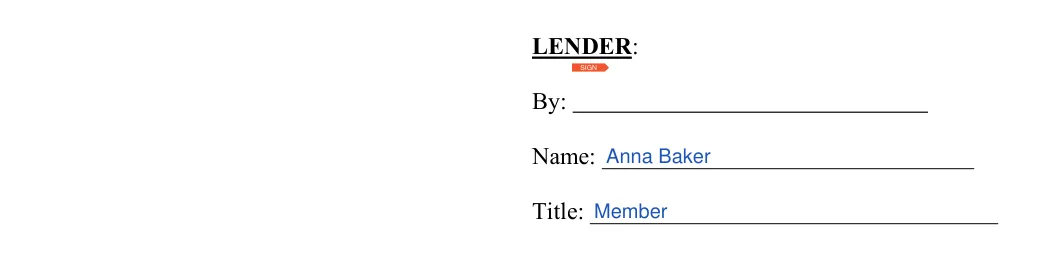
Page 2 also carries printed terms that you do not fill in. Read them before you sign:
New Jersey caps the interest on a loan at 16% a year when a written contract states the rate, and at 6% a year when no written contract fixes one.[2][1] The questions below walk through those two limits.
New Jersey sets a ceiling rather than one fixed rate. When a written contract specifies the rate, N.J.S.A. § 31:1-1(a) puts the ceiling at $16 for every $100 for a year, which is 16% a year.[2]
With a written contract that specifies the rate, the limit is $16 for every $100 for a year, or 16%.[2] Without a written contract that fixes a rate, the limit is $6 for every $100 for a year, or 6%.[1]
Under N.J.S.A. § 31:1-1(a), the highest rate is $16 for every $100 for a year, or 16%, and it applies when a written contract specifies the rate.[2]
A rate of 30% a year works out to $30 for every $100. That is more than the $16 for every $100 that N.J.S.A. § 31:1-1(a) lets a person take under a written contract.[2]
Usury laws set the most a lender can charge for a loan. In New Jersey, the limit sits in N.J.S.A. § 31:1-1(a):

General information, not legal or tax advice.
