Wisconsin Promissory Note Template

A Wisconsin promissory note is a written promise to repay borrowed money on stated conditions. It records the amount, the interest rate, the payment schedule, and the maturity date. Wisconsin caps the interest on loans like these in Wis. Stat. 138.05 at $12 upon $100 for one year, computed upon the declining principal balance, with exceptions.[1.2] This free template suits a loan between individuals.

Last Updated: October 2026. This guide is reviewed and updated regularly to reflect current Wisconsin law. If you notice an error or outdated information, please contact us.
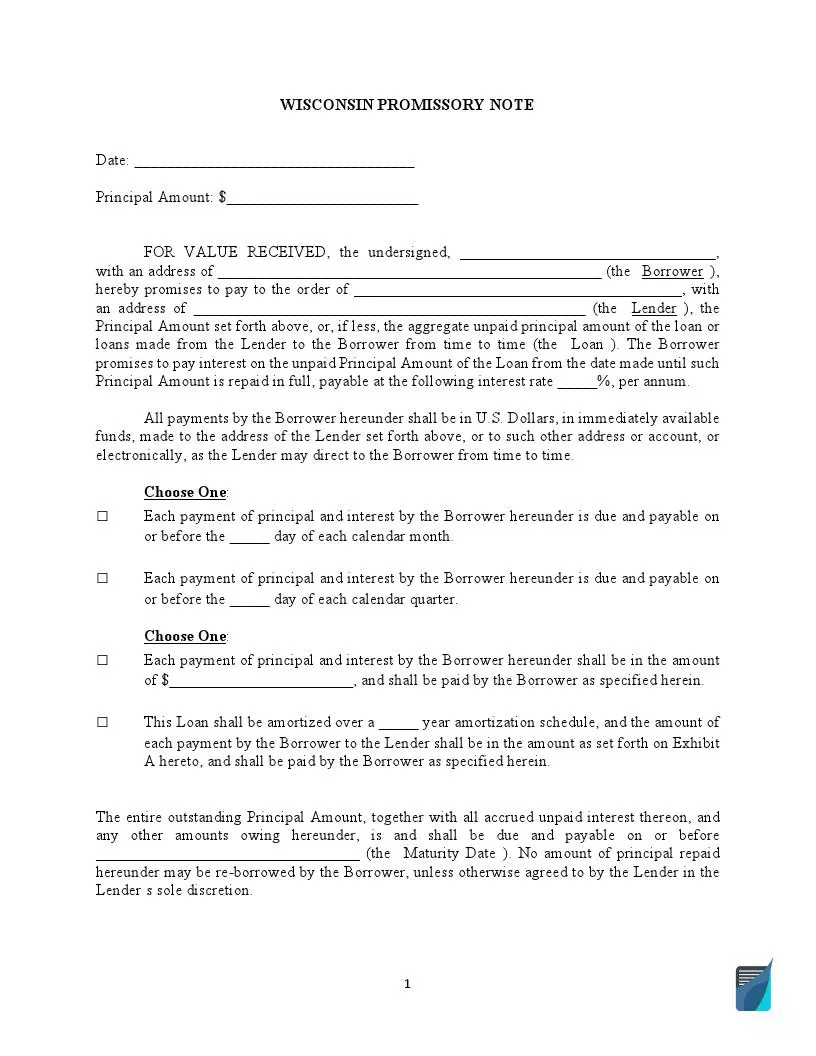
Wisconsin promissory note form preview

Create a free high quality Wisconsin Promissory Note online now!

Build Your Document

Answer a few simple questions to make your document in minutes

Save and Print

Save progress and finish on any device, download and print anytime

Sign and Use

Your valid, lawyer-approved document is ready

... or download your Wisconsin Promissory Note Template as a  PDF file

People use two types of promissory note template. The type decides whether the note names property to back the loan:

  • A secured promissory note names collateral, which is property such as a car that is pledged to cover the debt if payments stop.
  • An unsecured promissory note names no pledged property, so the lender relies on a promise to repay. This type of form suits an informal loan to a family member or another person you trust.

A single note covers one loan and its repayment schedule. For a loan with many conditions, a loan agreement can set out more detail than one note does, while a simple IOU records only that a debt exists.

Wisconsin Usury Laws

State law sets the interest rate for loans like these in Chapter 138 of the Wisconsin Statutes. Section 138.05 names a rate of $12 upon $100 for one year, computed upon the declining principal balance of the loan or forbearance. That works out to 12 percent a year on the amount still owed, although special rules and exceptions follow.[1.2]

The same section sets these special rules and exceptions:

  • Installment loans: A different rate applies to loans repayable in substantially equal weekly or monthly installments when the face amounts include predetermined interest charges. For those loans the rate is $6 upon $100 for one year. It is computed upon that portion of the original principal amount, not including interest charges, for the time of the loan, disregarding part payments and their dates.[1.2]
  • Corporations and LLCs: The section does not apply to loans to corporations or limited liability companies.[1.2]
  • Large loans: The section does not apply to a loan or forbearance of $150,000 or more made after May 26, 1978. That exception does not reach a loan secured by an encumbrance on a one- to four-family dwelling that the borrower uses as his or her principal place of residence.[1.2]
The form asks for the interest rate "per annum," which means per year. Write the yearly rate you and the other party agreed on, and compare it with the rates in this section before you sign.

The legal rate is a separate, lower figure. Under Section 138.04, the rate of interest upon the loan or forbearance of any money is $5 upon $100 for one year, which is 5 percent a year.[1.1] The $12 upon $100 figure in Section 138.05 is the maximum a person may contract for, take or receive, not the legal rate.[1.2]

Form Details

Document Name Wisconsin Promissory Note Form
Other Name WI Promissory Note
Max. Rate $12 upon $100 for one year, computed upon the declining principal balance (12% per year), with exceptions
Relevant Laws Wis. Stat. § 138.05
Avg. Time to Fill Out 10 minutes
# of Fillable Fields 28
Available Formats Adobe PDF
Template Preview
Create a free high quality Wisconsin Promissory Note online now!

Popular Local Promissory Note Forms

Individuals and companies generally need promissory notes to borrow money from other people and companies and keep away from lending institutions. Below are some of the most popular regional promissory notes searched by the users of this site.


How to Fill Out a Wisconsin Promissory Note

The FormsPal form has six parts across three sheets. Work through them in order, from the date and parties at the top of the first sheet to the signature blocks on the last. If you download the form, you can fill it in with the FormsPal online editor. The steps below double as a sample walkthrough of the form.

The screenshots under each step show the FormsPal Wisconsin promissory note template filled with sample entries in blue, so you can see where each answer goes. The names, addresses, dates and amounts are examples only.
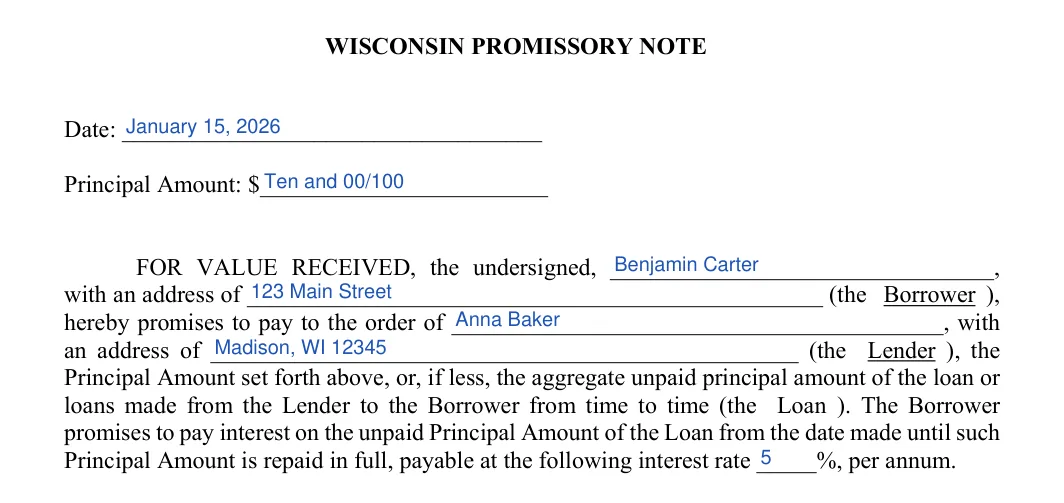
  1. Date, amount, parties, and interest rate. Enter the date and the principal amount, which is the sum being lent. Then add the borrower's name and address and the lender's name and address. Type the yearly rate in the blank before "per annum."
    Wisconsin promissory note: WISCONSIN PROMISSORY NOTE, filled with sample entries
    Step 1: sample entries, not a real document.
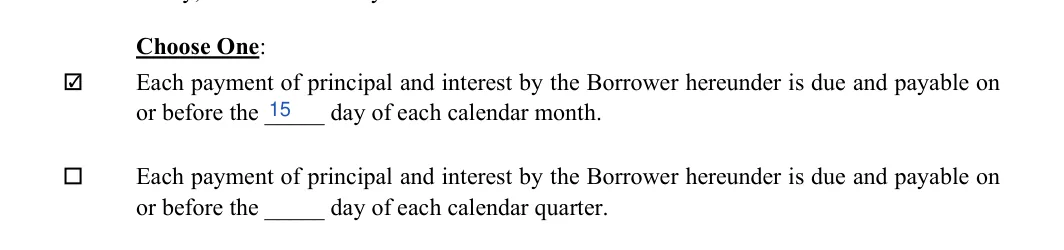
  2. Choose the payment day. Initial one box only, either monthly or quarterly. Then write the day on which each payment must be made.
    Wisconsin promissory note: Choose One, filled with sample entries
    Step 2: sample entries, not a real document.
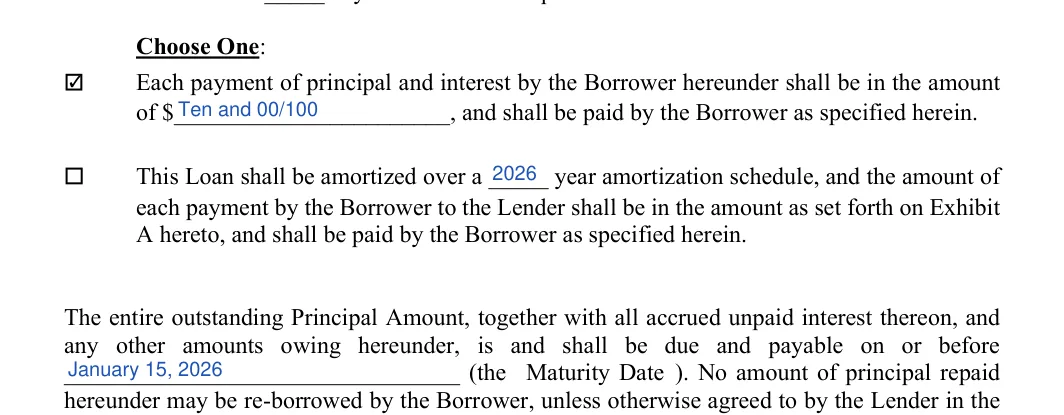
  3. Choose the payment amount and set the maturity date. Initial one box: a fixed payment amount, or an amortization schedule with a number of years. Fill in the blank for the box you chose, then write the maturity date, which is when the full balance must be repaid.
    Wisconsin promissory note: Choose One, filled with sample entries
    Step 3: sample entries, not a real document.
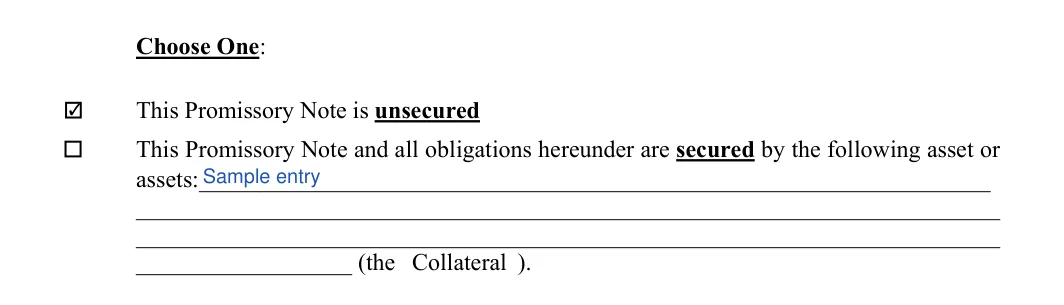
  4. Choose the type of note, unsecured or secured. Initial the first box if no property backs the note. Otherwise initial the second box and describe the secured property on the lines provided.
    Wisconsin promissory note: Choose One, filled with sample entries
    Step 4: sample entries, not a real document.
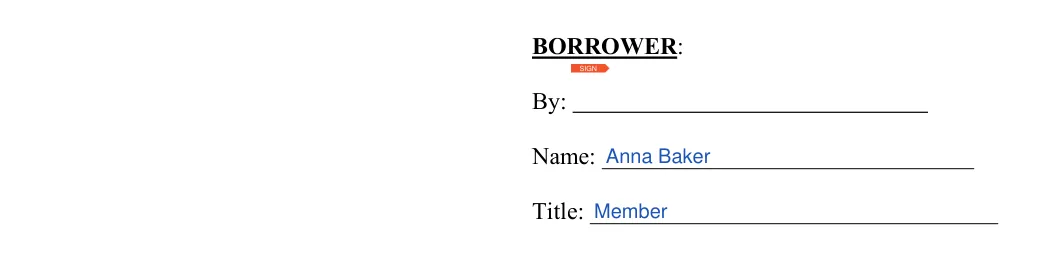
  5. Borrower signature block. The borrower signs on the "By" line and prints a name and title beneath it.
    Wisconsin promissory note: BORROWER, filled with sample entries
    Step 5: sample entries, not a real document.
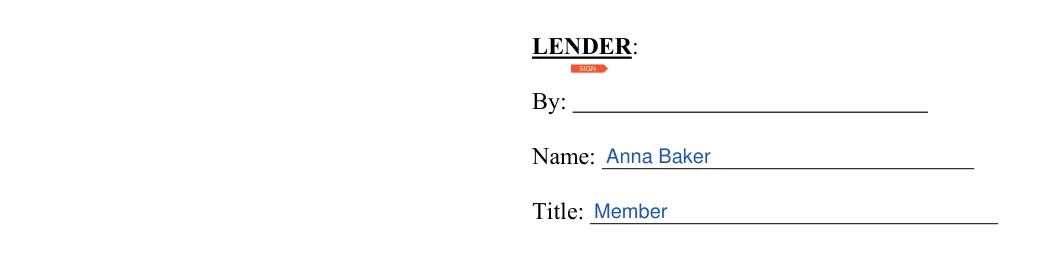
  6. Lender signature block. The lender signs on the "By" line and prints a name and title beneath it. The form has no witness or notary lines, so these two signatures complete the form.
    Wisconsin promissory note: LENDER, filled with sample entries
    Step 6: sample entries, not a real document.
In each "Choose One" group, initial a single box and leave the other box blank.

Here is a worked example of the form. Anna Baker (the lender) lends $2,000 to Ben Carter (the borrower) at 8 percent per year. Payments fall on the first day of each month, and the maturity date is two years out. The 8 percent goes in the blank before "per annum." These names, amounts, and dates are fictional and appear for illustration purposes only.

Before you sign, run through this short checklist:

  • Names and addresses: confirm that each party's name and address are spelled identically everywhere they appear in the note.
  • Repayment details: check that the payment day, the payment amount or schedule, and the maturity date match what you discussed.
  • Initialed boxes: make sure exactly one box is initialed in each group of choices.
  • Secured notes: describe the pledged property clearly enough that both sides know what it covers.
  • Signatures: both parties sign the form, and each one prints a name and title.

After both parties have signed the form, each of them should keep a complete copy of the signed document.

Printed Provisions on the Form

The second sheet of the form carries printed provisions that need no blanks. They apply to every note made on this form, so both parties should read them before either one signs. The form states these provisions:

  • On a secured note, the borrower agrees to sign the security documents the lender reasonably requests, not to sell or transfer the collateral until the loan is repaid, and to keep the collateral insured.
  • If the borrower defaults, the lender may accelerate the maturity date and declare the full outstanding principal and accrued interest payable at once.
  • The note may be prepaid at any time, in whole or in part, with no penalty or premium.
  • The laws of the State of Wisconsin govern the note, and the lender may assign it.

Interest, Prepayment, and Disclosure Rules

Beyond the rate itself, the statutes shape how a note is written and repaid. A contracted rate must be put in writing. Interest does not compound without a signed written agreement. Some loans may be prepaid at any time, and some require a written statement from the lender.

  • Rate in writing: Section 138.04 lets the parties contract for a rate of interest up to the rate the lending statutes allow. In that case, the rate must be clearly expressed in writing.[1.1]
  • Compound interest: Interest may not be compounded, and interest does not itself bear interest, unless an agreement to that effect is clearly expressed in writing and signed by the party to be charged.[1.2]
  • Prepayment: A loan on which the interest rate charged exceeds $10 per $100 for one year, computed upon the declining principal balance, may be prepaid by the borrower at any time, in whole or in part.[1.2]
  • Written statement: A person making a loan at a rate above $10 upon $100 for one year, computed upon the declining principal of the loan, must deliver to the borrower a statement of the terms. The statement may be part of a copy of the evidence of indebtedness. It must be delivered at or before the time the loan is made, and it must set forth all of the terms of the transaction in clear and distinct language.[1.2]

The statute states the compounding rule this way:

In the computation of interest upon any bond, note, or other instrument or agreement, interest shall not be compounded, nor shall the interest thereon be construed to bear interest, unless an agreement to that effect is clearly expressed in writing, and signed by the party to be charged therewith.

Wis. Stat. § 138.05

Frequently Asked Questions

These answers cover the rate that applies to a loan under this note and the loans the statute does not reach. Each answer draws on Section 138.05 of the Wisconsin Statutes, and on Section 138.04 where it says so.

Section 138.05 names a rate of $12 upon $100 for one year, computed upon the declining principal balance. That is 12 percent a year, so 30 percent is well above it. The section does not apply in these cases:

  • Loans to corporations or limited liability companies.
  • A loan or forbearance of $150,000 or more made after May 26, 1978, unless it is secured by an encumbrance on a one- to four-family dwelling that the borrower uses as his or her principal place of residence.[1.2]

The legal rate under Section 138.04 is $5 upon $100 for one year, which is 5 percent a year.[1.1] Section 138.05 sets a separate maximum of $12 upon $100 for one year, computed upon the declining principal balance of the loan or forbearance.[1.2] Parties may contract for a rate not exceeding the rate the lending statutes allow. The rate must then be clearly expressed in writing.[1.1]

What are usury laws and maximum interest rates?

Usury laws limit the interest a lender may charge. In Wisconsin, Section 138.05 names the rate of $12 upon $100 for one year, computed upon the declining principal balance. It sets a separate rate of $6 upon $100 for certain installment loans.[1.2]

General information, not legal or tax advice.

seal of wisconsin state
Other Wisconsin Forms
Take a look at other Wisconsin templates completed by FormsPal users. Consider our step-by-step tool to personalize any of these documents to your needs.

Sources

  1. Wis. Stat. §§ 138.04 to 138.05.
    • 1.1 § 138.04
    • 1.2 § 138.05
Published: Jun 11, 2022
Jennifer M. Settles
Jennifer M. Settles
Author & Attorney
With over 25 years of experience as a business and transactional attorney, Jennifer has mastered the craft of closing highly successful deals for her clients. Through her wide-ranging expertise in commercial contracts, real estate transactions, M&A and corporate law, Jennifer secures results that are second-to-none.