Virginia Promissory Note Template

A Virginia promissory note is a written promise to repay borrowed money on stated terms. It records the amount, the interest rate, the repayment schedule, and the due date. Virginia caps the interest rate on a loan at 12 percent per year, unless another law permits more.[1] Use this free promissory note template for a personal loan, and check your rate against that cap before you sign.

Last Updated: October 2026. This guide is reviewed and updated regularly to reflect current Virginia law. If you notice an error or outdated information, please contact us.
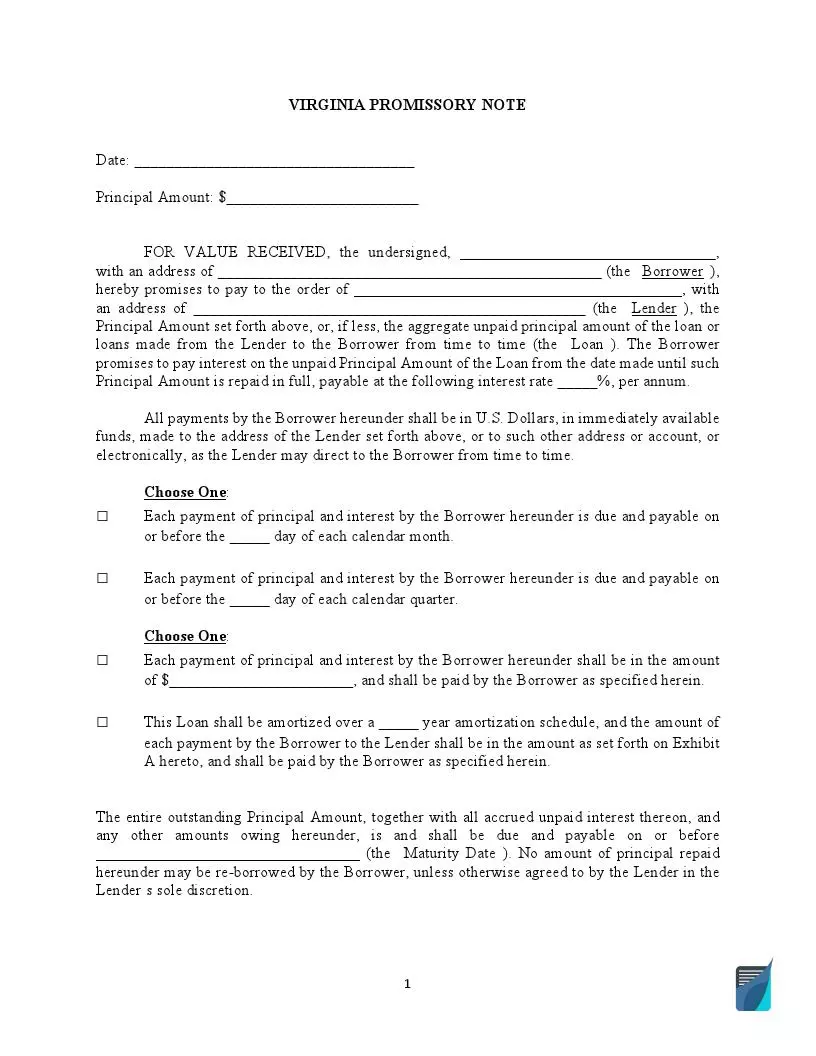
Virginia promissory note form preview

Create a free high quality Virginia Promissory Note online now!

Build Your Document

Answer a few simple questions to make your document in minutes

Save and Print

Save progress and finish on any device, download and print anytime

Sign and Use

Your valid, lawyer-approved document is ready

... or download your Virginia Promissory Note Template as a  PDF file

Settle these terms with the other party before you fill in the note, because each one has its own blank on the form:

  • Parties: the names and addresses of the borrower and the lender.
  • Principal: the sum being lent, in US dollars.
  • Interest rate: the rate per year, checked against the cap below.
  • Payments: a due day each month or each quarter, and either a fixed payment amount or an amortization schedule.
  • Maturity date: the date the whole balance is due.
  • Security: whether the note is unsecured or backed by collateral.

A secured note names property as collateral to back the loan. An unsecured note names none, so it suits a loan to someone you trust.

Virginia Usury Laws

Virginia sets its maximum interest rate in Section 6.2-303 of the Va. Code Ann. The limit is 12 percent per year, except as otherwise permitted by law. Check the rate on your Virginia promissory note against this limit before you sign.[1]

The statute puts the cap this way:

Except as otherwise permitted by law, no contract shall be made for the payment of interest on a loan at a rate that exceeds 12 percent per year.

Va. Code Ann. § 6.2-303

The same section adds these rules:

  • What counts as interest: any funds a person is obligated to pay under the terms of the contract, in addition to the total of the cash advance, are considered interest.
  • No workarounds: the cap applies to any person who seeks to evade it by any device, subterfuge, or pretense whatsoever. The statute lists examples, such as the use of collateral or related sales of goods or services, and the real or pretended arrangement of a loan through a third person.
  • Violations: any contract made in violation of this section is void. No person has the right to collect, receive, or retain any principal, interest, fees, or other charges in connection with the contract.
  • Loans where usury cannot be pleaded: on a loan upon which a person is not permitted to plead usury, interest and other charges may be imposed and collected as agreed by the parties.
  • Inheritance advances: a contract entered into on or after July 1, 2024, is considered a loan if a person receives a cash advance for assigning to a company or other entity a portion of the person's rights to receive inheritance funds from a will. The will must have been, or be anticipated to be, offered for probate in a circuit court of Virginia.[1]
The form asks for the interest rate "per annum," which means per year. Write the yearly rate you and the other party agreed on in that blank.

The legal rate of interest is a separate figure from this cap. Under Section 6.2-301(A) of the Code of Virginia, the legal rate of interest is an annual rate of six percent.[2]

Virginia Promissory Note Form Details

Document Name Virginia Promissory Note Form
Other Name VA Promissory Note
Max. Rate 12% per year, unless another law permits a higher rate
Relevant Laws Va. Code Ann. § 6.2-303
Avg. Time to Fill Out 10 minutes
# of Fillable Fields 28
Available Formats Adobe PDF
Template Preview
Create a free high quality Virginia Promissory Note online now!

Popular Local Promissory Note Forms

A promissory note (sometimes called loan agreement) is considered a useful lending document used regularly by many individuals and businesses in all states as a funds resource and an option to banks. Find out more about the most common US states searched by our website users when it comes to promissory note templates.


How Do You Fill Out a Virginia Promissory Note?

The FormsPal Virginia promissory note has six parts across three pages. Work through them in order, from the date and parties on page 1 to the signature blocks on page 3. If you download the PDF, you can fill it in with the FormsPal PDF editor.

The screenshots under each step show the FormsPal Virginia promissory note template filled with sample entries in blue, so you can see where each answer goes. The names, addresses, dates and amounts are examples only.
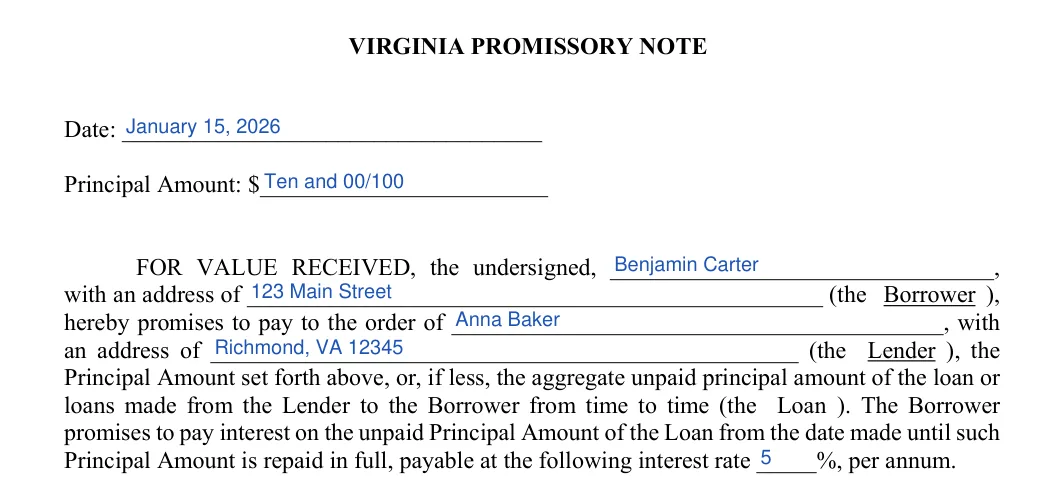
  1. Date, amount, parties, and interest rate (page 1). Enter the date and the principal amount, which is the sum being lent. Then add the borrower's name and address and the lender's name and address. Type the yearly rate in the blank before "per annum."
    Virginia promissory note: VIRGINIA PROMISSORY NOTE, filled with sample entries
    Step 1: sample entries, not a real document.
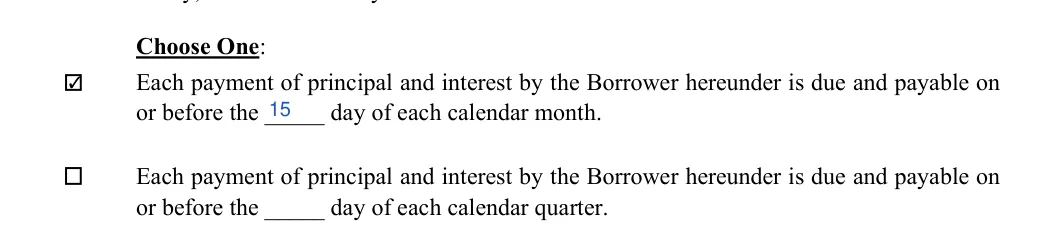
  2. Choose the payment due day (page 1). Initial one box only, either monthly or quarterly. Then write the day on which each payment is due.
    Virginia promissory note: Choose One, filled with sample entries
    Step 2: sample entries, not a real document.
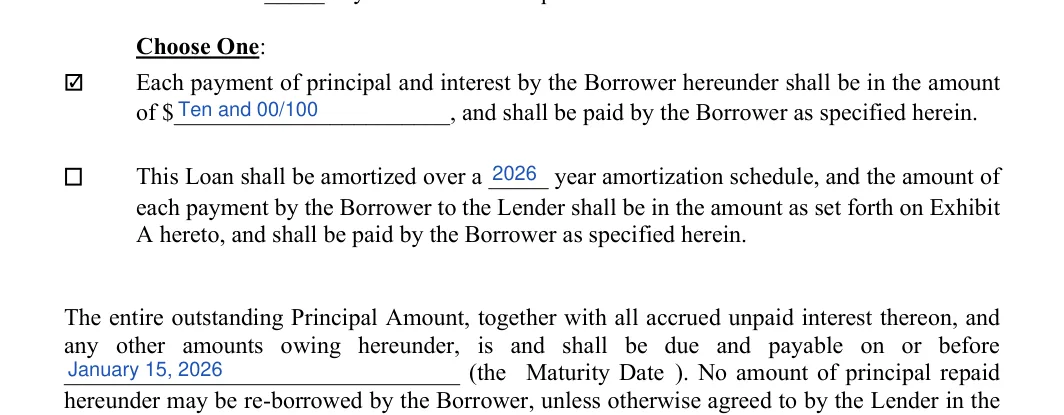
  3. Choose the payment amount and set the maturity date (page 1). Initial one box: a fixed payment amount, or an amortization schedule with a number of years. Fill in the blank for the box you chose, then write the maturity date, which is when the full balance is due.
    Virginia promissory note: Choose One, filled with sample entries
    Step 3: sample entries, not a real document.
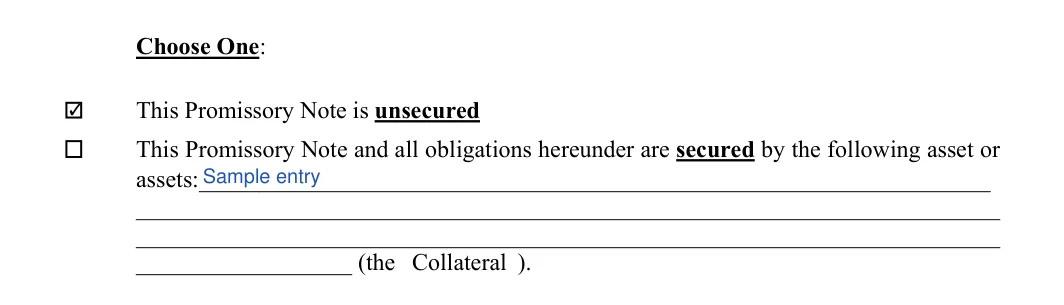
  4. Choose unsecured or secured (page 2). Initial the first box if no property backs the note. Otherwise initial the second box and describe the collateral on the lines provided. Collateral is the property that backs the loan.
    Virginia promissory note: Choose One, filled with sample entries
    Step 4: sample entries, not a real document.
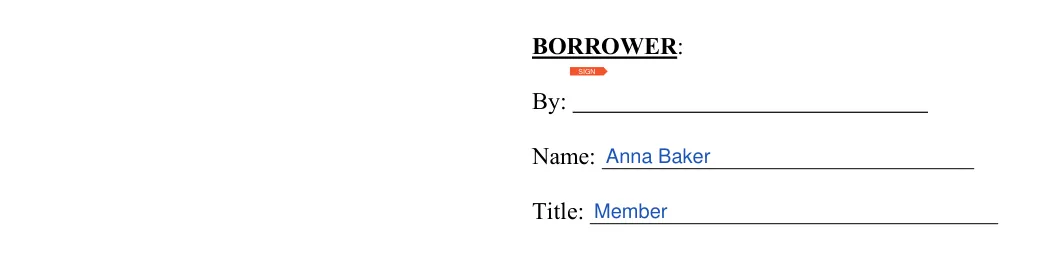
  5. Borrower signature block (page 3). The borrower signs on the "By" line and prints a name and title beneath it.
    Virginia promissory note: BORROWER, filled with sample entries
    Step 5: sample entries, not a real document.
  6. Lender signature block (page 3). The lender signs on the "By" line and prints a name and title beneath it.
    Virginia promissory note: LENDER, filled with sample entries
    Step 6: sample entries, not a real document.
In each "Choose One" group, initial a single box and leave the other box blank.

Page 2 also carries terms that are already printed on the form and have no blanks, including what happens on default, a late fee, and prepayment. Read them before you sign.

Here is a sample of how the first page reads. Suppose Dana Lee lends $5,000 to Priya Shah at 8 percent per year. Payments are due on the first day of each month, and the maturity date is three years out.

Dana is the lender and Priya is the borrower. The 8 percent goes in the blank before "per annum." These names, amounts, and dates are made up for illustration only.

Before you sign, run through this short checklist:

  • Names and addresses: confirm that each party's legal name is spelled the same way throughout the note.
  • Repayment terms: check that the due day, the payment amount or schedule, and the maturity date agree with what you discussed.
  • Initialed boxes: make sure exactly one box is initialed in each group of choices.
  • Collateral: if the note is secured, make sure the description of the property is specific enough that both sides know what it covers.
  • Blank lines: fill in or strike through any line you do not use, so nothing can be added later.

After both sides sign, each should keep a copy of the signed note.

Frequently Asked Questions

These answers cover the interest limit that applies to a Virginia promissory note, the rules that come with it, and what the statute says about a rate above the limit. Each answer draws on Section 6.2-303 of the Va. Code Ann.

Yes. In Virginia, a contract may not charge interest on a loan at a rate above 12 percent per year, except as otherwise permitted by law.[1]

The legal rate of interest is an annual rate of six percent under Section 6.2-301(A).[2] It is separate from the limit on a contract rate, which is 12 percent per year under Section 6.2-303, except as otherwise permitted by law. Agree on a rate at or below that 12 percent limit and write it on the interest line of the note.[1]

Is a 30% interest rate illegal?

A 30% rate exceeds the 12 percent per year limit in Section 6.2-303, unless another law permits it. Any contract made in violation of the section is void. No person has the right to collect, receive, or retain any principal, interest, fees, or other charges in connection with the contract.[1]

What are the rules for a promissory note?

The Virginia rules covered on this page are about interest. The cap is 12 percent per year, and it applies to any person who seeks to evade it by any device, subterfuge, or pretense whatsoever. A contract made in violation is void.[1] Section 6.2-303 also sets these points:

  • Funds a person must pay in addition to the cash advance are considered interest.
  • A qualifying inheritance advance contract entered into on or after July 1, 2024, is considered a loan.
  • On a loan where usury cannot be pleaded, interest and other charges may be imposed and collected as agreed by the parties.[1]

What are usury laws and maximum interest rates?

Virginia's usury limit is 12 percent per year, except as otherwise permitted by law. The same section covers any person who seeks to evade the limit, and it makes a contract in violation void.[1]

General information, not legal or tax advice.

seal of virginia state
Other Virginia Forms
Some other printable Virginia templates readily available for download and that can be customized in our hassle-free document builder.

Sources

  1. Va. Code Ann. § 6.2-303.
  2. Va. Code Ann. § 6.2-301.
Published: May 29, 2022
Jennifer M. Settles
Jennifer M. Settles
Author & Attorney
With over 25 years of experience as a business and transactional attorney, Jennifer has mastered the craft of closing highly successful deals for her clients. Through her wide-ranging expertise in commercial contracts, real estate transactions, M&A and corporate law, Jennifer secures results that are second-to-none.