
Updated:
An Ohio medical POA is a document naming your health care agent. Ohio Rev. Code Ann. § 1337.12 requires at least two adult witnesses unless a notary public acknowledges it.[1] This page explains the signing rules, who cannot serve, and each part of the form.
Key facts
Build Your Document
Answer a few simple questions to make your document in minutes
Save and Print
Save progress and finish on any device, download and print anytime
Sign and Use
Your valid, lawyer-approved document is ready
An Ohio health care power of attorney is a signed document that appoints an agent to make medical decisions for the person who signs it, called the principal, and it also goes by medical power of attorney, medical POA or HCPOA.
The form also names an alternate agent, who steps in when the first agent cannot act.
For other Ohio documents, browse our Ohio power of attorney forms, or read how a medical power of attorney form works in general.
Ohio's statute calls this document a durable power of attorney for health care, the term behind searches for a "durable healthcare power of attorney" or a "durable power of attorney for medical decisions." "Durable" means the appointment is built to keep working when the principal can no longer decide.
Under section 1337.12(A)(1), an adult who is of sound mind may create a durable power of attorney for health care.[1] Section 1337.11(A) defines an adult as a person who is 18 years of age or older.[2]
A health care power of attorney covers medical decisions, while Ohio's statutory form power of attorney in Ohio Rev. Code Ann. § 1337.60 authorizes an agent to make decisions concerning the principal's property. Many people sign both, one for each kind of decision.
For money and property, see our Ohio general power of attorney or Ohio durable power of attorney. For written treatment wishes alone, compare our Ohio living will, and for a do not resuscitate order, our Ohio DNR form.
The health care power of attorney is signed at the end and dated by the principal, then either witnessed by at least two adults or acknowledged before a notary public, under Ohio Rev. Code Ann. § 1337.12.[1]
| Rule | What Ohio sets | Source |
|---|---|---|
| Signature | Signed at the end of the instrument by the principal | Ohio Rev. Code Ann. § 1337.12 |
| Date | States the date of its execution | Ohio Rev. Code Ann. § 1337.12 |
| Witnesses | At least two adults who are not ineligible, if the principal does not use a notary | Ohio Rev. Code Ann. § 1337.12 |
| Notary | Acknowledgment before a notary public, if the principal uses that route instead of witnesses | Ohio Rev. Code Ann. § 1337.12 |
| Who cannot be agent | The attending physician, and the administrator of a nursing home where the principal is receiving care | Ohio Rev. Code Ann. § 1337.12 |
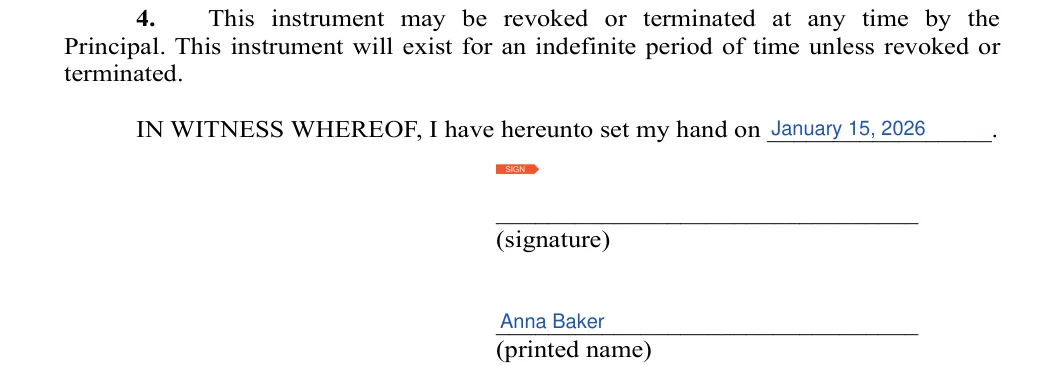
The document carries the principal's signature at the end and the date it was signed: Ohio Rev. Code Ann. § 1337.12 says it "shall be signed at the end of the instrument by the principal and shall state the date of its execution."[1] On the FormsPal form, both sit on page 6.
The witness route asks for at least two adults who are not ineligible to be witnesses, when the principal chooses witnesses rather than a notary (Ohio Rev. Code Ann. § 1337.12).[1] The FormsPal form has no witness lines, only a notary page, so plan the route before you print.
When the principal uses the notary route, the notary public makes the certification described in section 147.53 and attests that the principal appears to be of sound mind and not under or subject to duress, fraud, or undue influence (Ohio Rev. Code Ann. § 1337.12).[1] FormsPal also has a separate Ohio notary acknowledgment template.
Popular Local Medical POA Forms
Health care power of attorney forms are used in every state. Have a look at other samples of Medical POA forms regularly filled out by people.
When it is signed before witnesses, the health care power of attorney cannot use four groups of people as witnesses, whom Ohio Rev. Code Ann. § 1337.12 lists as ineligible.[1]
A friend, a neighbor or a coworker who is an adult and outside these groups fits the rule. Two such people are enough.
The document cannot name the principal's attending physician as agent, nor the administrator of any nursing home where the principal is receiving care, and neither may act as one (Ohio Rev. Code Ann. § 1337.12).[1]
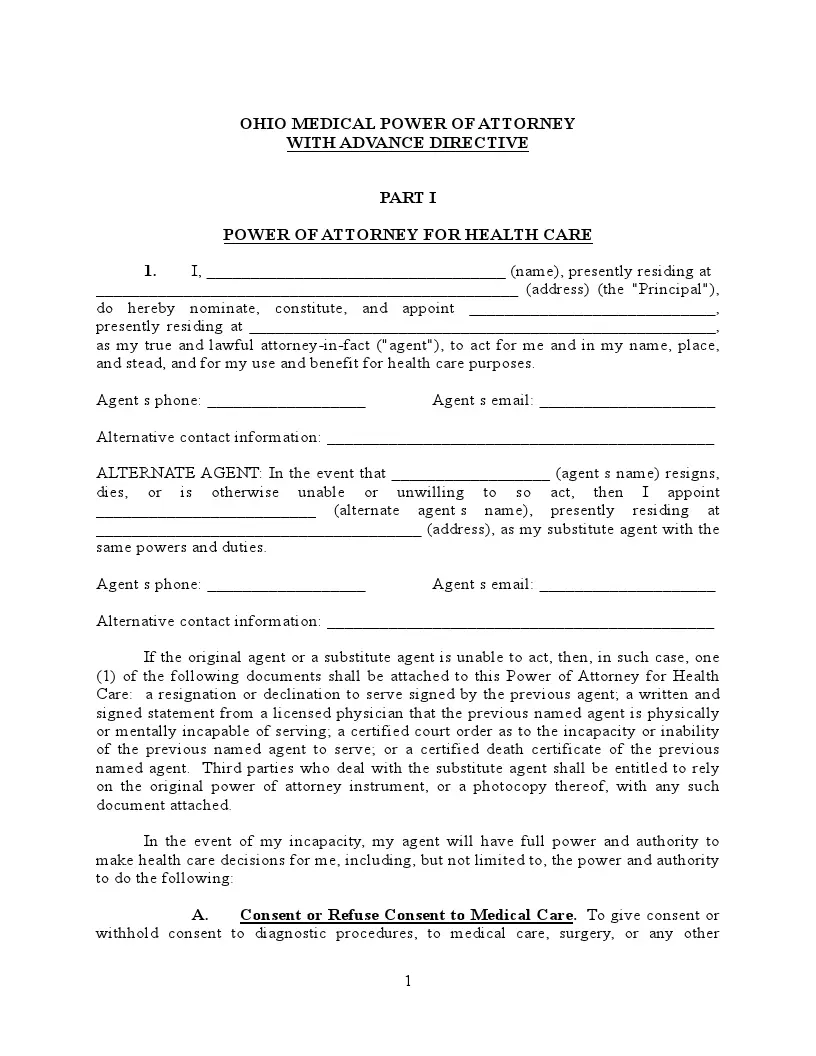
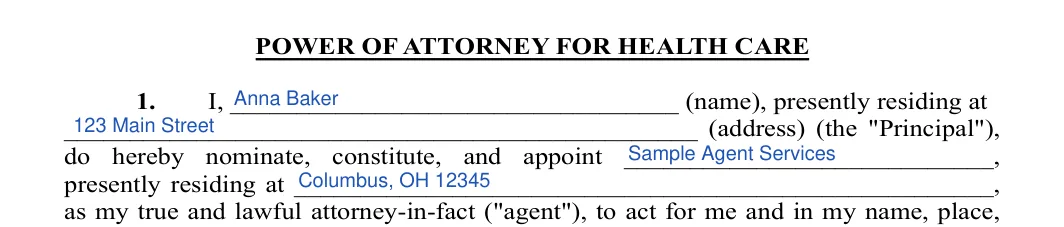
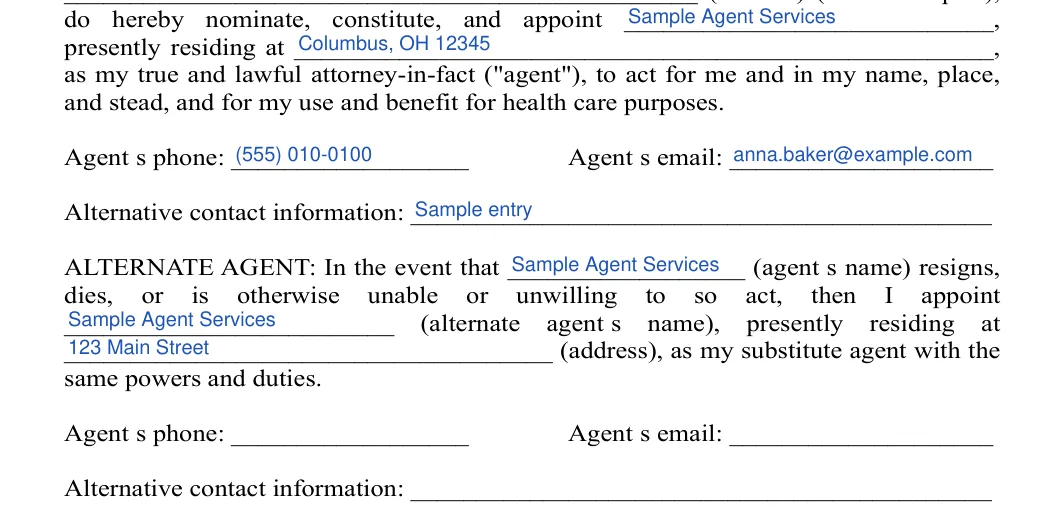
The agent's name and address go on page 1 of the form, with a phone number and email.
The document works only as well as the agent it names, so the agent and the alternate deserve the most thought of any entry. These points are common practice, not Ohio rules:
The FormsPal Ohio form is titled Ohio Medical Power of Attorney with Advance Directive, and its seven pages hold three parts, a signature page and a notary acknowledgment. What each part says comes from the printed form, not from the statute.
The form's HIPAA release in Section 3 of Part I lets the agent receive the principal's medical records. The clause is printed text, so it applies once the document is signed.
The advance directive in Part II is a fixed statement about end-of-life care, with no blanks to change. If it does not match your wishes, talk to a lawyer or your doctor before you sign, or compare it with a separate living will.
The form has 21 fillable fields on pages 1, 6 and 7, and the five steps below follow them in order. Pages 2 to 5 are printed text with no blanks.
The screenshots under each step show the FormsPal Ohio form filled with sample entries in blue, so you can see where each answer goes. The names, addresses, dates and amounts are examples only.
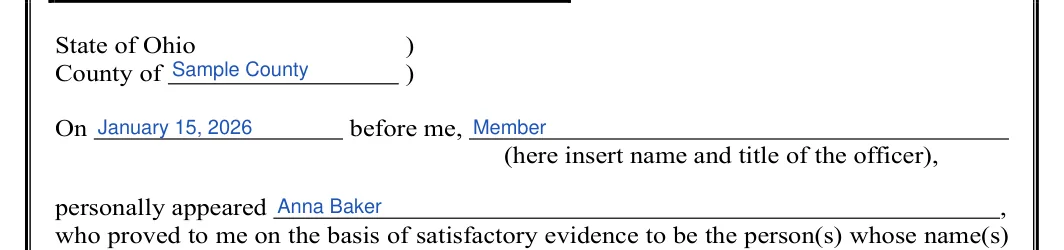

The document is signed in one of two ways under Ohio Rev. Code Ann. § 1337.12: before at least two adult witnesses, or before a notary public if the principal chooses an acknowledgment instead.[1] These steps cover the signing and what comes after it.
The document goes wrong on a few avoidable points: a witness or an agent the statute rules out, a missing date, or a signature in the wrong place. Each item below comes from Ohio Rev. Code Ann. § 1337.12, where it applies, or from the printed form.[1]
The example entries below are made up to show where each answer goes on the form. Replace every one with your own details before you sign.
No, not if two adult witnesses sign instead: Ohio Rev. Code Ann. § 1337.12 accepts either at least two adult witnesses or an acknowledgment before a notary public.[1] The FormsPal form includes a notary acknowledgment on page 7.
Ohio's statute calls it a durable power of attorney for health care. People also call it a medical power of attorney, a healthcare power of attorney, a medical POA or an HCPOA.
No, not your attending physician: Ohio Rev. Code Ann. § 1337.12 bars the attending physician, and the administrator of a nursing home where you are receiving care, from being named or acting as agent.[1]
When the document is notarized, the notary makes the certification described in section 147.53 and attests that you appear to be of sound mind and not under or subject to duress, fraud, or undue influence (Ohio Rev. Code Ann. § 1337.12).[1]
The signing rules of Ohio Rev. Code Ann. § 1337.12 name the principal, the witnesses and the notary, and no lawyer among them.[1] A lawyer helps if the fixed advance directive in Part II does not fit your wishes, or if you choose witnesses for a form with no witness lines.

Other Medical POA Forms by State
The Ohio medical power of attorney PDF is a seven-page Adobe PDF with 21 fillable fields on pages 1, 6 and 7, so the answers can be typed before printing.
General information, not legal or tax advice.
Each rule on this page comes from these official Ohio Revised Code pages; the notary rules of section 1337.12 apply only when the principal uses the notary route.
