
Updated:
A California general power of attorney is a financial power of attorney. The principal names an agent, or attorney-in-fact, to handle the money matters the principal initials. This page covers the California signing rules, how the document ends and every form field.
The form below has five pages and 41 fillable fields and does not authorize health-care decisions. See all California power of attorney forms and our power of attorney guide.
Key facts

Build Your Document
Answer a few simple questions to make your document in minutes
Save and Print
Save progress and finish on any device, download and print anytime
Sign and Use
Your valid, lawyer-approved document is ready
The California general power of attorney form gives an agent authority over the principal's financial matters that the principal initials, in any lawful way. The form is titled California Financial Power of Attorney. Its notice at the top of page 1 says the powers are broad, do not include every power the law allows, and may be revoked later.
A general power of attorney differs from a limited one in scope. The general form lists a full set of financial subjects, and the principal picks among them. A California limited power of attorney grants narrower, named powers instead.
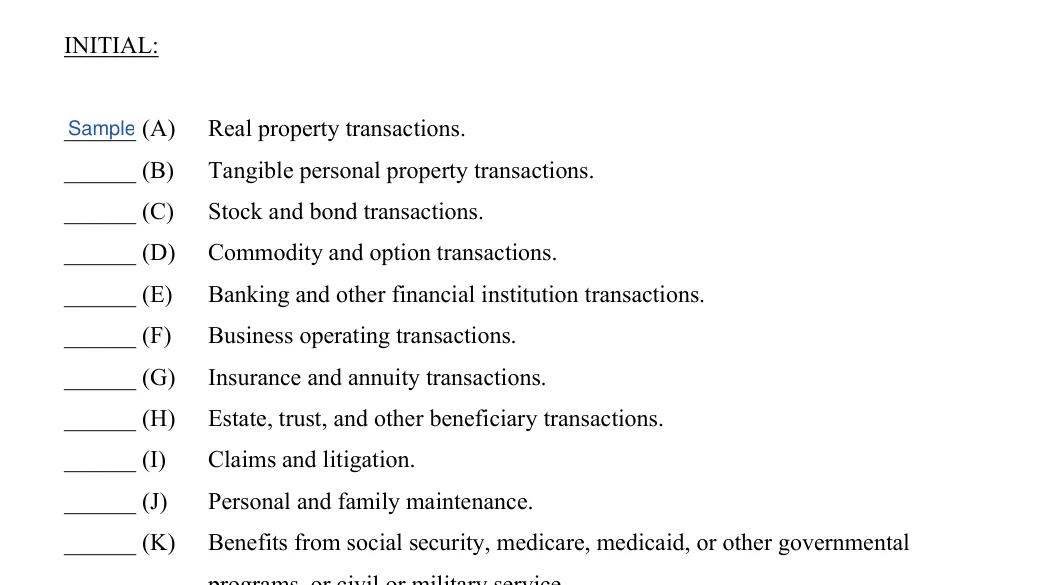
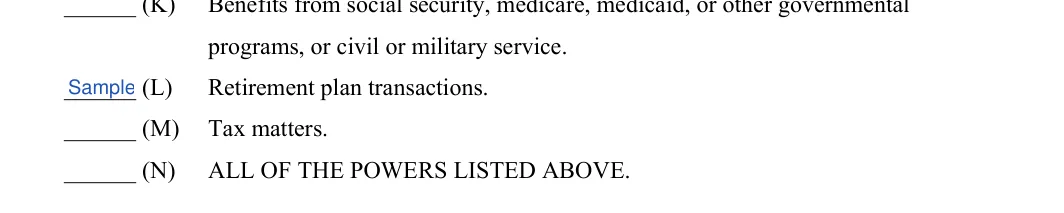
The form's powers list sets out thirteen financial subjects, each on its own line to initial:
Line (N) grants all of the powers listed above with one set of initials. A blank line withholds that power from the agent.
Pages 2 and 3 print three special instructions that need no entries. They cover medical claims and reimbursements, retirement and savings accounts, and digital assets such as email and social-network accounts. The instructions are already part of the form, so the principal writes nothing there.
Page 4 adds pre-printed paragraphs that apply without any entry. With more than one agent named, the form says decisions are made by a majority of the agents. The form also says any third party who receives a copy may act under it. It states that all prior general powers of attorney the principal executed are revoked.
The table below summarizes the key details of this California general power of attorney form.
| Document Name | California General Power of Attorney Form |
| Other Name | California Financial Power of Attorney |
| Signing rules | Cal. Prob. Code § 4121 |
| Ending and revocation | Cal. Prob. Code §§ 4151 and 4152 |
| Pages | 5 |
| Avg. Time to Fill Out | 10 minutes |
| # of Fillable Fields | 41 |
| Available Formats | Adobe PDF |
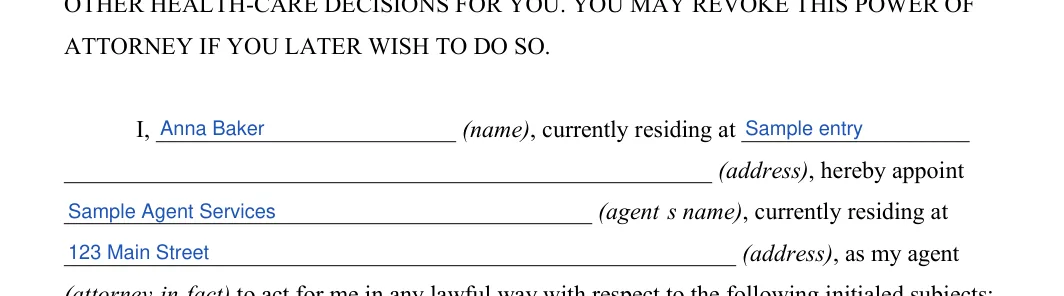
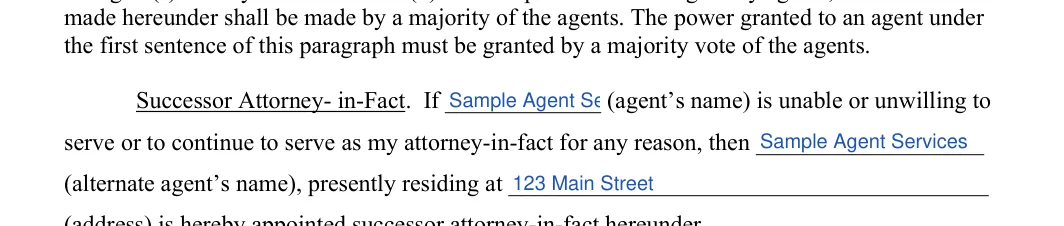
The power of attorney names two roles: the principal, who grants the powers, and the agent, also called the attorney-in-fact, who acts for the principal. Page 1 holds both names and addresses. Page 4 adds a successor attorney-in-fact who takes over if the agent is unable or unwilling to serve.
The agent's choice matters more than any other entry. A good agent is someone the principal trusts to handle money carefully and who has some experience with financial matters. A talk with that person before signing confirms the agent is willing to serve.
People often use a general financial power of attorney when they cannot manage their money matters themselves for a while, for example during a long trip. Our pages on the general power of attorney and the durable power of attorney explain the other types.
A California power of attorney is valid when it meets three signing rules of Cal. Prob. Code § 4121: a signature, a date, and either a notary's acknowledgment or at least two witnesses.[1] The third rule offers a choice between the two routes.
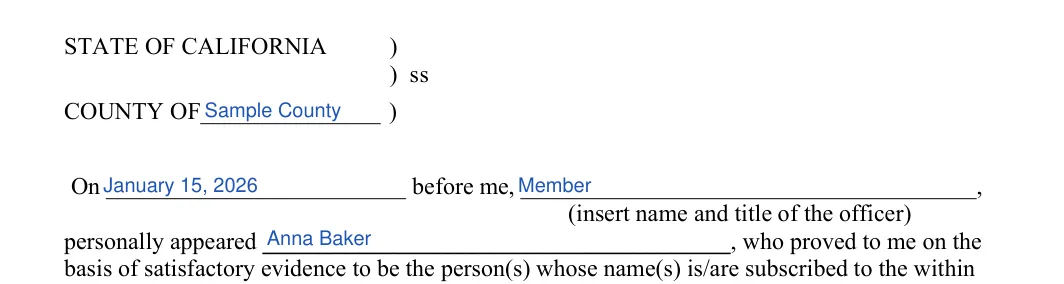
The form on this page takes the notary route. Page 4 holds the principal's signature and the date, and page 5 holds the acknowledgment that the notary completes. The form has no witness lines. If you are unsure whether your situation calls for witnesses, ask a California lawyer.
A California power of attorney becomes durable through words such as "This power of attorney shall not be affected by subsequent incapacity of the principal," the language of Cal. Prob. Code § 4124.[4] A durable document keeps working after the principal loses capacity.
A springing power of attorney starts later. Cal. Prob. Code § 4124 gives its wording: "This power of attorney shall become effective upon the incapacity of the principal."[4]
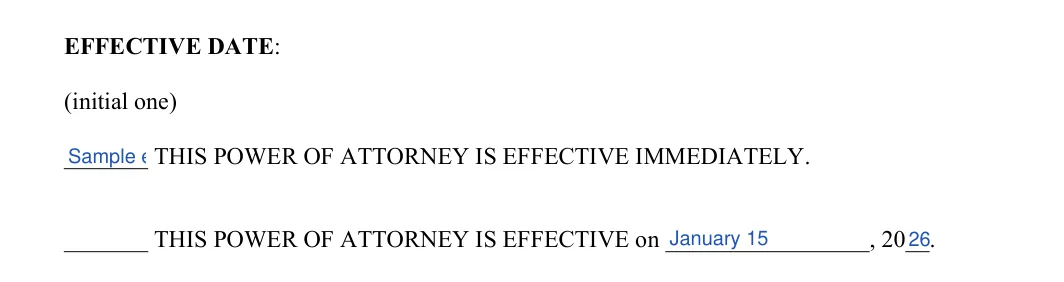
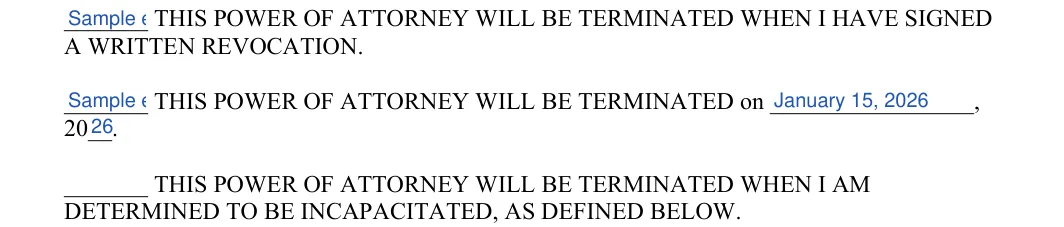
The form sets its own start and end on page 3. Under EFFECTIVE DATE, the principal initials one line: an immediate start, or a start on a date written in. Under TERMINATION DATE, the principal initials one line: a signed written revocation, a date written in, or the principal's incapacity as the form defines it.
A principal who wants the agent's authority to continue through incapacity can compare our California durable power of attorney form, a separate document.
A California power of attorney ends by revocation, by an ending the principal chose on page 3, or by an event of Cal. Prob. Code § 4152, such as the death of the principal or of the agent.[3]
Under Cal. Prob. Code § 4151, a principal may revoke a power of attorney in accordance with its own terms.[2] A principal may also revoke by a writing, and Cal. Prob. Code § 4151 says the power of attorney cannot limit that method.[2] Our guide to revoking a power of attorney covers the steps.
Cal. Prob. Code § 4152 lists the events that end the attorney-in-fact's authority:[3]
An ending does not bind everyone at once. Under Cal. Prob. Code § 4151, an attorney-in-fact or third person who does not have notice of the revocation is protected from liability as provided in Chapter 5, which starts at Section 4300.[2] Cal. Prob. Code § 4152 gives the same protection when the person has no notice of an event that terminates the power of attorney or the agent's authority.[3]
The form is filled in from top to bottom over five pages: names, powers, dates, a successor, the signature and the notary's acknowledgment. The steps below follow that order, for typed answers in the form builder above or handwritten ones on the PDF.
The screenshots under each step show the FormsPal California general power of attorney template filled with sample entries in blue, so you can see where each answer goes. The names, addresses, dates and amounts are examples only.



The signed power of attorney is ready to use once the notary completes page 5 and the agent and institutions hold copies. These steps finish the job in order:
A few small errors cause most trouble with a signed power of attorney:
The general form does not fit health-care, vehicle or single-task needs, and California has separate forms for each. Pick the document by what the agent must do:
These answers cover the questions people search most about a California financial power of attorney. The numbered sources are listed at the end of the page.
Not always: the document is either acknowledged before a notary public or signed by at least two witnesses who satisfy Section 4122 (Cal. Prob. Code § 4121).[1] The form on this page has a notary acknowledgment on page 5 and no witness lines.
This form follows the lettered layout people know as the uniform statutory form: thirteen financial powers, (A) to (M), each with a line to initial, and (N) for all of them. Its title is California Financial Power of Attorney, and it adds three special instructions and its own effective date and termination choices.
Yes, another adult may sign in your name, in your presence and at your direction (Cal. Prob. Code § 4121).[1] Otherwise, you sign it yourself.
Yes, the agent's authority ends on the death of the principal, except as to specific authority permitted by statute to be exercised after the principal's death (Cal. Prob. Code § 4152).[3] The form has no line about death, so this rule comes from the statute, not from a choice on the form.
The agent's authority ends on the death, removal or resignation of the attorney-in-fact, and on incapacity, except that a temporary incapacity suspends it only while it lasts (Cal. Prob. Code § 4152).[3] A successor named on page 4 takes over when the agent is unable or unwilling to serve.
No, this form does not authorize anyone to make medical or other health-care decisions for the principal. Its special instruction on medical claims and reimbursements covers paying and collecting medical bills, not care decisions; a California medical power of attorney covers those.
General information, not legal or tax advice.
Unless noted otherwise, the sources below are from the California Probate Code, published by the California Legislative Information.
