A Florida month-to-month lease agreement is a rental contract with no end date that renews each month until the landlord or the tenant ends it. Ending it takes at least 30 days' notice before the end of a monthly period.[6] The agreement names the landlord, the tenant, the property, the monthly rent and the security deposit. FormsPal offers a free PDF template and an online builder for it.
Last Updated: October 2026. This guide is reviewed and updated regularly to reflect current Florida law. If you notice an error or outdated information, please contact us.
Create a free high quality Florida Monthly Lease Agreement online now!
Build Your Document
Answer a few simple questions to make your document in minutes
Save and Print
Save progress and finish on any device, download and print anytime
Sign and Use
Your valid, lawyer-approved document is ready
... or download your Florida Monthly Lease Agreement Form as a PDF file
A landlord or tenant who wants to end a Florida month-to-month tenancy gives advance notice. The notice period is not less than 30 days before the end of any monthly period.[6] If rent is paid and nobody gives notice, the lease continues into the next month.
The minimum depends on how often rent is paid:
Month to month: not less than 30 days' notice before the end of any monthly period.[6]
Week to week: not less than 7 days' notice before the end of any weekly period.[6]
Quarter to quarter: not less than 30 days' notice before the end of any quarterly period.[7]
Year to year: not less than 60 days' notice before the end of any annual period.[6]
Written Lease and Required Disclosures
Florida defines a rental agreement as any written agreement, including amendments or addenda, that provides for use and occupancy of premises. An oral agreement for a duration of less than 1 year counts too.[1] In practice, most landlords put a month-to-month tenancy on paper so the rent, deposit and notice terms are clear to both sides.
The landlord owes the tenant these written disclosures:
At or before the start of the tenancy, the landlord, or a person authorized to enter into a rental agreement for the landlord, must disclose in writing the name and address of the landlord or of a person authorized to receive notices and demands for the landlord.[3]
The landlord must give the tenant written notice that discloses any advance rent or security deposit. It can be in the lease agreement or sent within 30 days after the landlord receives the money.[2]
That notice must state whether the tenant is entitled to interest on the deposit. It must also give the name and address of the depository where the money is held, or state that the landlord has posted a surety bond as provided by law.[2]
Security Deposit Rules for a Florida Month-to-Month Lease
Section 83.49 of the Fla. Stat. covers how a landlord holds a security deposit and when the landlord must return it or claim against it.[2] The deadlines below count from the end of the rental agreement or from the landlord's notice.
Holding the Deposit
The landlord must hold or secure the deposit in one of the ways the statute prescribes:
Hold the total amount in a separate non-interest-bearing account in a Florida financial institution for the benefit of the tenant or tenants.[2]
Post a surety bond with the clerk of the circuit court in the county where the dwelling unit is located. The bond covers the total of the security deposits and advance rent the landlord holds for tenants or $50,000, whichever is less. A landlord who posts the bond must also pay the tenant interest at the rate of 5 percent per year, simple interest.[2]
Where interest is due to the tenant, the landlord must pay it directly to the tenant, or credit it against the current month's rent, at least once annually.[2]
If the landlord changes the manner or location in which the advance rent or security deposit is held, the landlord must notify the tenant within 30 days after the change.[2]
The rental property may be sold, title may pass to another owner, or the designated rental agent may change. Then the landlord must transfer the security deposits and advance rents held for the tenants to the new owner or agent. The transfer includes any earned interest and an accurate accounting showing the amounts to be credited to each tenant account.[2]
Deadlines When the Tenancy Ends
Step
Deadline
Landlord returns the deposit when there is no claim
Within 15 days after the termination of the rental agreement[2]
Landlord sends written notice of a claim on the deposit
Within 30 days after the termination of the rental agreement, by certified mail to the tenant's last known mailing address or by e-mail as the statute allows[2]
Tenant objects to the claim or its amount
Within 15 days after receiving the landlord's notice of intention to impose a claim[2]
Landlord remits the balance after a claim the tenant did not object to
Within 30 days after the date of the notice of intention to impose a claim[2]
If the landlord does not intend to impose a claim on the security deposit, the landlord must return the security deposit, together with interest if otherwise required, within 15 days after the termination of the rental agreement.
The notice must also give the reason for the claim. If the tenant does not object in time, the landlord may deduct the amount of the claim and must remit the balance of the deposit to the tenant.[2]
The two landlord deadlines are different. The landlord has 15 days to return the deposit when there is no claim. A landlord who intends to claim against the deposit has 30 days to send written notice of the claim.[2]
Landlord Entry, Unpaid Rent and Lease Breaches
Florida law sets how much notice a landlord gives before entering the rental unit. It also sets the cure periods that apply before a landlord may end a tenancy for unpaid rent or another breach.
Entry for repair: reasonable notice is notice given at least 24 hours before the entry. A reasonable time for the entry is between 7:30 a.m. and 8:00 p.m.[4]
Unpaid rent: if the tenant fails to pay rent when due and the default continues for 3 days, excluding Saturday, Sunday and legal holidays, after delivery of written demand for the rent or possession, the landlord may terminate the rental agreement.[5]
Other breaches: when the tenant can cure the noncompliance, the landlord delivers a written notice that specifies it. The notice says the landlord will terminate the rental agreement if the noncompliance is not corrected within 7 days from the date the notice is delivered.[5]
Under Section 83.51(1)(a) of the Florida Statutes, the landlord must comply with the requirements of applicable building, housing and health codes at all times during the tenancy.[8]
How to Fill Out the Florida Month-to-month Lease Agreement
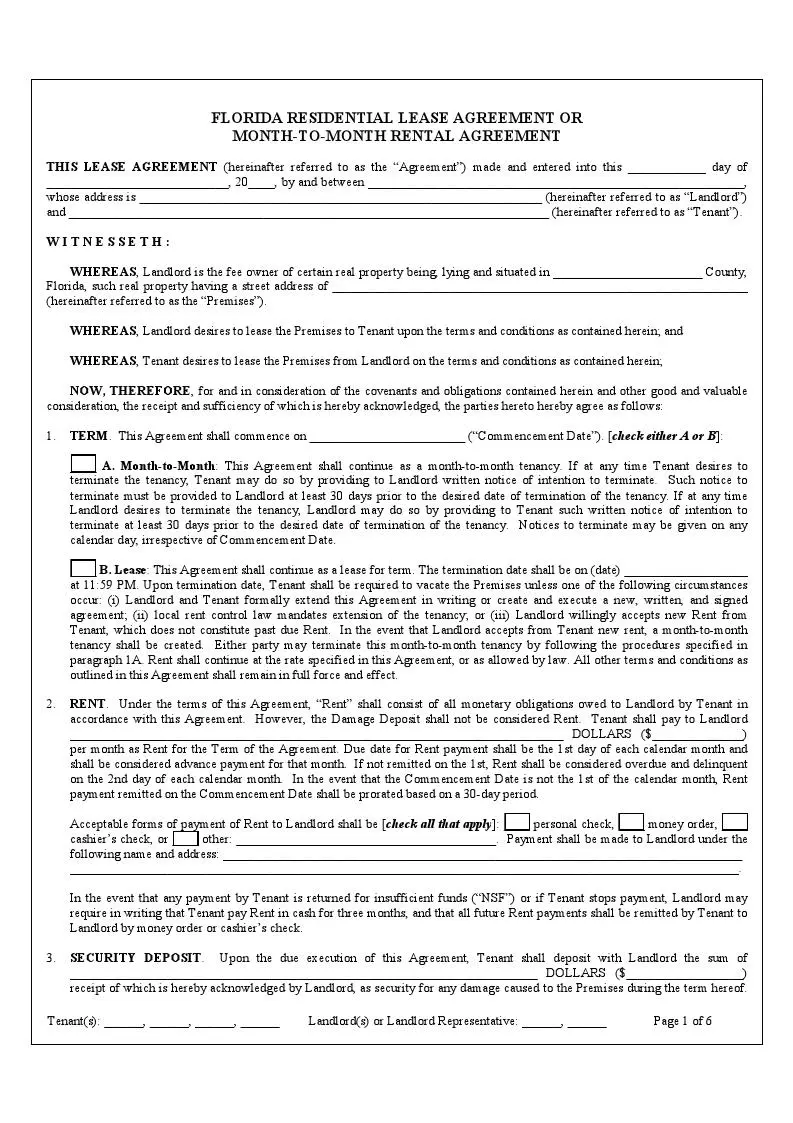
The Florida month-to-month lease agreement is a six-page PDF with 98 fillable fields. You can build it online with FormsPal or download the PDF and complete it yourself. The steps below follow the form from page 1 to page 6.
The screenshots under each step show the FormsPal Florida month-to-month lease agreement template filled with sample entries in blue, so you can see where each answer goes. The names, addresses, dates and amounts are examples only.
Date, Landlord and Tenant (opening paragraph), page 1. At the top of page 1, enter the day, month and year of the agreement, then the Landlord name and address and the Tenant name in the opening paragraph.Step 1: sample entries, not a real document.
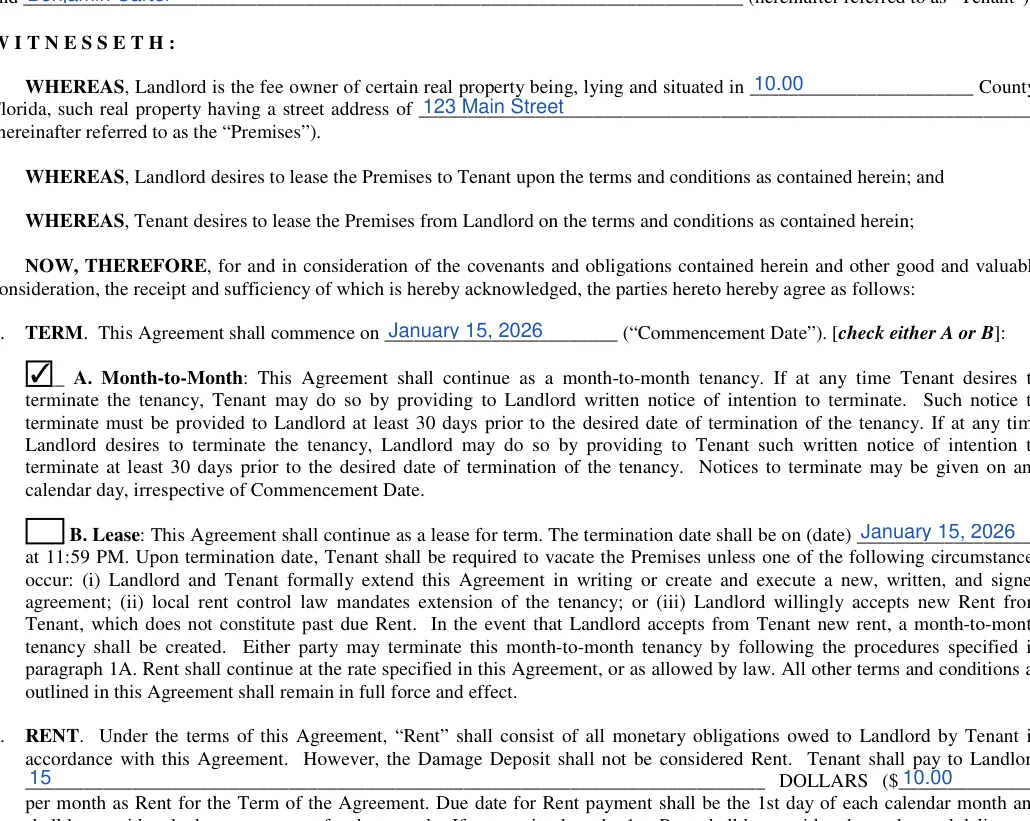
Premises, Term and Rent (Sections 1 and 2), page 1. Under WITNESSETH write the county and street address of the Premises. In Section 1 enter the Commencement Date and mark A for a month-to-month tenancy (B is the fixed-term option and asks for a termination date), then write the monthly Rent in words and in figures in Section 2.Step 2: sample entries, not a real document.
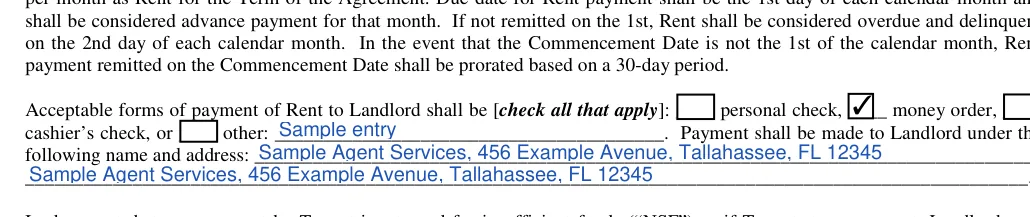
Payment methods and payee (Section 2), page 1. Tick each accepted form of Rent payment (personal check, money order, cashier check, or other with a description), then enter the name and address where payment is to be made.Step 3: sample entries, not a real document.
Section 3 Security Deposit amount, page 1. Write the security deposit in words and in figures. The footer at the bottom of page 1 has blanks for the Tenant(s) and for the Landlord or Landlord Representative.Step 4: sample entries, not a real document.
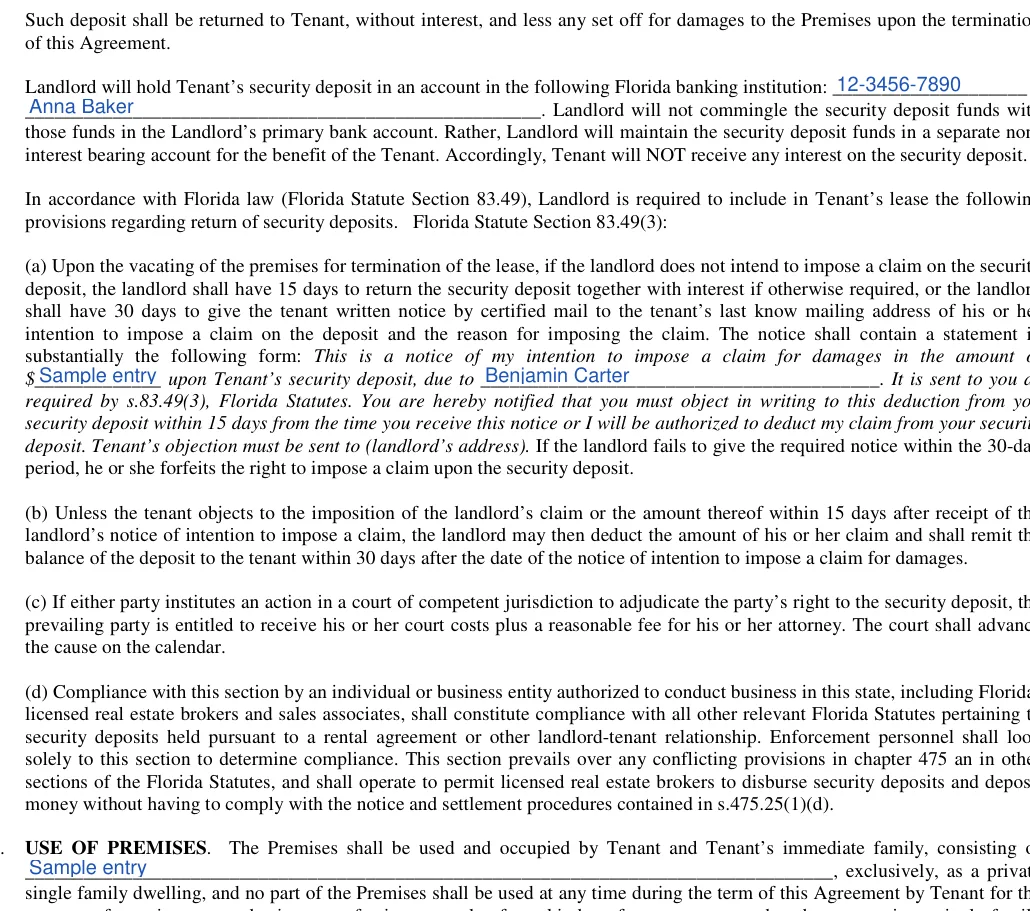
Deposit bank and Use of Premises (Sections 3 and 4), page 2. Enter the Florida bank that will hold the deposit. The amount and due-to blanks sit inside the claim-notice wording the form quotes for a claim after the tenancy ends, so they are not part of filling in the lease. In Section 4 list the immediate family members who will live in the Premises.Step 5: sample entries, not a real document.
Sections 5 to 7, page 2. Page 2 sets out the condition of the premises, assignment and sub-letting, and alterations. Its only blanks are the Tenant(s) and Landlord footer lines.Step 6: sample entries, not a real document.
Sections 8 to 14, page 3. Page 3 has no blanks to fill except the footer lines for the Tenant(s) and the Landlord. It covers possession, hazardous materials, utilities, maintenance and repair, insurance, damage and inspection.Step 7: sample entries, not a real document.
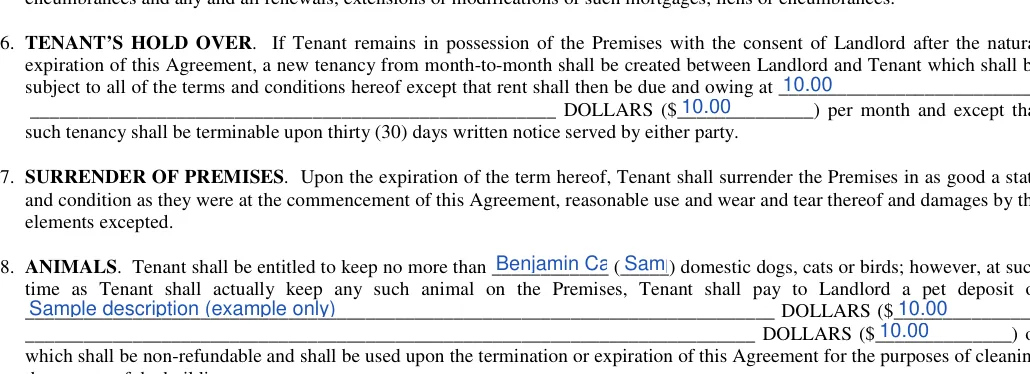
Hold Over rent and Animals (Sections 16 and 18), page 4. In Section 16 write the monthly rent that applies if the Tenant stays on with the Landlord consent after the agreement ends. In Section 18 enter how many animals are allowed, the pet deposit, and the part of that deposit that is non-refundable, each in words and figures.Step 8: sample entries, not a real document.
Sections 15 to 21, page 4. The rest of page 4 covers subordination, surrender, quiet enjoyment, indemnification and default. Complete the footer lines for the Tenant(s) and the Landlord.Step 9: sample entries, not a real document.
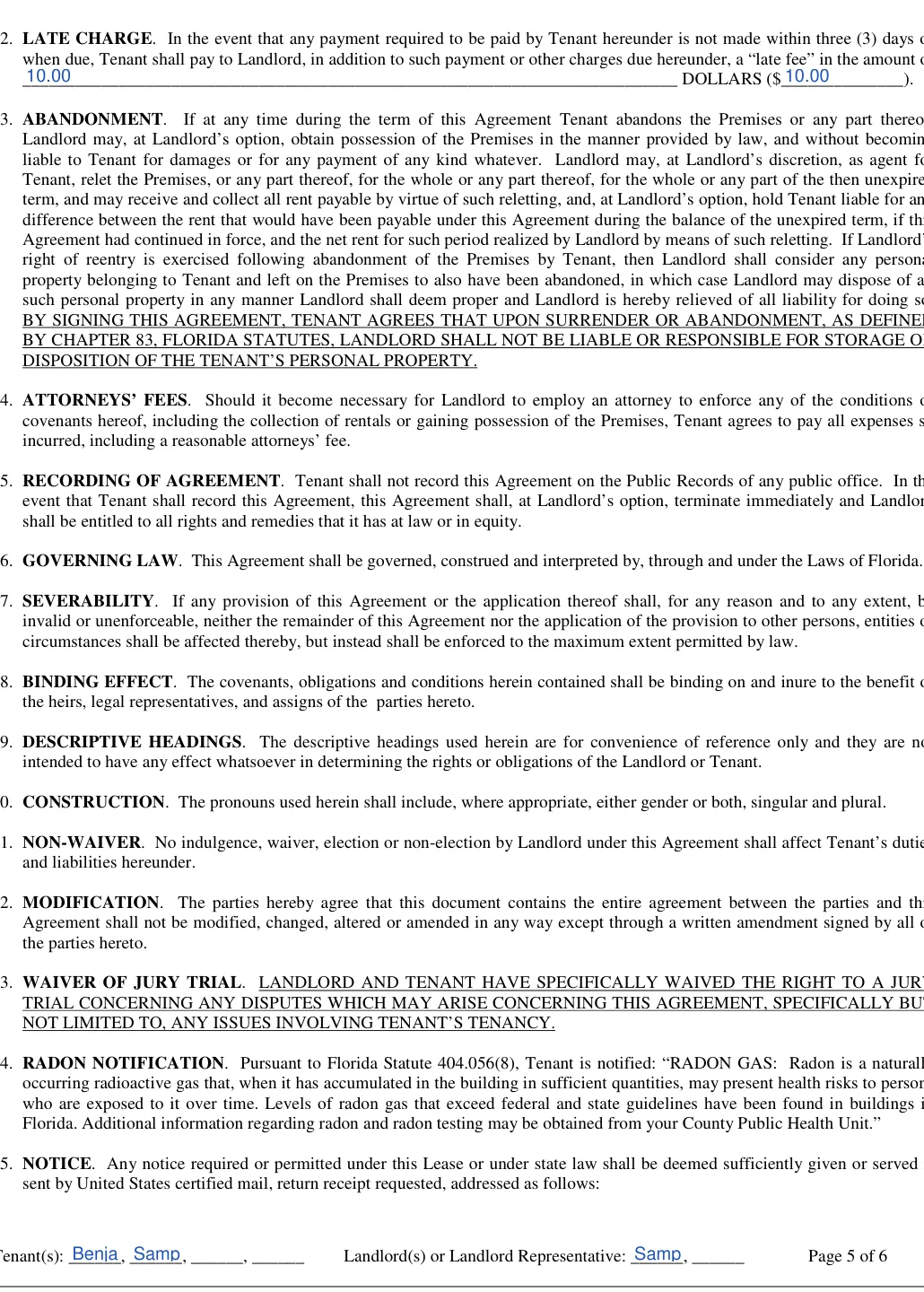
Late Charge (Section 22), page 5. In Section 22 write the late fee in words and figures. The rest of the page holds Sections 23 to 35, and the footer lines for the Tenant(s) and the Landlord sit at the bottom.Step 10: sample entries, not a real document.
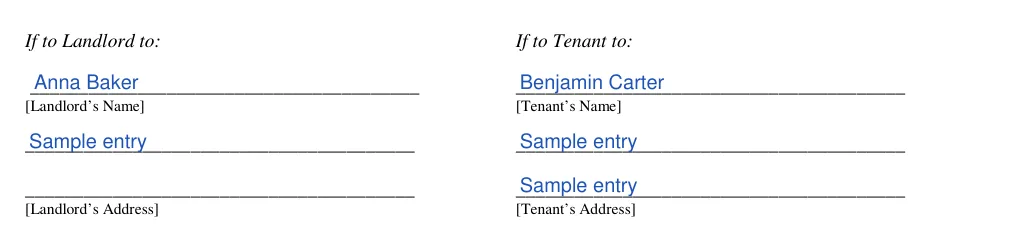
Delivery addresses (Section 35), page 6. Under If to Landlord to and If to Tenant to, enter each party's name and mailing address.Step 11: sample entries, not a real document.
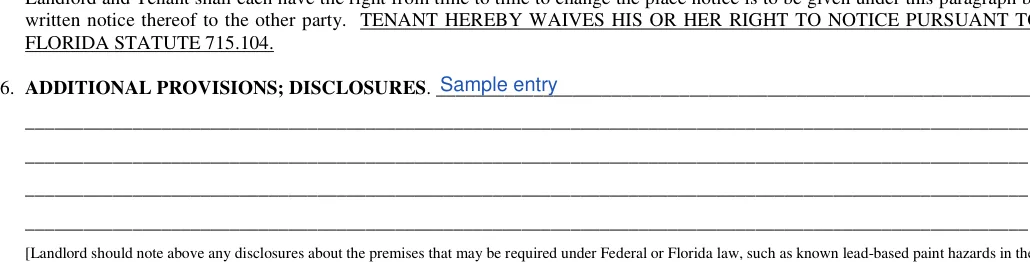
Additional Provisions and Disclosures (Section 36), page 6. Use the lines to list any disclosures about the Premises. The form note says the Landlord should list disclosures required under Federal or Florida law, such as known lead-based paint hazards and any flood hazards.Step 12: sample entries, not a real document.
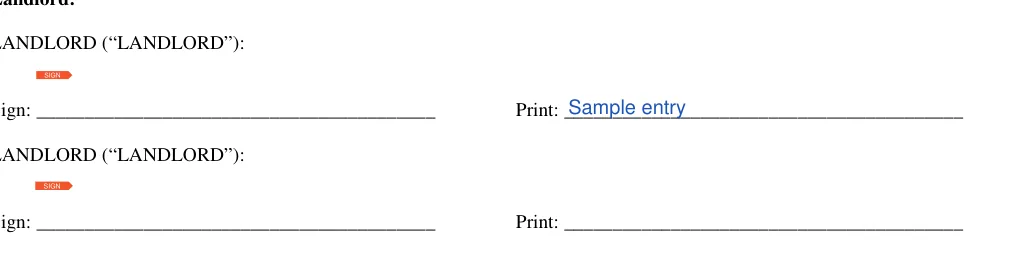
Landlord signatures, page 6. Each Landlord signs and prints a name in a LANDLORD block. The form has two.Step 13: sample entries, not a real document.
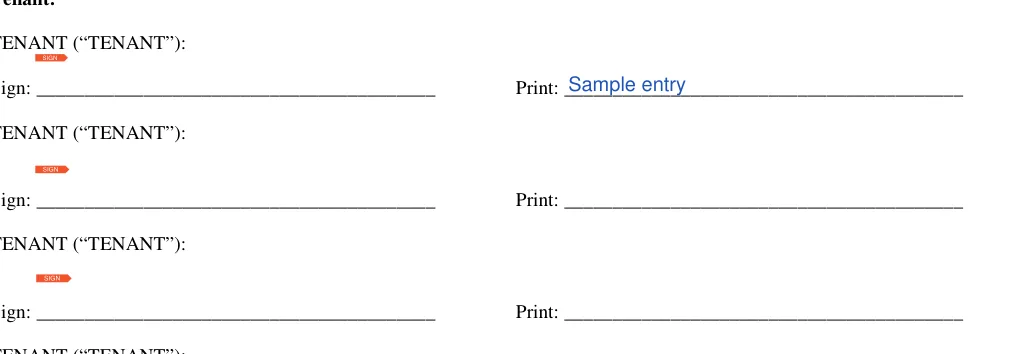
Tenant signatures, page 6. Each Tenant signs and prints a name in a TENANT block. This picture shows the first three of the four on the form.Step 14: sample entries, not a real document.
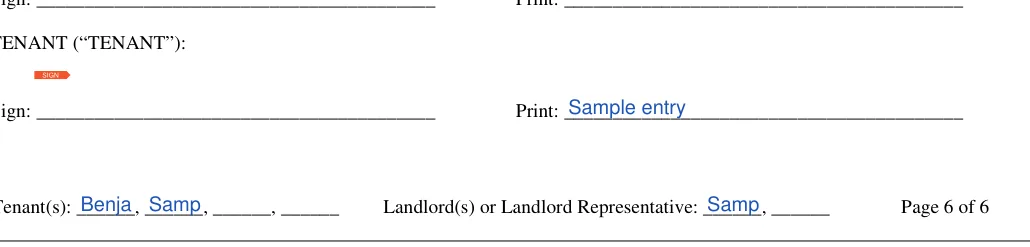
Fourth Tenant signature, page 6. A fourth Tenant signs and prints a name in the last TENANT block.Step 15: sample entries, not a real document.
Florida Month-to-month Lease Agreement Form Details
FormsPal's Florida month-to-month lease agreement is a six-page Adobe PDF with 98 fillable fields. Most people fill it out in about 18 minutes. It is also known as the FL Monthly Lease Agreement or the Florida month to month rental agreement.
Document Name
Florida Monthly Lease Agreement Form
Other Names
FL Monthly Lease Agreement, Florida Month to Month Rental Agreement
Create a free high quality Florida Monthly Lease Agreement online now!
How to Sign and Use the Florida Month-to-month Lease Agreement
Signing is the last step on the form, but a few things come before and after it. Read the whole lease, hand over the landlord's written disclosures and keep a signed copy for each party.
Create or download the lease. Build it with the FormsPal document builder. Or download the PDF and fill it in with the PDF editor, or print it and write by hand.
Read the pre-written sections. The form already contains terms on the condition of the premises, assignment and subletting, alterations, utilities, maintenance, insurance, default, governing law and radon notification, among others. Read them before you initial each page. If a clause is hard to follow, you can ask questions about the PDF in Chat with PDF.
Give the required written notices. The landlord discloses the name and address of the person who receives notices and demands.[3] The landlord also gives written notice of any advance rent or security deposit, in the lease or within 30 days after receiving the money.[2]
Sign and keep copies. After everyone has signed, each party keeps a signed copy. When you end the tenancy later, send the notice to the address the other party listed in Section 35 of the lease.
Frequently Asked Questions
When Must a Landlord Return a Security Deposit in Florida?
A landlord who does not intend to claim against the security deposit must return it within 15 days after the rental agreement ends. Interest is returned with it if otherwise required.[2]
How Long Do Florida Landlords Have to Make a Claim Against a Security Deposit?
A landlord who intends to claim against the deposit must give the tenant written notice within 30 days after the rental agreement ends. The notice goes by certified mail to the tenant's last known mailing address, or by e-mail as the statute allows. It states the landlord's intention and the reason for the claim.[2]
How Much Notice Does It Take to End a Month-to-Month Lease in Florida?
Ending a month-to-month tenancy takes not less than 30 days' notice before the end of any monthly period.[6]
General information, not legal or tax advice.
Other Florida Forms
Try our document builder to customize any template found on FormsPal to your needs. Here’s a group of some other popular Florida documents we provide.
With over 25 years of experience as a business and transactional attorney, Jennifer has mastered the craft of closing highly successful deals for her clients. Through her wide-ranging expertise in commercial contracts, real estate transactions, M&A and corporate law, Jennifer secures results that are second-to-none.