
Updated:
A Florida rental application is a landlord's screening form for prospective tenants. The form collects identity, employment, rental history, credit history and references, and every applicant signs it. Landlords and property managers use it, especially when several people want the same home.
This page walks through each part of the form, how to sign and hand it in, and the Florida rules that apply once a lease and a security deposit follow.
Key facts

Build Your Document
Answer a few simple questions to make your document in minutes
Save and Print
Save progress and finish on any device, download and print anytime
Sign and Use
Your valid, lawyer-approved document is ready
A Florida rental application is a written questionnaire a landlord hands to each person who asks to rent, so every applicant answers the same questions on the same form. The form works like a written interview: it records who the applicant is, where the applicant has lived and worked, and how the applicant has handled credit.
The application comes before the lease. It sets no rent, no term and no house rules; the lease does that once the landlord picks an applicant.
| Document Name | Florida Rental Application Form |
| Other Names | FL Rental Application, Florida Application to Rent |
| Avg. Time to Fill Out | 17 minutes |
| # of Fillable Fields | 96 |
| Available Formats | Adobe PDF |
The Florida rental application asks for six groups of information: the home and move-in date, the tenant's details, employment, residential history, credit history, and bank and credit references. The landlord reads each group to answer one question about the applicant.
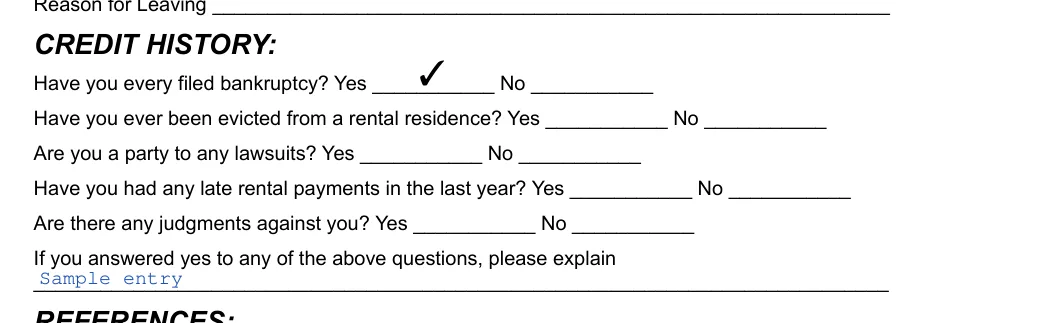
The credit history part of the form is a set of yes or no questions with a line to explain each yes. The bank and credit references on the second page give the landlord names to contact. Before signing, read the Authorization paragraph and ask the landlord which checks, such as a credit report, the signature allows.
The tenant information part has co-applicant lines, so two people applying together can each enter their details. The occupant lines list everyone who will live in the home, and separate lines cover pets and vehicles.
A finished application holds a Social Security number, a driver's license number and bank account numbers. Hand it only to the landlord or property manager, in person or through a channel the landlord names, and keep your own copy somewhere safe.
A Florida rental application serves landlords, property managers and property owners who screen people asking to rent a house, apartment, condo or room. The form gives them the same set of answers from every applicant, so they can compare applications side by side before they offer a lease.
For the applicant, the form is a chance to present a rental history clearly. A complete application saves back-and-forth questions about a missing address or phone number.
The rental application only screens; it does not let anyone move in. Once the landlord accepts an applicant, the Florida lease agreement sets the rent, the term and each side's duties. A landlord who turns an applicant down uses a letter, not this form, to say so.
The Florida rental application is filled in from the top of the first page to the bottom of the second, one part at a time, with every applicant's answers on the same copy. The steps below follow that order.
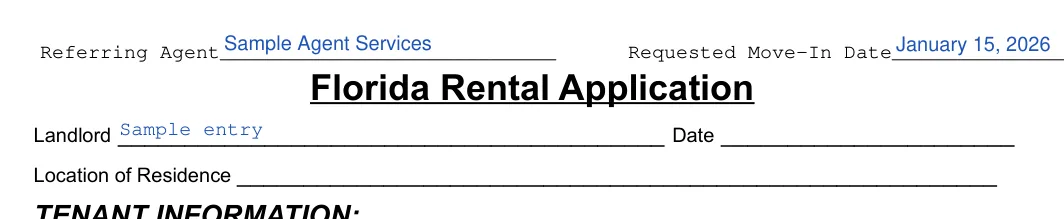
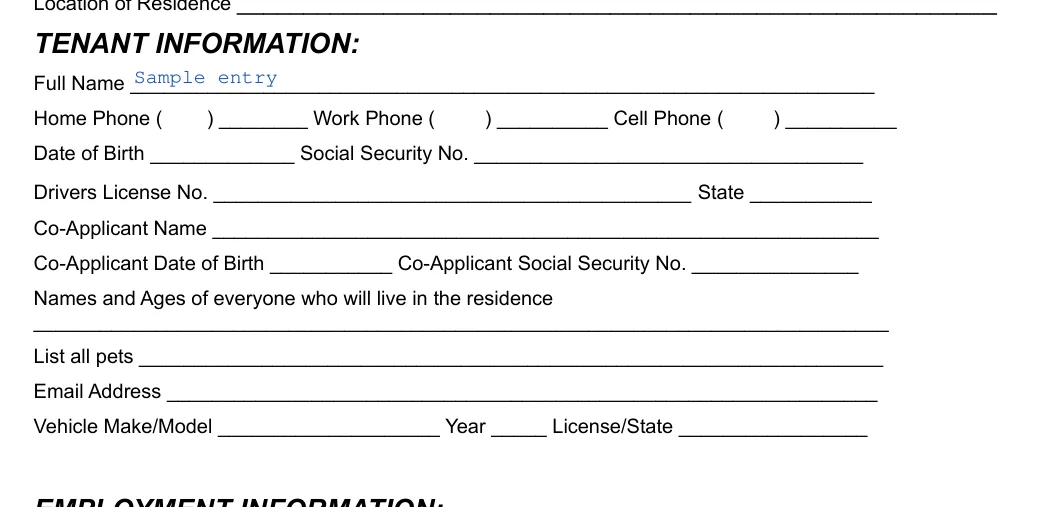
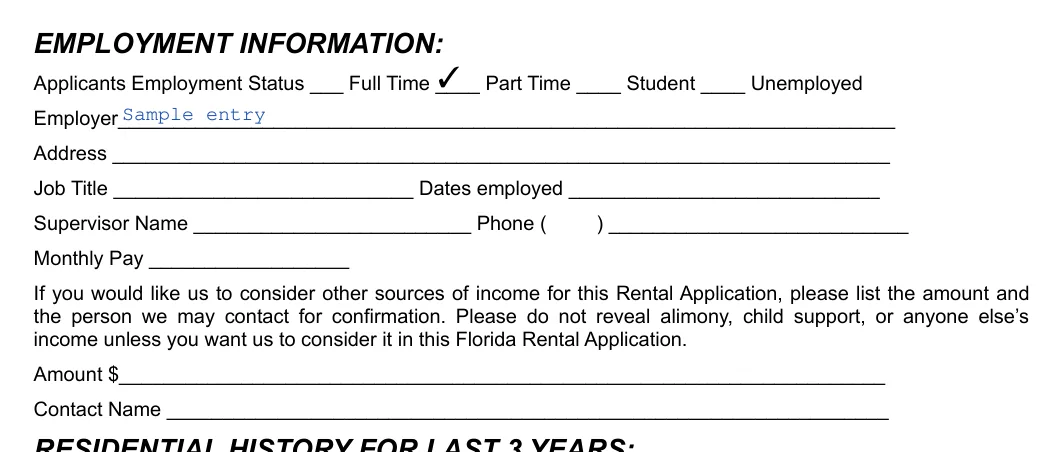
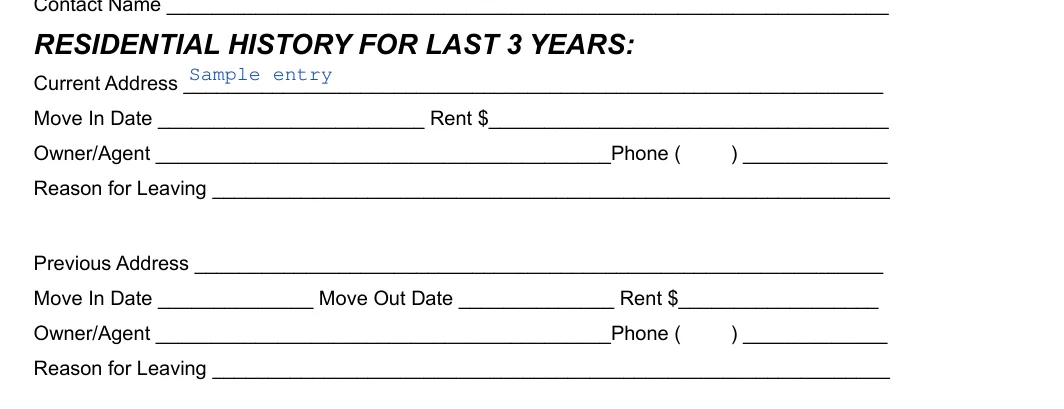
The screenshots under each step show the FormsPal Florida Florida Rental Application template filled with sample entries in blue, so you can see where each answer goes. The names, addresses, dates and amounts are examples only.
Landlord, Location of Residence and Move-In Date
At the top of page 1, enter the landlord's name, today's date and the address of the home you want to rent. Add the referring agent, if there is one, and the move-in date you would like.
Tenant Information
Enter your full name, phone numbers, date of birth, Social Security number, and driver's license number and state. Check that every phone and fax number is current. Fill in the co-applicant lines if someone is applying with you. List everyone who will live in the residence with their names and ages, any pets, your email address and your vehicle.
Employment Information
Mark your employment status, then enter your employer, address, job title, dates employed, supervisor's name and phone number, and monthly pay. Use the other income lines for any additional income you want the landlord to consider, along with a contact name who can confirm it.
Residential History for Last 3 Years
Under Current Address, enter the move-in date, rent, owner or agent with a phone number, and your reason for leaving. Then fill in the Previous Address block the same way, adding the move-out date.
Residential History, Continued
Complete the next Previous Address block at the top of page 2. Enter the address, move-in and move-out dates, rent, owner or agent with a phone number, and reason for leaving. Leave it blank if you have no earlier address.

Credit History
Mark Yes or No for each of the five questions about bankruptcy, eviction, lawsuits, late rent payments in the last year and judgments. If any answer is Yes, explain it on the line below.
References and Applicant Signatures
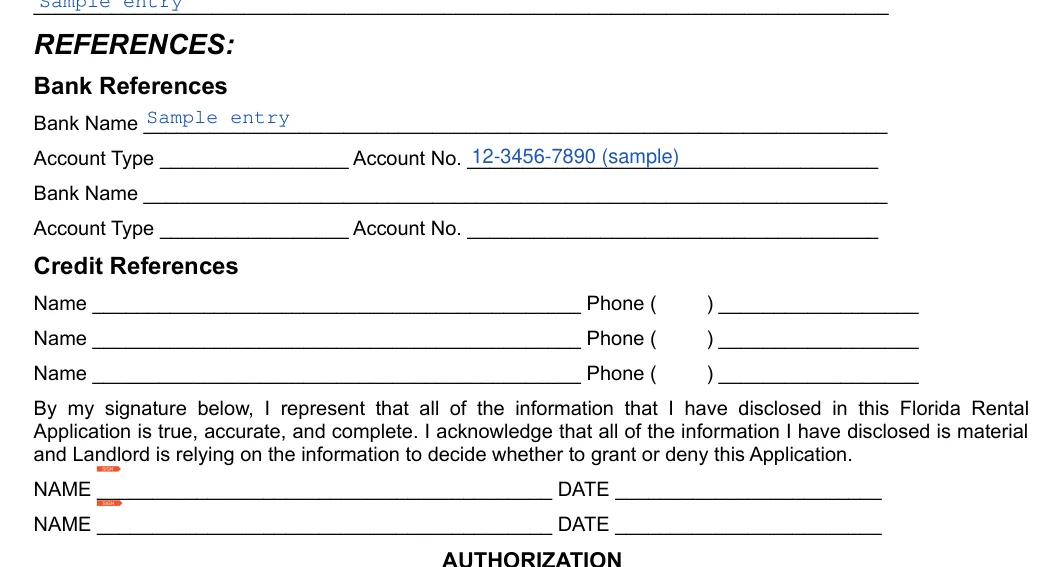
List two bank references with the bank name, account type and account number. Then add three credit references with a name and phone number each. Read the statement that begins 'By my signature below' and enter a name and date for each applicant on the lines under it.
Authorization
Read the Authorization paragraph at the bottom of page 2, then enter a name and date on each line under it.
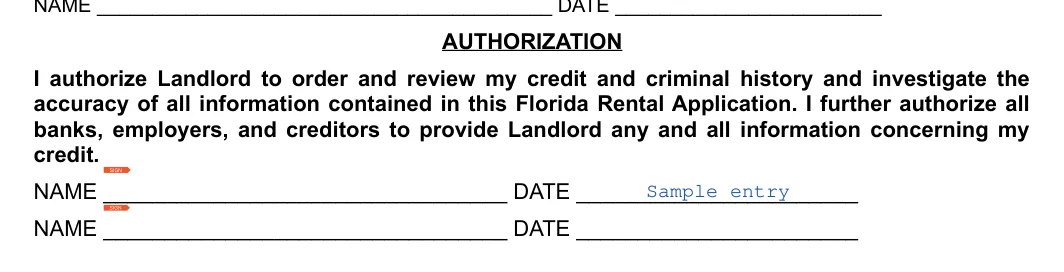
The Florida rental application is signed by every applicant twice: once under the "By my signature below" statement and once under the Authorization paragraph. A signature confirms the applicant has read both and stands behind every answer.
A rental application asks to rent; the lease grants the right to rent. Fla. Stat. § 83.43 defines a rental agreement as any written agreement, including amendments or addenda, or an oral agreement for a duration of less than 1 year, providing for use and occupancy of premises.
| Point | Rental application | Lease agreement |
|---|---|---|
| Purpose | Screens an applicant | Sets the rental terms |
| Who signs | Each applicant | Landlord and tenant |
| When | Before the landlord picks a tenant | After the landlord accepts an applicant |
| Holds | Identity, work, past addresses, credit answers, references | Rent, term, deposit and each side's duties |
The landlord's identity reaches the tenant in writing too. Fla. Stat. § 83.50 has the landlord, or a person authorized to enter into a rental agreement on the landlord's behalf, disclose in writing, at or before the commencement of the tenancy, the name and address of the landlord or a person authorized to receive notices and demands.
A Florida security deposit is paid once a lease follows the application, and Fla. Stat. § 83.49 sets the notice and return deadlines for it. The table lists each deadline with the condition it applies under.
| Deposit rule | Deadline or content, with its condition | Source |
|---|---|---|
| Written notice of the deposit | In the lease agreement or within 30 days after receipt of advance rent or a security deposit | Fla. Stat. § 83.49 |
| What the notice states | The name and address of the depository holding the money, or that the landlord has posted a surety bond; and whether the tenant is entitled to interest | Fla. Stat. § 83.49 |
| Change in how the deposit is held | Within 30 days after the change, if the landlord changes the manner or location of holding the deposit | Fla. Stat. § 83.49 |
| Return with no claim | Within 15 days after the termination of the rental agreement, if the landlord does not intend to impose a claim | Fla. Stat. § 83.49 |
| Notice of a claim | If the landlord intends to impose a claim: within 30 days after the termination of the rental agreement, written notice of the intention to impose a claim and the reason for it, by certified mail to the tenant's last known mailing address or by e-mail in accordance with s. 83.505 | Fla. Stat. § 83.49 |
| Tenant's objection | Within 15 days after receipt of the claim notice; unless the tenant objects, the landlord may deduct the claim and remit the balance within 30 days after the date of the notice | Fla. Stat. § 83.49 |
An application fee is a charge the landlord sets for processing the application. Ask before paying what the fee covers, such as a credit report, and whether any part of it comes back if another applicant gets the home.
A clean Florida rental application is complete, legible and consistent, so the landlord can read it without calling back. These habits apply whether you type into the PDF or print it and write by hand.
The Florida Statutes sections cited on this page are Fla. Stat. § 83.43, § 83.49 and § 83.50, each linked at its first mention above.

The details table above lists an average of 17 minutes. Having your addresses, employer details and references on hand makes the form quicker to finish.
A landlord approves an applicant by comparing the application with the landlord's own rental criteria. Ask for those criteria first, then hand in a complete form whose dates, income and references the landlord can confirm.
The form has co-applicant lines in the tenant information part, so two people applying together can each enter their details. Every applicant then adds a name and date in the signature lines near the end of page 2.
The application asks each applicant's date of birth, and the landlord reviews it with the rest of the form. This page cites no Florida rule on a minimum renting age, so ask the landlord about age limits before applying.
Yes. The form is a fillable PDF, so each field takes typed text before you print it or send it to the landlord.
Keep these details within reach so you can finish the form in one sitting:
General information, not legal or tax advice.
