
A Florida lease termination letter is a written notice that ends a tenancy on a date it names. Under Section 83.57 of the Fla. Stat., the minimum notice is 7 days for a week-to-week tenancy, 30 days for a month-to-month tenancy and 60 days for a year-to-year tenancy.[1] FormsPal's template is a landlord's notice of termination of tenancy that you can build online or download as a PDF.
Last Updated: October 2026. This guide is reviewed and updated regularly to reflect current state law. If you notice an error or outdated information, please contact us.
Build Your Document
Answer a few simple questions to make your document in minutes
Save and Print
Save progress and finish on any device, download and print anytime
Sign and Use
Your valid, lawyer-approved document is ready
State law sets a minimum notice for ending a tenancy that has no fixed end date, and the length depends on the rental period. Section 83.57 of the Fla. Stat. names four periods, one each for weekly, monthly, quarterly and yearly tenancies. A quarter-to-quarter tenancy takes not less than 30 days' notice before the end of any quarterly period. A landlord or a tenant who ends such a tenancy should give the notice before the current period ends, and a lease agreement may add its own terms.[1]
For a month-to-month tenancy, the statute puts the rule this way:
When the tenancy is from month to month, by giving not less than 30 days' notice prior to the end of any monthly period
A lease starts a tenancy and a termination letter ends it. If you still need the lease itself, see our Florida rental lease agreement templates or the full list of lease agreement forms.
| Document Name | Florida Lease Termination Letter |
| Other Names | Notice of Termination of Tenancy, Florida Lease Termination Notice |
| Relevant Laws | Florida Statutes, Section 83.57 |
| Avg. Time to Fill Out | 7 minutes |
| # of Fillable Fields | 23 |
| Available Formats | Adobe PDF |
A termination letter works best when the tenant can read it once and know what the landlord expects. The form on this page asks for the specific details that matter, and each one is listed here.
A written lease agreement can have its own terms about ending the tenancy, so read the agreement before you send the letter. Landlords and tenants should both keep a copy of the signed letter, because a notice that cannot be shown to have been legally delivered may be disputed.
A landlord who wants to remove a tenant over unpaid rent or a broken lease works from a different document, such as an eviction notice. A landlord or tenant with a legal question about a specific tenancy can ask an attorney.
The FormsPal template is a notice of termination of tenancy. The notice itself is on page 2 of the PDF, and it has three parts to complete. You can build the letter with our document builder or fill in the downloaded PDF with our online PDF editor. The steps below follow the form from top to bottom.
The screenshots under each step show the FormsPal Florida lease termination letter template filled with sample entries in blue, so you can see where each answer goes. The names, addresses, dates and amounts are examples only.
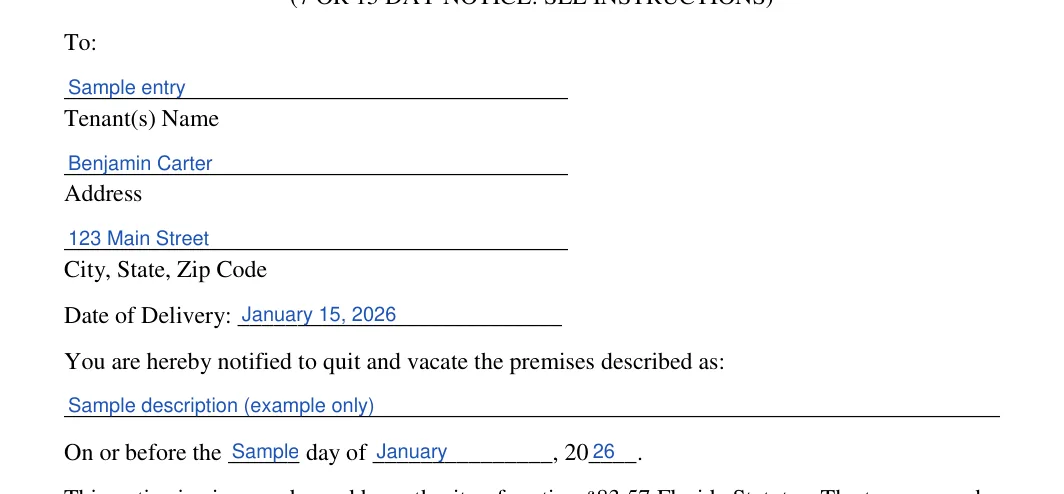
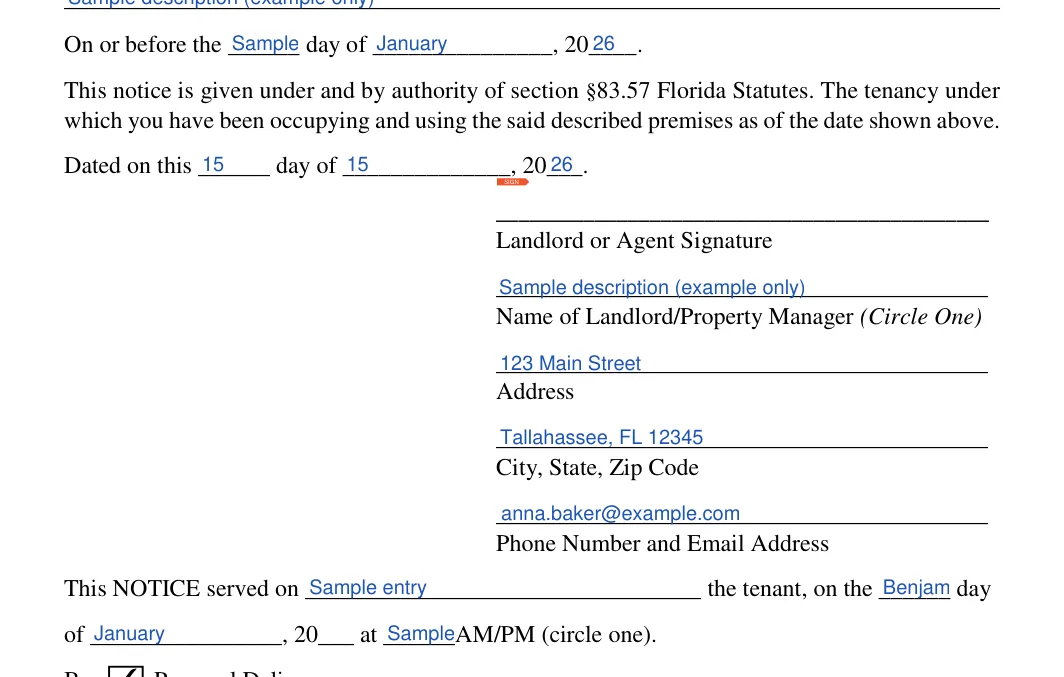

Filling out the letter is only part of the process. The form lists two ways to deliver it, personal delivery and posting a copy at the residence, and it has a service record for the date and time. Whichever way you choose, keep a copy of the signed letter and a note of what you did and when.
A month-to-month tenancy takes not less than 30 days' notice before the end of any monthly period, under Section 83.57 of the Fla. Stat. Give the notice at least 30 days before the period ends, and count the days back from its last day.[1]
A week-to-week tenancy takes not less than 7 days' notice before the end of any weekly period. A year-to-year tenancy takes not less than 60 days' notice before the end of any annual period.[1]
The FormsPal template is written as a landlord's notice to the tenant, with a signature line for the landlord or agent and a delivery record. A tenant who wants to end a tenancy should check the lease agreement first, because the rules for a tenant depend on the lease and on the situation.
General information, not legal or tax advice.

