
In Colorado, a living will, called the Advance Directive for Medical or Surgical Treatment, is a written document that lets you state your wishes about medical and mental health care in advance.
Last Updated: September 2026. This guide is reviewed and updated regularly to reflect current Colorado law. If you notice an error or outdated information, please contact us.
If you later face a life-threatening condition, such as a persistent vegetative state or an irreversible illness, and can no longer make your own decisions, this paperwork lets an appointed health care agent speak on your behalf.
Before you create a Colorado Living Will, consider these related documents. Each covers similar ground with a few key differences.
Colorado law sets two valid ways to sign a living will. You sign the declaration in the presence of two witnesses, or you sign it and have it acknowledged before a notary public or another person authorized by law to take acknowledgments.[1.2]
You only need to complete one of these two paths, not both. Choose whichever is easier for you to arrange, then follow it exactly.[1.2]
The same law limits who can serve as a witness or notary. That person cannot be the attending physician or any other physician, or an employee of that physician's practice or the health care facility where you are a patient. They also cannot be a person who has a claim against your estate, or a person who expects to inherit from you as a beneficiary or an heir.[1.2][1.1]
Except as otherwise provided in section 15-18-105, a declaration must be: signed by the declarant in the presence of two witnesses; or signed by the declarant and acknowledged before a notary public or other individual authorized by law to take acknowledgments, unless a court determines that this subsection (1)(b) should not apply to the declaration in the interest of justice.
Under the terms of the free living will form, you may appoint someone to make medical decisions on your behalf if you become incapacitated. If you have already named a health care agent elsewhere, check that the two choices do not conflict. This person speaks for you under stressful circumstances, so choose someone you trust and describe your wishes clearly.
The Colorado Advance Medical Directive document creates a list of preferences regarding one’s treatment and includes:
Many people update or cancel their living will if their wishes change, for example after a divorce or a new diagnosis. Ask your lawyer about the right way to revoke or replace your document in Colorado.
Without a living will, your family and doctors must guess at your wishes during a medical crisis. This can cause disagreements at an already hard time.
You may revoke a declaration orally, in writing, or by burning, tearing, canceling, obliterating or destroying it (C.R.S. § 15-18-109).[1.7]
Decisional capacity means the ability to give informed consent to or refusal of medical treatment, or to make an informed health care benefit decision (C.R.S. § 15-18-103(6)).[1.6]
Any adult with decisional capacity may sign a declaration (C.R.S. § 15-18-104(1)). It is acted on only after your attending physician and one other physician certify in writing that you have a terminal condition or are in a persistent vegetative state and lack decisional capacity (C.R.S. § 15-18-107).[1.5]
| Document Name | Colorado Living Will Form |
| State Form Name | Advance Directive for Surgical / Medical Treatment |
| Signing Requirements | Two witnesses, or signed and notarized[1.2] |
| Avg. Time to Fill Out | 13 minutes |
| # of Fillable Fields | 48 |
| Available Formats | Adobe PDF; Microsoft Word |
| State Laws: Colo. Rev. Stat. §§ 15-18-101 to 15-18-113[1] | |
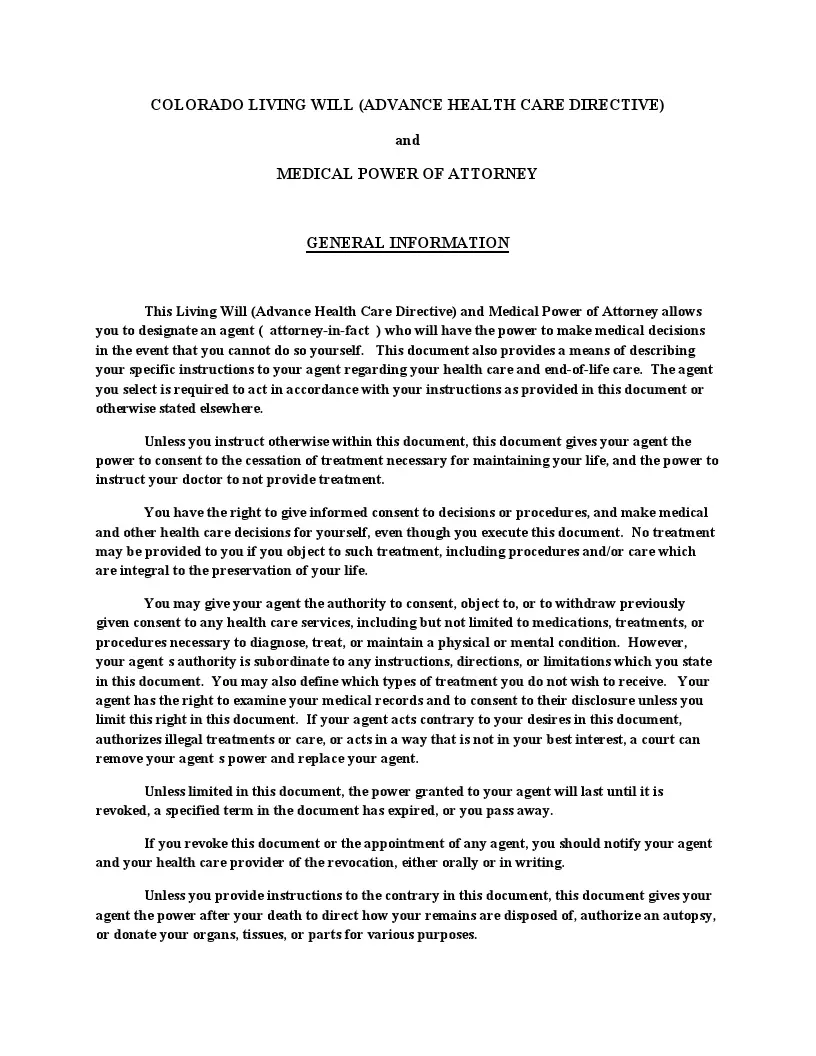
To create your Colorado Living Will and Medical Power of Attorney, download it or build it online, then complete each section in order from the declaration on page 2 through the witness acknowledgment on page 8. The steps below follow the PDF's own sections, so you can work through it from start to finish.


Colorado requires you to sign your living will in the presence of two witnesses, or sign it and have it acknowledged before a notary public or another person authorized to take acknowledgments.[1.2] Your witness, notary, or signer cannot be:
Colorado also has a separate behavioral health orders form for mental health treatment decisions. That form must carry the dated signatures of two disinterested witnesses.[1.4] A disinterested witness cannot be your spouse, partner in a civil union, domestic partner, or romantic partner. They also cannot be your child, parent, sibling, grandchild, grandparent, or health care provider, and cannot have a financial interest in your estate.[1.3]
General information, not legal or tax advice.
