Colorado Small Estate Affidavit Form

A Colorado small estate affidavit is a sworn written statement that a person signs to collect the personal property of someone who has died, when the estate is small. Colorado's small estate law, C.R.S. § 15-12-1201, sets three conditions: a value limit,[1.1] a waiting period of at least ten days after the death,[1.2] and no pending or granted application to appoint a personal representative in any jurisdiction.[1.3]

Last Updated: October 2026. This guide is reviewed and updated regularly to reflect current Colorado law. If you notice an error or outdated information, please contact us.
Colorado small estate affidavit form preview

Create a free high quality Colorado Small Estate Affidavit online now!

Build Your Document

Answer a few simple questions to make your document in minutes

Save and Print

Save progress and finish on any device, download and print anytime

Sign and Use

Your valid, lawyer-approved document is ready

... or download your Colorado Small Estate Affidavit Form as a  PDF file

What Are the Colorado Small Estate Affidavit Requirements?

Colorado sets three conditions for using the affidavit, all found in C.R.S. § 15-12-1201(1). They cover the value of the estate, the time since the death, and whether anyone has asked a court to appoint a personal representative. The sections below explain each one, then summarize them in a table.

  • Value limit: The estate must not be worth more than twice the amount set in section 15-11-403, as adjusted by section 15-10-112.[1.1]
  • Waiting period: At least ten days must have elapsed since the death of the decedent.[1.2]
  • No personal representative: No application or petition for the appointment of a personal representative may be pending or granted in any jurisdiction.[1.3]

The statute measures the fair market value of the property the decedent owned that passes by will or intestate succession. Intestate succession means passing under state law when there is no will. The statute counts that property wherever it is located and subtracts liens and encumbrances.[1.1] Here is its wording:

The fair market value of property owned by the decedent and subject to disposition by will or intestate succession at the time of his or her death, wherever that property is located, less liens and encumbrances, does not exceed twice the amount set forth in section 15-11-403, as adjusted by section 15-10-112.

C.R.S. § 15-12-1201(1)(a)

The limit on the estate is a formula, not a dollar figure. It is twice the amount in section 15-11-403, adjusted under section 15-10-112. Because that amount is adjusted each year for the cost of living, the limit depends on the year of death, and the Colorado Department of Revenue publishes the adjusted amounts.[1.4]

Do not rely on a dollar figure from an old form or website. Look up the current amount in those two sections before you sign.

A personal representative is the person a court appoints to manage a dead person's estate, often called an executor or administrator. The statute says "in any jurisdiction," so a pending application anywhere counts.[1.3]

The court's form JDF 999, the PDF you can download on this page, is titled "Collection of Personal Property by Affidavit."[2] So you may also see this document called a collection of personal property affidavit. For how the document works in other states, see our general small estate affidavit page.

Planning your own estate? Our Colorado last will template lets you name who receives your property, and our Colorado power of attorney forms let someone act for you while you are alive.

Colorado Estate Laws at a Glance

Max. Estate Twice the amount set in C.R.S. § 15-11-403, as adjusted by § 15-10-112[1.1]
Min. Time to Wait After Death At least 10 days[1.2]
Personal Representative No application or petition pending or granted in any jurisdiction[1.3]
State Laws Colorado Revised Statutes, Sections 15-12-1201 to 15-12-1205
seal of colorado state
Other Colorado Forms
Try our maker to customize any form available on our website to your preferences. Here’s a range of some other fillable Colorado forms we offer.
Template Preview
Create a free high quality Colorado Small Estate Affidavit online now!

How Do You Fill Out the Colorado Small Estate Affidavit Form?

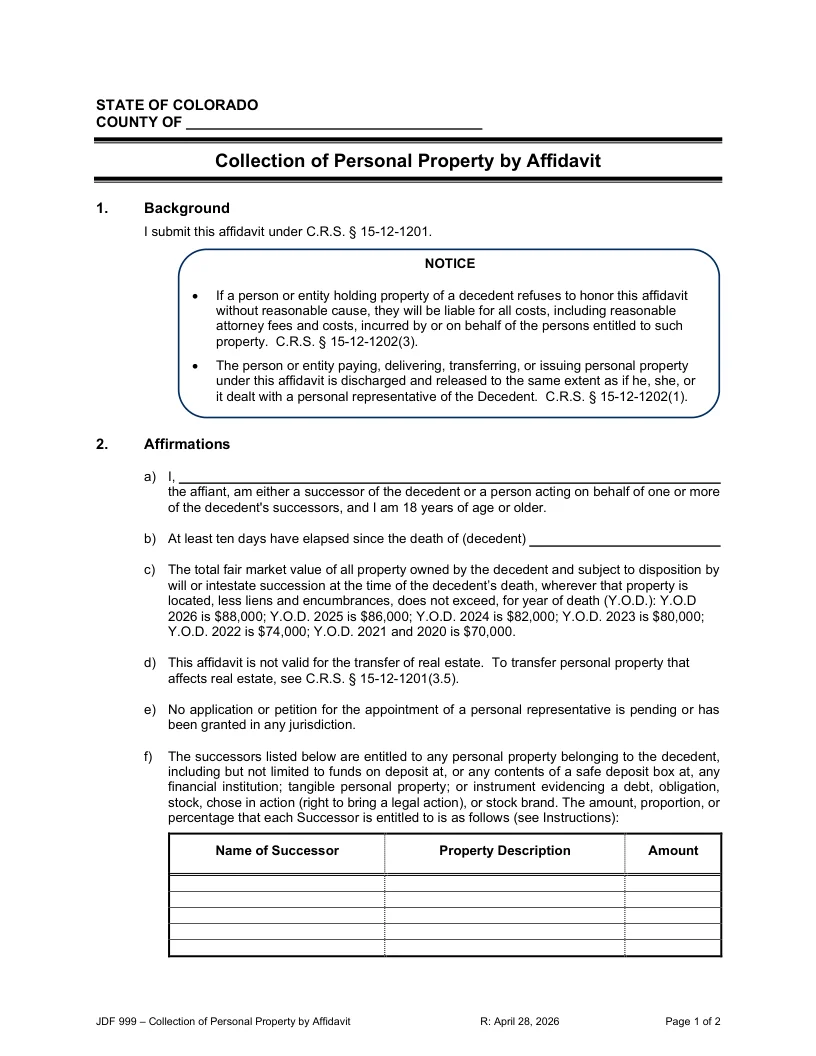
The PDF on this page is the court's own form, JDF 999, Collection of Personal Property by Affidavit (R: April 28, 2026), from the Colorado Judicial Branch.[2] It has two pages and three sections: Background, Affirmations a) to i), and Notarized Signature. These instructions follow that order. Fill it in with our online PDF editor, or print it and write the answers by hand.

The screenshots under each step show JDF 999, the official Colorado form, filled with sample entries in blue, so you can see where each answer goes. The names, dates and amounts are examples only.


  1. State and county. At the top of page 1, write the county on the COUNTY OF line. Section 1, Background, needs no entry. It states that you submit the affidavit under C.R.S. § 15-12-1201, and its NOTICE box explains what happens when a holder of the property refuses or honors the affidavit.
    Colorado small estate affidavit, JDF 999: state and county, filled with sample entries
    Step 1: sample entries, not a real document.
  2. Your name and age (affirmation a). In section 2, Affirmations, print your full name on the line in a). The rest of a) states that you are a successor of the decedent, or act for one or more successors, and that you are 18 or older.
    Colorado small estate affidavit, JDF 999: affiant name and age, filled with sample entries
    Step 2: sample entries, not a real document.
  3. Decedent, ten days and value limit (affirmations b and c). Write the decedent's full name in b), which states that at least ten days have passed since the death. Affirmation c) prints the value limit for each year of death, from $70,000 for a death in 2020 or 2021 to $88,000 for a death in 2026. Compare the decedent's property, less liens and encumbrances, with the figure for the year of death before you go on.
    Colorado small estate affidavit, JDF 999: decedent, ten days and value limit, filled with sample entries
    Step 3: sample entries, not a real document.
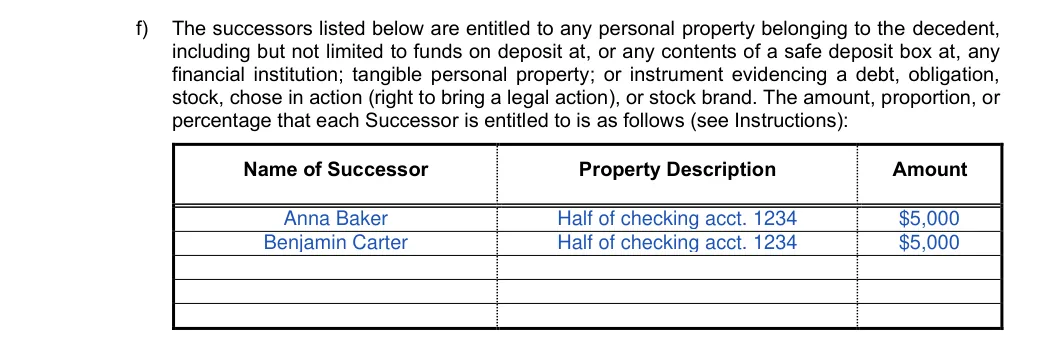
  4. Successors and their shares (affirmation f). Affirmations d) and e) are printed. They state that the affidavit is not valid for transferring real estate and that no application or petition to appoint a personal representative is pending or has been granted. In the table under f), list each successor with a description of the property and the amount, proportion or percentage that successor receives. The table has five rows.
    Colorado small estate affidavit, JDF 999: successors and their shares, filled with sample entries
    Step 4: sample entries, not a real document.
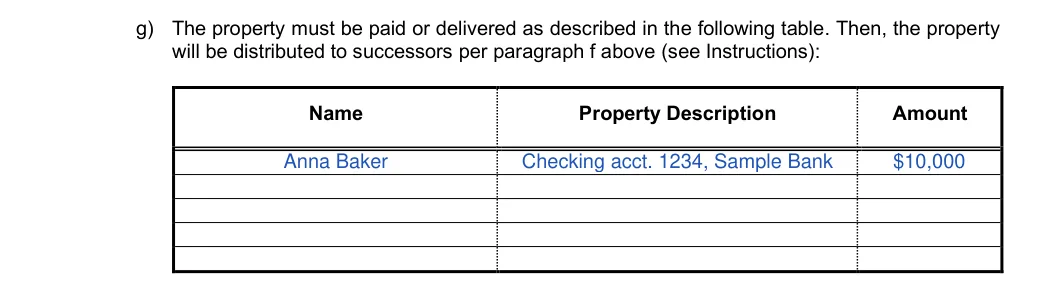
  5. Who receives the property (affirmation g). On page 2, the table under g) names the person the property is paid or delivered to, with the property description and the amount. The property is then distributed to the successors as listed in f). Affirmations h) and i) are printed. They say that anyone who collects property for other successors acts as their agent, and that anyone who receives property must account for it to a personal representative appointed later.
    Colorado small estate affidavit, JDF 999: who the property is paid or delivered to, filled with sample entries
    Step 5: sample entries, not a real document.
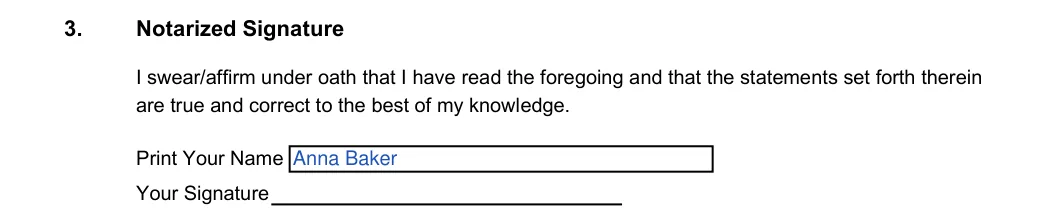
  6. Your printed name and signature (section 3). In section 3, Notarized Signature, print your name and sign on the Your Signature line. Sign in front of a notary public, because you swear or affirm under oath that the statements in the affidavit are true.[2.1]
    Colorado small estate affidavit, JDF 999: your printed name and signature, filled with sample entries
    Step 6: sample entries, not a real document.
  7. Notary block. The notary completes the rest of section 3: the county and state where you signed, the day, month and year, the date the notary's commission expires, and the notary's signature.
    Colorado small estate affidavit, JDF 999: notary block, filled with sample entries
    Step 7: sample entries, not a real document.

Frequently Asked Questions

These answers come from C.R.S. § 15-12-1201, the Colorado statute that sets the conditions for a small estate affidavit. Probate is the court process for settling a dead person's estate, and these conditions decide whether the shortcut is open. They cover the value limit, how it is measured, and the personal representative condition.

Do I need probate if the estate is small?

Colorado's small estate procedure applies only when the estate stays within a value limit. The fair market value of the decedent's property, less liens and encumbrances, may not exceed twice the amount set forth in section 15-11-403, as adjusted by section 15-10-112.[1.1]

What is the small estate threshold in Colorado?

The threshold is a formula: twice the amount set forth in section 15-11-403, as adjusted by section 15-10-112.[1.1] Check those sections for the current dollar amount.

Does a pending petition for a personal representative matter?

Yes. No application or petition for the appointment of a personal representative may be pending or granted in any jurisdiction.[1.3]

General information, not legal or tax advice.

Sources

  1. C.R.S. § 15-12-1201.
    • 1.1 § 15-12-1201(1)(a)
    • 1.2 § 15-12-1201(1)(b)
    • 1.3 § 15-12-1201(1)(c)
    • 1.4 C.R.S. § 15-10-112(2) and (3)
  2. Colorado Judicial Branch, Form JDF 999 (Collection of Personal Property by Affidavit)
    • 2.1 Form JDF 999, section 3 (Notarized Signature)
Published: Aug 4, 2022
Mara Erlach
Mara Erlach
Writer & Attorney
Mara has been practicing estate planning and trust law in California since 2003, taking pride in helping clients of all backgrounds and asset profiles form a complete and customized estate plan. Her specialties are: estate planning, wills and trusts, trust and probate administration.