
Updated:
A Kansas power of attorney is a document that appoints your agent. Under Kan. Stat. Ann. § 58-652, the principal signs, dates and acknowledges a durable one before a notary. The forms below cover finances, health care, a child, real estate, taxes and vehicles.
Key facts
Build Your Document
Answer a few simple questions to make your document in minutes
Save and Print
Save progress and finish on any device, download and print anytime
Sign and Use
Your valid, lawyer-approved document is ready
A Kansas power of attorney comes in separate forms for money, health care, a child, real estate, taxes and vehicles. Each form gives the agent a different set of powers, so the right one matches the job the agent will do. In Kansas, a durable power of attorney keeps working after a disability only if it is signed by you, dated, and acknowledged before a notary public in the way Kansas notarial law prescribes.[1]
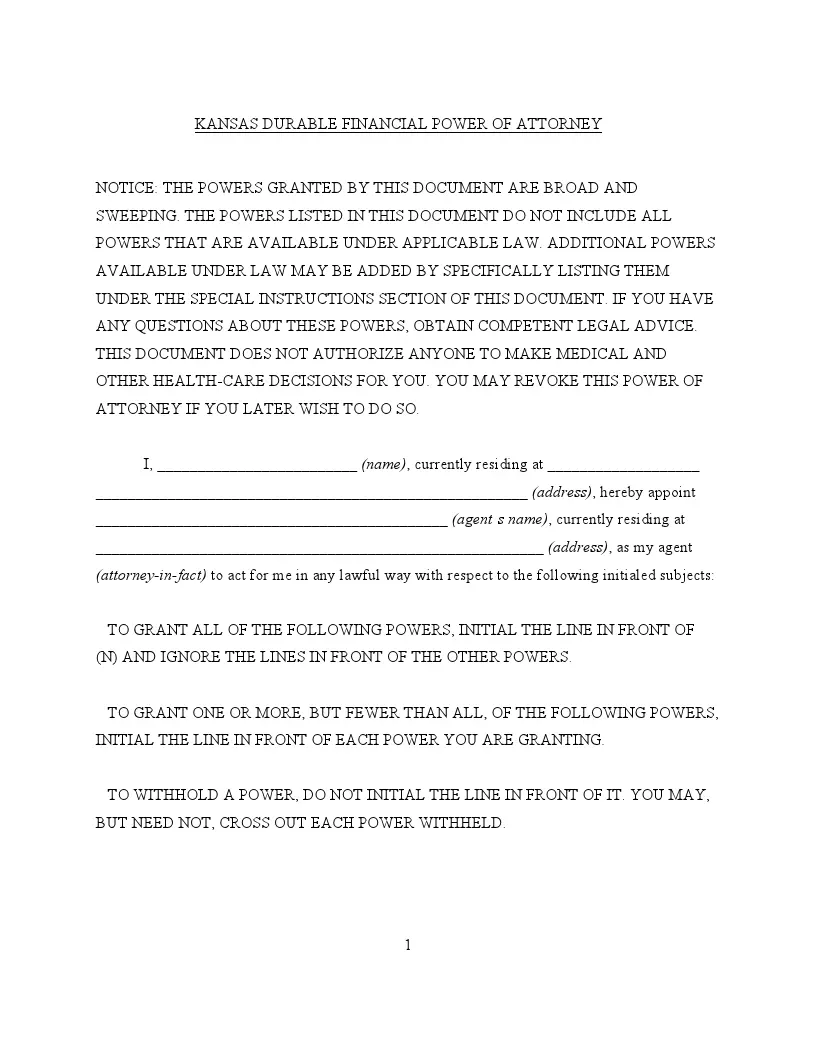
Durable power of attorney is the Kansas financial power of attorney that keeps working if the principal becomes disabled only when the document is denominated a "durable power of attorney", includes the durable provision, and is signed by the principal, dated and acknowledged (Kan. Stat. Ann. § 58-652). The agent can manage accounts, handle banking and business transactions, and complete the other acts the form lists.
| Also Known As | Kansas DPOA |
| Signing Requirements | Notary |
| Download | PDF Template |

Medical power of attorney, or the durable power of attorney for health care decisions, names an agent who makes medical decisions for the principal. The agent can act when the principal cannot speak with doctors. Kansas law requires a durable power of attorney for health care decisions to be dated and signed in the presence of two adult witnesses who meet the law's conditions, or acknowledged before a notary public.[2]
| Also Known As | Health Care POA or MPOA |
| Signing Requirements | Notary or Two Witnesses |
| Download | PDF Template |

General power of attorney is a legal form for the appointment of your representative in financial matters, but it has a certain limitation. If you are unable to make decisions on your own, that is, you become incapacitated, this form will cease to operate.
| Also Known As | Generic Financial POA |
| Signing Requirements | Notary |
| Download | PDF Template |

Limited power of attorney hands the agent one task or a short list of tasks. The form lists the acts the agent may perform and can set the date the form ends.
| Also Known As | Special POA |
| Signing Requirements | Notary |
| Download | PDF Template |

Child power of attorney names a temporary caregiver who can make decisions about a child's health or education. If you use this form to place your child with a host family program, Kansas law limits it to one year, and it can be renewed once for one more year. A parent on active duty service may set a longer term, up to the length of that service plus 30 days.[3]
| Also Known As | Minor POA |
| Signing Requirements | Notary |
| Download | PDF Template |

Real estate power of attorney gives an agent authority over property matters. The agent can rent, buy, sell or negotiate a deal on the real estate the form names.
| Also Known As | Limited Real Estate POA |
| Signing Requirements | Notary |
| Download | PDF Template |

State tax power of attorney (Form DO-10) is a legal form for appointing your representative to fill out tax forms and represent you in front of the Kansas Department of Revenue.
| Also Known As | Form DO-10 |
| Signing Requirements | Taxpayer and Agent |
| Download | Form DO-10 (DOC) |

Vehicle power of attorney (Form TR-41) is a form that allows your designated representative to apply for title and registration in Kansas Division of Vehicles, as well as transfer or endorse title of a specified vehicle.
| Also Known As | Form TR-41 |
| Signing Requirements | Owner of Vehicle |
| Download | PDF Template | Form TR-41 (DOC) |

Revocation power of attorney ends a power of attorney the principal signed earlier. The revocation tells the agent and the people who relied on the old document that the agent's authority has stopped.
| Also Known As | POA Termination Form |
| Signing Requirements | Notary |
| Download | PDF Template |

Other Kansas documents for estates, sales and rentals are listed here.
A Kansas financial power of attorney gives an agent authority over the principal's money and property, such as bank accounts, investments, business matters and bills. The principal is the person who gives the powers. The agent, called the attorney in fact in the statute, is the person who receives them.
The financial document comes in three main forms. A general power of attorney covers broad financial matters. A limited power of attorney covers one task. A durable power of attorney keeps working after the principal becomes disabled.
A Kansas power of attorney stays in effect after the principal becomes wholly or partially disabled only if the document is denominated a "durable power of attorney", includes a durable provision, and is signed by the principal, dated and acknowledged before a notary, under Kan. Stat. Ann. § 58-652. The provision states in substance that the agent's authority does not end if the principal becomes disabled or if it later is uncertain whether the principal is dead or alive (Kan. Stat. Ann. § 58-652).
A power of attorney without that label or provision ends when the principal becomes incapacitated. That is the difference between a durable and a general power of attorney.
A springing power of attorney takes effect only on a future date, event or condition, if the writing expressly so provides, under Kan. Stat. Ann. § 58-652. A common trigger is the principal's later incapacity. When the document depends on such an event, a person shown the document may rely on the agent's affidavit that the event has occurred, unless that person actually knows otherwise (Kan. Stat. Ann. § 58-652).
A power of attorney in Kansas is made by choosing the right form, filling it in and signing it as Kan. Stat. Ann. § 58-652 sets out for a financial form. These steps apply to the financial forms; the health care form follows the signing rules in the next section.
The right form depends on what the agent will do for you. Match the task to a document in the table, then open its entry above.
| Your task | Document |
|---|---|
| Give someone financial powers that last through a disability | Durable power of attorney |
| Let someone handle everyday finances | General power of attorney |
| Hand off one specific matter | Limited power of attorney |
| Name someone to make health care decisions | Medical power of attorney (Durable Power of Attorney for Health Care Decisions) |
| Leave your child in someone's care | Child power of attorney |
| Sell or rent a property | Real estate power of attorney |
| Deal with Kansas tax matters | State tax power of attorney (Form DO-10) |
| Get a title or register a vehicle | Vehicle power of attorney (Form TR-41) |
| Replace or stop an agent | Revocation of power of attorney |
Form DO-10 is the Kansas Department of Revenue power of attorney for tax matters. It names a representative to fill out tax forms and to represent the taxpayer before the department. Both the taxpayer and the agent sign it, as its entry above shows. Form TR-41 does the same job for a vehicle title and registration with the Kansas Division of Vehicles.
A Kansas durable power of attorney keeps the agent's authority after a disability only if it is signed by the principal, dated, and acknowledged in the manner the revised uniform law on notarial acts prescribes.[1]
A Kansas durable power of attorney may be signed by an adult designee if the principal is physically unable to sign but is otherwise competent and conscious. The designee signs in the principal's presence and at the principal's specific direction, which the principal expresses in front of a notary public.[1]
A Kansas durable power of attorney for health care decisions is dated and signed before two witnesses, or acknowledged before a notary public, under Kan. Stat. Ann. § 58-629. Each witness is at least 18 years old (Kan. Stat. Ann. § 58-629). Under Kan. Stat. Ann. § 58-629, neither witness may be:
A Kansas health care power of attorney cannot name the treating health care provider as agent, unless an exception applies, under Kan. Stat. Ann. § 58-629. The same bar covers an employee of the treating provider and an employee, owner, director or officer of a care facility the statute describes. The bar does not apply if the person is related to the principal by blood, marriage or adoption, or if both belong to the same religious community bound by vows (Kan. Stat. Ann. § 58-629).
A Kansas power of attorney does not have to be recorded to be valid and binding between the principal and the agent or between the principal and third persons.[1] Recording does change how the document ends: if a power of attorney is recorded, any revocation of it must be recorded in the same manner to take effect (Kan. Stat. Ann. § 58-652).
A Kansas power of attorney that was never recorded may be revoked by a recorded revocation or in any other appropriate manner, under Kan. Stat. Ann. § 58-652. A recorded power of attorney ends only by a revocation recorded in the same manner (Kan. Stat. Ann. § 58-652).
If the power of attorney requires notice of revocation to named persons, those persons may rely on the agent's authority until they receive the notice (Kan. Stat. Ann. § 58-652).
A Kansas power of attorney ends on the date it shows, in accordance with its express provisions, under Kan. Stat. Ann. § 58-657. A limited form that names an end date stops on that day without a separate revocation, when its own terms say so.
A Kansas child power of attorney used for a host family program lasts at most one year, with one renewal for one more year, under Kan. Stat. Ann. § 38-2403. A parent on active duty service may set a longer term, up to the term of that service plus 30 days (Kan. Stat. Ann. § 38-2403).
When a parent places a child with a host family under Kan. Stat. Ann. § 38-2403, these rules also apply:
A power of attorney works only as well as the agent it names, so the choice comes first. A person named as agent in a Kansas durable power of attorney has no duty to use the authority it gives, unless the agent has expressly agreed in writing to act for the principal.[1] A talk with the person before signing tells you whether they will act.
Kansas power of attorney law sits mainly in Chapter 58 of the Kansas Statutes, with the host family rules in Chapter 38. A power of attorney signed on or after July 1, 2021, is sufficient if it is in substantial compliance with the form set forth by the Judicial Council (Kan. Stat. Ann. § 58-652). Form DO-10 and Form TR-41 are the state's own forms for taxes and vehicles.
Governing Laws:
A power of attorney is a document in which you, the principal, name another person, the agent, to act for you. The powers can be broad or limited to one task, depending on the document you choose.
Yes, a Kansas durable power of attorney is acknowledged before a notary, one of the conditions Kan. Stat. Ann. § 58-652 sets for the agent's authority to survive a disability. A health care power of attorney may use two qualified witnesses instead of a notary (Kan. Stat. Ann. § 58-629).
Yes, for a durable power of attorney: if you are physically unable to sign but otherwise competent and conscious, an adult designee may sign the power of attorney in your presence and at your direction, expressed before a notary public (Kan. Stat. Ann. § 58-652).
No, an agent under a durable power of attorney has no duty to act unless the agent has agreed expressly in writing to act for you (Kan. Stat. Ann. § 58-652).
The Kansas Judicial Council sets a form, and a power of attorney signed on or after July 1, 2021, is sufficient if it substantially complies with it (Kan. Stat. Ann. § 58-652). Form DO-10 is the Kansas Department of Revenue form for tax matters.
Use the Kansas revocation form listed above. If the power of attorney was recorded, the revocation must be recorded in the same manner to take effect (Kan. Stat. Ann. § 58-652). After you sign it, give a signed copy to your agent so your agent knows to stop acting for you.
General information, not legal or tax advice.
