
A Kansas eviction notice is a written notice a landlord serves on a tenant to end the tenancy for unpaid rent, a lease violation, or without cause. The landlord must give this notice before filing an eviction case in court, and Kansas law sets a specific waiting period for each reason.[1]
Last Updated: September 2026. This guide is reviewed and updated regularly to reflect current Kansas law. If you notice an error or outdated information, please contact us.
Build Your Document
Answer a few simple questions to make your document in minutes
Save and Print
Save progress and finish on any device, download and print anytime
Sign and Use
Your valid, lawyer-approved document is ready
Kansas eviction notice templates cover late rent, lease violations, and no-cause terminations. Pick the version that matches the reason for ending the tenancy, since each carries its own eviction notice timeline. Getting the eviction process right protects the landlord’s right to the rental property.
Kansas law requires a landlord to give the tenant written warning before ending a tenancy, and how much time the tenant gets depends on the reason. A landlord who skips this step or goes to court too soon cannot win an eviction case.
Kansas sets a required waiting period for each of the following:
| Rent Grace Period | As stated in the lease |
| Notice for Nonpayment of Rent | 3 days[1] |
| Notice for Lease Violation (Curable) | 30 days notice, 14 days to cure[1] |
| Notice for a Repeat Violation | 30 days, no cure[1] |
| No-Cause Notice (Month-to-Month) | 30 days[3] |
| State Law | Kan. Stat. Ann. § 58-2564 |
Landlords and tenants can use FormsPal’s deadline calculator to count these dates correctly.
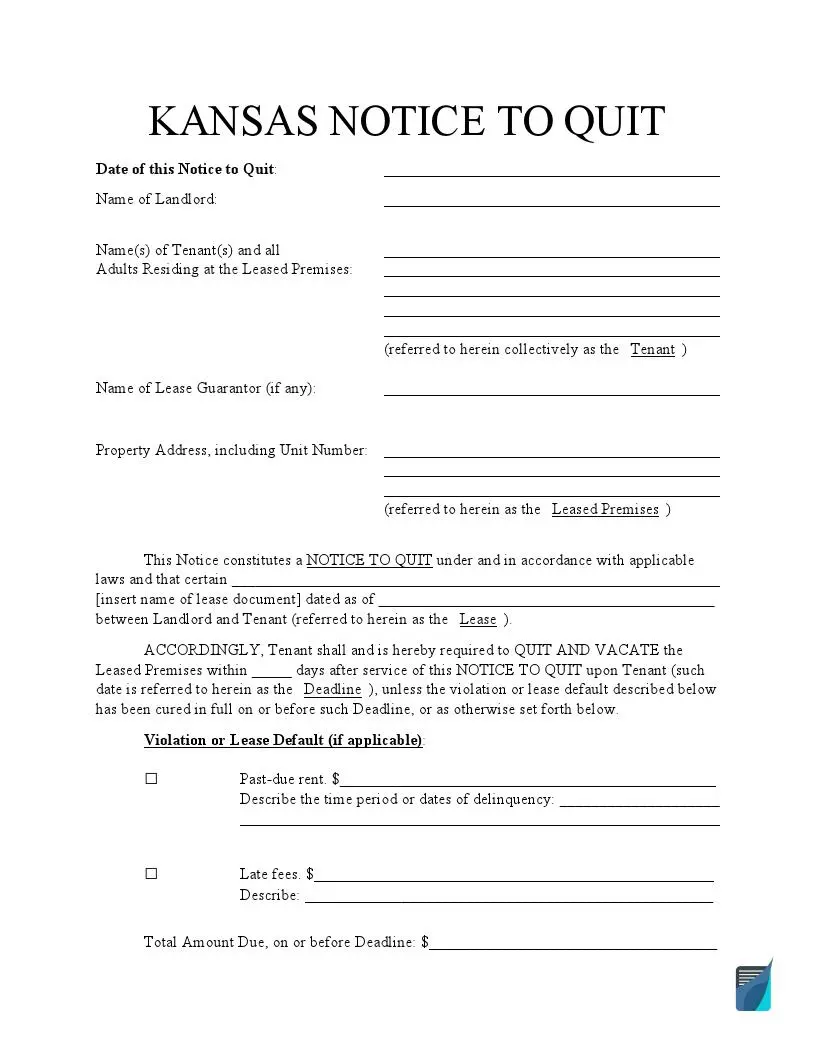
This document is also called a notice to quit, or for unpaid rent, a 3-day notice.
A 3-day eviction notice is the written warning a Kansas landlord must give a tenant when rent is unpaid. State law gives the tenant three days after receiving it to pay the rent in full before the landlord can file for eviction in court. Kansas counts this window as three full 24-hour periods, and if the landlord mails the warning instead of delivering it, the tenant gets two extra days to pay.[1]
The notice may be served on the tenant, on someone over 12 years old residing on the premises, or by posting a copy of the notice in a conspicuous place on the property.[1]
A typical Kansas eviction notice includes the property address, the tenant’s name, the reason for the eviction, and a specific date tied to paying rent, fixing the problem, or moving out. Landlords often keep a signed copy and proof of delivery, since that paperwork protects the landlord’s claim to the property if the eviction process moves to court.
Kansas landlords use different eviction notices depending on why the tenancy is ending. The list below covers each type and the property-recovery timeline that goes with it, as part of the broader Kansas eviction process.[1]
If a tenant does not fix a lease violation or does not leave after the waiting period ends, the landlord may start the Kansas eviction process by filing a case in the local district court. State law does not allow a landlord to remove a tenant from the property without going through the court, no matter the reason.[2]
Self-help evictions are illegal in Kansas. A landlord may not take possession of the rental property by action or otherwise, including turning off electric, gas, water, or another essential service, to pressure a tenant to leave. Only a court order and the county sheriff can carry out an eviction.[2]
The general court process includes:
After the case, the landlord should complete a certificate of service confirming that the required paperwork was properly delivered to the tenant. Keeping this record protects the landlord if any step of the eviction process is later questioned.
Kansas district courts use several standard forms during an eviction case, from the initial petition to the final writ that authorizes the sheriff to remove a tenant. A landlord typically obtains these forms from the district court clerk or the court’s website, and each form plays a specific role in moving the case forward.
The landlord files this form with the district court when the tenant has not paid rent. It opens the court case and asks the court to award the landlord possession of the property along with the rent owed.
The court gives this paperwork to the county sheriff, authorizing the sheriff to remove the tenant from the property once the court decides the case in the landlord’s favor.
This form proves that the landlord properly delivered the notice or court paperwork to the tenant. Courts often require it before moving the case forward.
The judge signs this form after ruling in the landlord’s favor. It documents the court’s decision and gives the landlord the legal right to retake the property.
This form summarizes the type of case being filed and helps the court clerk route the paperwork correctly.
Landlords use this version of the petition when the eviction is based on a lease violation rather than unpaid rent.
This paperwork authorizes the county sheriff to remove the tenant from the property right away, for cases where the court grants immediate possession of the property.
The court issues this form to formally notify the tenant that an eviction case has been filed against them and that they are a party to the case.

General information, not legal or tax advice.
Unless noted otherwise, the sources below are from the Kan. Stat. Ann..
