
A West Virginia eviction notice is a written notice a landlord serves on a tenant to end a tenancy for unpaid rent, a lease violation, or property damage. It comes before the landlord files an eviction case in court. Sending one is optional under state law, but the eviction notice form gives the tenant clear notice of the problem and gives the landlord a paper trail for the hearing.
Last Updated: September 2026. This guide is reviewed and updated regularly to reflect current West Virginia law. If you notice an error or outdated information, please contact us.
Build Your Document
Answer a few simple questions to make your document in minutes
Save and Print
Save progress and finish on any device, download and print anytime
Sign and Use
Your valid, lawyer-approved document is ready
A landlord issues this notice either to end a month-to-month tenancy without cause, or to end a tenancy for a lease violation such as unpaid rent or property damage. Fill out the notice and the later court petition carefully, since the judge reviews both at the hearing.
West Virginia eviction law is set out in W. Va. Code sections 55-3A-1 and 55-3A-3.[1.1] These cover the grounds a landlord may cite and the court process that follows. The statute does not set a pre-suit notice period for every situation. Where the law stays silent, this guide says so directly instead of guessing at a number.
A landlord who wants to remove a tenant must state a reason in the court petition. West Virginia law recognizes three grounds: unpaid rent, a broken warranty or lease term, or property damage.[1.2]
West Virginia's summary eviction statute (W. Va. Code Section 55-3A-1) requires no notice before the landlord files the petition. The tenant is then served with notice of the hearing.[1.3] Still, keeping a copy of any notice sent to the tenant can help a landlord show good faith at the hearing.
Under W. Va. Code Section 37-6-5, a month-to-month tenancy ends without cause on notice given at least one full rental period before the end of a rental period (for a month-to-month tenancy, a full month ending on a period end), unless the lease sets another notice period. A written notice fixes the termination date and helps show good faith if the case reaches court.[3.1]
No law in West Virginia sets a grace period for late rent. The landlord does not have to remind the tenant of the payment deadline. An unpaid rent dispute is handled under the lease terms and, if needed, through the court process below.
| Rent Grace Period | Not specified by statute |
| Notice Before Filing for Nonpayment | Not specified by statute |
| Notice Before Filing for a Lease Violation | Not specified by statute |
| State Laws | West Virginia Code, Sections 55-3A-1 to 55-3A-3 |
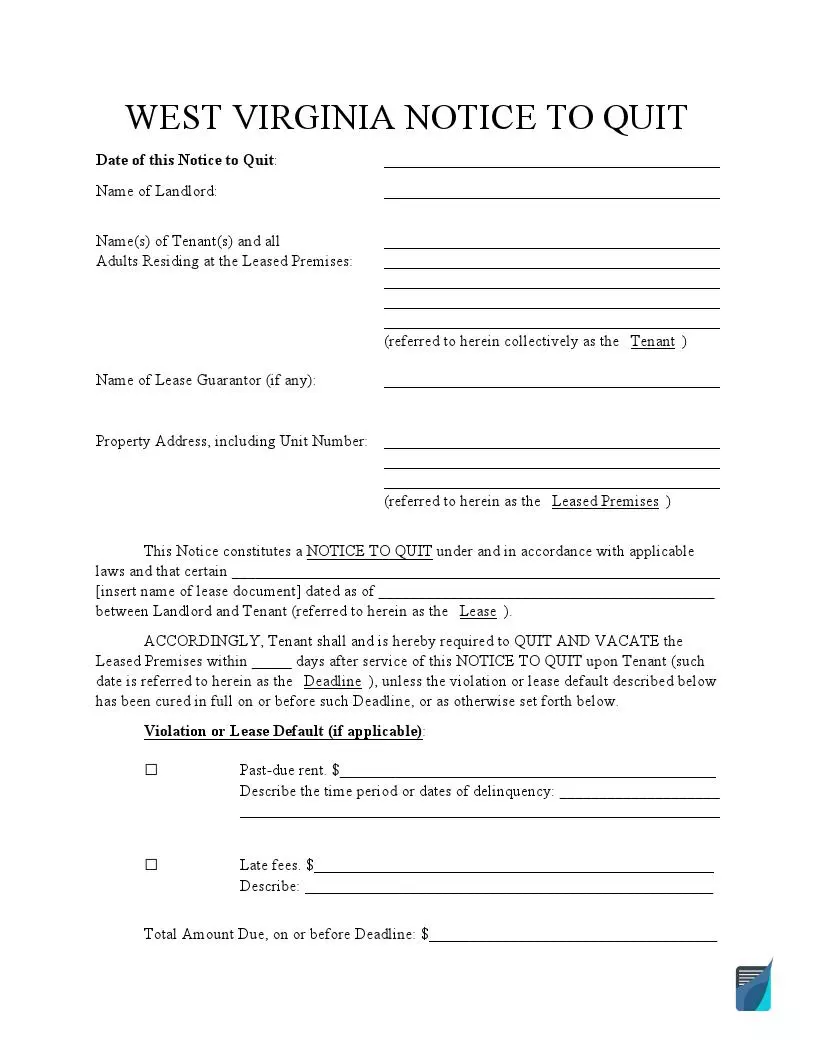
FormsPal offers two versions of this document, matched to why the landlord is ending the tenancy: one for unpaid rent, a broken lease term, or property damage, and one for ending a month-to-month tenancy without cause. Review both below, then pick the one that fits the situation.
Notice for Nonpayment or a Lease Violation
This document tells the tenant the landlord intends to seek possession because of unpaid rent, a broken lease term, or property damage. Describe the reason clearly.[1.2] The later court petition must state the same grounds. Nothing in the statute requires the landlord to accept a late payment or a fix once the notice is sent, though many landlords still do.
Notice of Termination of a Monthly Rental Agreement
A month-to-month rental agreement renews automatically with each rent payment. This makes it convenient for both the landlord and the tenant. When a landlord wants to end this kind of tenancy without a lease violation, this notice works like a lease termination letter. It tells the tenant the date the tenancy will end, so the tenant has time to plan a move.
Popular Local Eviction Notice Forms
A clear notice helps the tenant understand the problem. It also gives the landlord a document to point to if the case goes to court. Whichever type applies, include the details below.
Keep a signed copy and a record of how and when the notice was delivered. That record gives the landlord something concrete to show the judge if the tenant does not respond and the case moves to a hearing. If a deadline in the case is counted in days, a deadline calculator can help confirm the exact date. After downloading the notice, use the FormsPal PDF Editor to fill in the tenant's name, the property address, and the reason for the notice before printing or sending it.
The eviction process runs through the magistrate court or the circuit court of the county where the property is located.[1.1] The landlord files a petition, the court schedules a hearing, the tenant is served notice, and the tenant may file a written defense before the judge decides the case.
A tenant has legal rights at every stage of a West Virginia eviction case, from the notice of hearing through the judge's final order. Knowing them helps a tenant respond on time, and it helps a landlord run a case the court will accept without delay.
These rights come from W. Va. Code Section 55-3A-1, the same statute that sets out the landlord's side of the process.[1.1] A landlord who follows the Eviction Process steps above is also giving the tenant the notice and the hearing state law requires.
A West Virginia eviction case moves on a small set of documents. There is the petition that starts the case, the tenant's answer, and the writ that lets the sheriff carry out the judge's order. Each is described below, in the order the case usually follows.
This is the sworn, or "verified," document the landlord files to start the case. It must state that the tenant is in arrears in rent, has broken a warranty or lease term, or has damaged the property. It must also ask the court for possession.[1.2]
This is the tenant's written defense to the landlord's petition. It may be filed within five days of receiving the notice of hearing.[1.1]
This document directs the sheriff to remove the tenant. It issues once the judge has ordered the landlord back into possession and the deadline in that order has passed.[2]
Yes. State law does not let a landlord remove a tenant without going to court first. A landlord who wants a tenant out must apply to the magistrate court or the circuit court of the county where the property sits, by filing a verified petition.[1.1] A landlord who locks out a tenant, or removes a tenant's belongings without a court order, is acting outside this legal process.

General information, not legal or tax advice.
Unless noted otherwise, the sources below are from the W. Va. Code.
