
A West Virginia bill of sale is a written record of a private sale of personal property such as a vehicle, boat, firearm, or general item. It names the seller and buyer, describes the item, and states the price and date, giving both sides proof of the transaction.
Last Updated: September 2026. This guide is reviewed and updated regularly to reflect current West Virginia law. If you notice an error or outdated information, please contact us.
Build Your Document
Answer a few simple questions to make your document in minutes
Save and Print
Save progress and finish on any device, download and print anytime
Sign and Use
Your valid, lawyer-approved document is ready
You can build a customized West Virginia bill of sale online in about 10 minutes, or download the state’s official form for a vehicle or boat, Form DMV-7-TR.
| Document Name | West Virginia Vehicle Bill of Sale Form |
| Other Names | West Virginia Car Bill of Sale, West Virginia Automobile Bill of Sale |
| DMV | West Virginia Division of Motor Vehicles |
| Bill of Sale Required? | Yes, for private sales priced below 50% of NADA value[2] |
| Avg. Time to Fill Out | 7 minutes |
| # of Fillable Fields | 28 |
West Virginia recognizes several bill of sale forms, one for each kind of property such as a vehicle, boat, firearm, or general item. Each version asks for different details about the item being sold, so using the right one keeps your document valid for its purpose. Pick the type below that matches what you are selling.
A West Virginia bill of sale for a vehicle records the transfer of a car, truck, or motorcycle. It supports the buyer’s title transfer and registration application with the West Virginia DMV.
| Alternative Name | Car Bill of Sale |
| Seller’s Signature | Required |
| Buyer’s Signature | Required |
| Notarization | Required |
| Download | PDF Template |

A West Virginia bill of sale for a boat records the sale of a boat or personal watercraft and supports the buyer’s registration of the vessel with the state. A motorboat must be titled, and its registration runs on a three-year cycle. The DMV asks for a notarized bill of sale in some cases, for example when the purchase price is under 50% of book value, and otherwise for the assigned title.[4.1]
| Alternative Name | Vessel Bill of Sale |
| Seller’s Signature | Required |
| Buyer’s Signature | Required |
| Notarization | Required |
| Download | PDF Template |

A West Virginia firearm bill of sale records the private transfer of a firearm between a seller and a buyer, including a description of the firearm and the price paid.
| Alternative Name | Gun Bill of Sale |
| Seller’s Signature | Required |
| Buyer’s Signature | Required |
| Notarization | Optional |
| Download | PDF Template |

A West Virginia general bill of sale covers most other personal property sales, such as trailers, equipment, or livestock.
| Alternative Name | Generic Bill of Sale |
| Seller’s Signature | Required |
| Buyer’s Signature | Required |
| Notarization | Optional |
| Download | PDF Template |
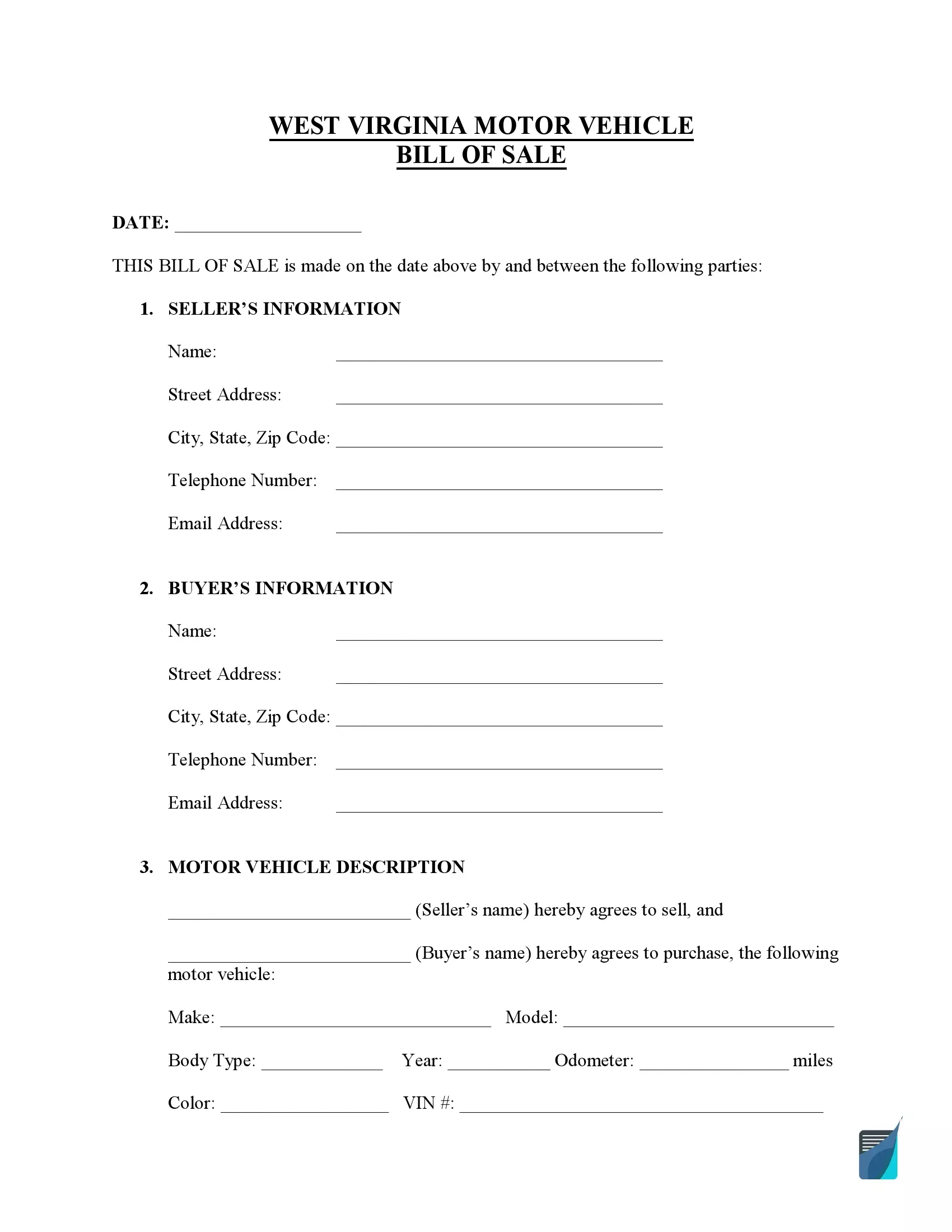
West Virginia’s motor vehicle bill of sale form asks for the seller’s and buyer’s information, a description of the vehicle, the purchase price, and signatures. This guide walks through each section in order, from the top of the form to the notary acknowledgment.
Step 1: Enter the date
At the top of the form, enter the date you are making the bill of sale.
Step 2: Enter the seller’s information
Fill in the seller’s contact details:

Step 3: Enter the buyer’s information
Fill in the buyer’s contact details:

Step 4: Describe the vehicle
Enter the vehicle’s details:

Step 5: Enter the purchase date and price
Enter the date of the sale and the total purchase price.

Step 6: Select how the price is paid
Choose one:
Step 7: Select the payment form and taxes
Choose the payment form, cash, check, cashier’s check, or money order, and mark whether taxes are included in the price.
Step 8: Review the miscellaneous provisions
Read the as-is sale, no-warranties, and entire-agreement clauses before you sign.
Step 9: Sign the bill of sale
The seller and buyer each sign, print their name, and date the form. A witness also signs, prints their name, and dates the form.

Step 10: Notarize the form when the price is below 50% of NADA value
West Virginia requires the bill of sale to be notarized in one case. The vehicle must be bought from a private individual at a price below 50% of the current NADA Clean Loan Book value.[2]

The bill of sale form could be requested during title transfer, so the buyer needs to keep the original. Prepare and sign two identical documents, or make a copy for the seller to keep.
West Virginia requires the buyer to file the bill of sale with the Department of Transportation (DOT) as part of vehicle registration. This applies to a private sale and to a new state resident registering a vehicle to drive on West Virginia roads. File it together with the other registration documents listed below.
Registering the vehicle in West Virginia also typically calls for:
Registering the vehicle includes a title fee, a 6% titling sales tax when the net purchase price is over $500 (a flat tax applies when the net price is under $500), and a lien recording fee when a lender holds a lien on the vehicle.[2.1]
Otherwise, the tax deduction is calculated from the value NADA assigns to that vehicle type.
Joint ownership on the title. If the seller is a joint owner listed with “or,” the surviving owner can complete the sale alone. The owner signs as seller and fills out the purchaser section to title the vehicle in the new owner’s name.[2]
If the seller is a joint owner listed with “and,” two signatures are required. The surviving owner signs, and an executor, administrator, or legal heir signs on behalf of the deceased owner.[2]
West Virginia’s odometer disclosure rule requires the mileage statement to be marked as actual mileage, not actual mileage, or mileage exceeds mechanical limits. A reading known to differ from the vehicle’s true mileage may not be represented as its actual mileage.[2]
When you transfer or assign the title, endorse the assignment and warranty of title on the certificate of title. Include a statement of all liens and encumbrances, verified under oath by the owner. Then deliver the certificate to the buyer within 60 days of the sale (count the deadline with our deadline calculator).[1.2]
If a lender holds a lien on the vehicle, the seller needs an electronic lien release from the lienholder. Once West Virginia’s DMV receives that release, it issues a new title free of the lien to the vehicle’s owner at no extra charge.[3]
A notarized bill of sale is required in West Virginia in one case. You are buying a vehicle from a private individual at a price below 50% of the current NADA Clean Loan Book value.[2] In practice, many buyers and sellers notarize the document anyway, since it adds proof if a dispute over the sale comes up later.
For cases when the vehicles are purchased privately from individuals, and their actual purchase price is above the one set by NADA, the tax deduction is calculated from that sum. All used vehicles that are two years old and less are taxed based on the value established by NADA, regardless of the price indicated in the notarized bill of sale.
A gifted vehicle or one transferred to satisfy a lien is still subject to the 6% titling sales tax. To register a gifted vehicle, the new owner submits Form DMV-5-TR, the Affidavit of Transfer of Ownership Without Consideration.
Form DMV-1B or Verification of Vehicle Identification Number is used by a law enforcement officer to examine and verify the vehicle identification number (VIN).

Form DMV-5-TR is known as Affidavit of Transfer of Ownership Without Consideration and used to prove that the vehicle is transferred for no consideration, monetary or otherwise.

A motor vehicle power of attorney, known as Form DMV-9-TR, allows to appoint a representative to handle the matters related to the vehicle.

Application for Concealed Pistol/Revolver License

Application for Provisional Concealed Pistol/Revolver License


Other West Virginia Forms
A West Virginia bill of sale is a signed record of a private sale of property such as a vehicle, boat, firearm, or general item. It lists the seller, the buyer, the item, the price, and the date, and it serves as proof of the transaction if a question about ownership comes up later.
General information, not legal or tax advice.


