
Updated:
An acknowledgment form is a notary's certificate identifying who signed a document. The certificate confirms who signed, not that the document is true or valid. Pick your state below for its wording, or create a notary acknowledgement form online.
A notary acknowledgement form is the certificate a notary completes when a signer acknowledges a signature. It records what the notary confirmed, so a reader can see who appeared, where and when. The certificate is written on the document or attached to it as a separate page.
The acknowledgment itself is the signer's statement. Illinois law defines it as a declaration by a person that the person has executed an instrument for the purposes stated in it (5 ILCS 312/6-101(b)). Nevada uses the same definition and adds that, if the instrument is executed in a representative capacity, the person signed it with proper authority (Nev. Rev. Stat. § 240.002). New Jersey adds that the declaration is made before a notarial officer (N.J.S.A. 52:7-10.1).
A notary public is a person commissioned under state law to verify the signing of documents. Documents commonly notarized include a power of attorney, deeds and affidavits. Whether a document must be notarized depends on the document and the state.
A notary acknowledgement form lists where and when the act took place, who acknowledged the signature and which officer took the acknowledgment. Most state forms include:
Some states spell out these parts in their statutes:
A stamp or seal rule decides what the notary adds next to the signature. Several of the rules below apply only to paper, or tangible, records:
| State | Stamp or seal rule | Citation |
|---|---|---|
| Arkansas | The notary provides a seal of office in blue or black ink, by rubber stamp or embosser, under or near the official signature on every notary certificate | Ark. Code Ann. § 21-14-107 |
| Colorado | An official stamp is affixed to the certificate when a notary public performs the act on a tangible record | Colo. Rev. Stat. § 24-21-515 |
| Delaware | An official stamp is affixed to or embossed on the certificate when a notary public performs the act on a tangible record | 29 Del. C. § 4328 |
| Texas | The officer makes and signs the certificate and seals it with the seal of office | Tex. Civ. Prac. & Rem. Code § 121.004(b) |
| Virginia | On a paper document, a sharp, legible, permanent and photographically reproducible image of the official seal goes near the notary's signature | Va. Code Ann. § 47.1-16(C) |
| Washington | An official stamp is affixed to or embossed on the certificate when a notary public performs the act on a tangible record | Wash. Rev. Code § 42.45.130 |
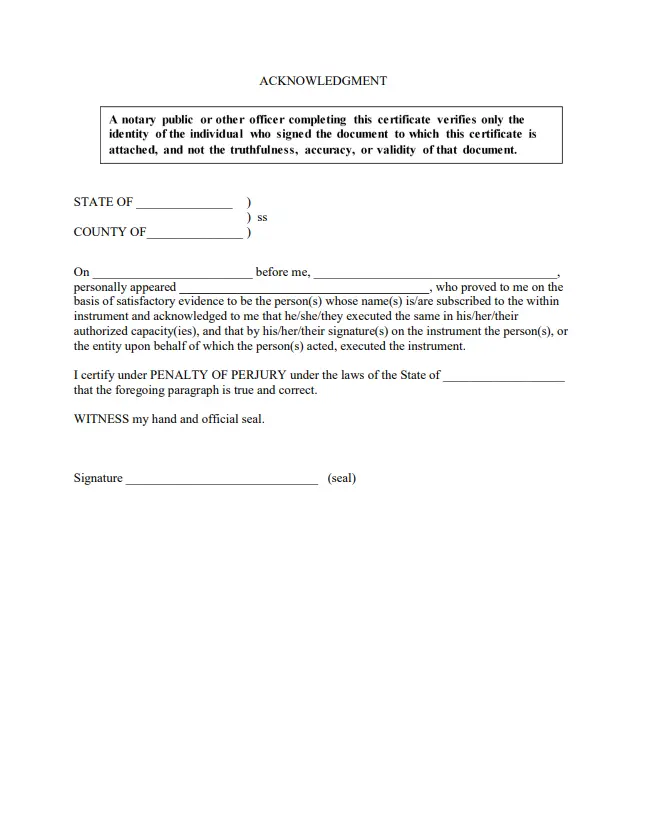
The notary acknowledgement table below names, for each state in our sources, the statute section that holds its acknowledgment form. Wording differs by state, so use the certificate wording of the state where the notarization happens.
A short form the statute calls "sufficient" counts for its purpose when completed as the statute says: Colorado's short forms, for example, are sufficient if completed with the information its certificate section requires (Colo. Rev. Stat. § 24-21-516(1)). In Alaska, Florida, Nebraska and Virginia, the statute adds that its forms do not preclude the use of other forms (Alaska Stat. § 09.63.100; Fla. Stat. § 695.25; Neb. Rev. Stat. § 64-206; Va. Code Ann. § 55.1-621).
| State | What the statute sets out | Citation |
|---|---|---|
| Alabama | Forms to be used, substantially, on conveyances and instruments admitted to record | Ala. Code § 35-4-29 |
| Alaska | Forms that may be used and are sufficient; other forms not precluded | Alaska Stat. § 09.63.100 |
| Arizona | Short forms for individual and representative capacity, sufficient if completed with the information the statute requires | Ariz. Rev. Stat. § 41-265 |
| California | A certificate taken in California shall be in the statute's form, with the identity notice in a box at the top | Cal. Civ. Code § 1189 |
| Colorado | Short form certificates, sufficient if completed with the information the statute requires | Colo. Rev. Stat. § 24-21-516 |
| Connecticut | The officer endorses or attaches a certificate substantially in one of the statute's forms | Conn. Gen. Stat. § 1-34 |
| Delaware | Form for an acknowledgment in an individual capacity | 29 Del. C. § 4329 |
| District of Columbia | Short form certificates, sufficient if completed with the information the code requires | D.C. Code § 1-1231.15 |
| Florida | Forms that may be used and are sufficient, with a box for physical presence or online notarization; other forms not precluded | Fla. Stat. § 695.25 |
| Hawaii | An acknowledgment endorsed, subjoined or attached in the form the statute provides or authorizes | Haw. Rev. Stat. § 502-41 |
| Idaho | Form for an individual capacity, completed with the information the statute requires | Idaho Code § 51-116 |
| Illinois | Short form certificates, sufficient for the purposes indicated | 5 ILCS 312/6-105 |
| Iowa | Short form certificates, sufficient if completed with the information the statute requires | Iowa Code § 9B.16 |
| Kansas | Short form certificates, sufficient if completed following the procedures for a notarial act | Kan. Admin. Regs. § 7-43-17 |
| Kentucky | Form for an individual acting in his own right | Ky. Rev. Stat. § 423.160 |
| Louisiana | Form beginning with a caption naming the state and place | La. Rev. Stat. § 35:511 |
| Maine | Form for an individual capacity, completed with the information the statute requires | Me. Rev. Stat. tit. 4, § 1917 |
| Maryland | Short form certificates, sufficient if completed with the information the statute requires | Md. Code, State Gov't § 18-216 |
| Massachusetts | The notary uses substantially the statute's form, for signers acting for themselves or in a representative capacity | Mass. Gen. Laws ch. 222, § 15 |
| Minnesota | Short form certificates, sufficient if completed with the information the statute requires | Minn. Stat. § 358.66 |
| Mississippi | Long forms that may be used for conveyances or other instruments affecting real or personal property | Miss. Code Ann. § 89-3-7 |
| Missouri | The notary uses a certificate substantially in the statute's form, for a person acting on their own behalf or in a representative role | Mo. Rev. Stat. § 486.750 |
| Montana | Short-form certificates, sufficient if completed with the information the statute requires | Mont. Code Ann. § 1-5-610 |
| Nebraska | Form for an individual acting in his or her own right; other forms not precluded | Neb. Rev. Stat. § 64-206 |
| Nevada | Short form for an acknowledgment in an individual capacity | Nev. Rev. Stat. § 240.166 |
| New Hampshire | Form for an individual capacity, completed with the information the statute requires | N.H. Rev. Stat. Ann. § 456-B:8 |
| New Jersey | Short form certificates, sufficient if the statute's certificate requirements are met | N.J.S.A. 52:7-10.12 |
| New Mexico | Short-form certificates, sufficient if completed with the information the statute requires | N.M. Stat. Ann. § 14-14A-15 |
| New York | For an instrument on real property in New York acknowledged in the state, the certificate must conform substantially to the statute's form | N.Y. Real Prop. Law § 309-a |
| North Dakota | Short form certificates, sufficient if completed with the information the statute requires | N.D.C.C. § 44-06.1-19 |
| Ohio | Forms that may be used and are sufficient under any section of the Revised Code | Ohio Rev. Code Ann. § 147.55 |
| Oklahoma | Form for an acknowledgment in an individual capacity | Okla. Stat. tit. 49, § 119 |
| Oregon | Short form certificates, sufficient if completed with the information the statute requires | Or. Rev. Stat. § 194.285 |
| Pennsylvania | Short form certificates, sufficient if completed with the information the statute requires | 57 Pa.C.S. § 316 |
| South Carolina | Form for an individual acting in his own right | S.C. Code Ann. § 26-3-70 |
| South Dakota | Form for a certificate of acknowledgment by individuals | S.D. Codified Laws § 18-5-8 |
| Tennessee | The officer writes upon or annexes to the instrument the statute's certificate, stating the officer's capacity | Tenn. Code Ann. § 66-22-107 |
| Texas | An ordinary certificate must be substantially in the statute's form; short forms for natural persons, attorneys-in-fact, corporations and LLCs | Tex. Civ. Prac. & Rem. Code § 121.007; Tex. Civ. Prac. & Rem. Code § 121.008 |
| Utah | A correctly completed certificate (the statute calls it an affidavit) in substantially the statute's form, included in or attached to the document, is sufficient | Utah Code § 46-1-6.5 |
| Vermont | Short-form certificates, sufficient if completed with the information the statute requires | 26 V.S.A. § 5368 |
| Virginia | Form for an individual acknowledgment; other forms not precluded | Va. Code Ann. § 55.1-621 |
| Washington | Short forms, completed with the information the statute requires | Wash. Rev. Code § 42.45.140 |
| West Virginia | Short form certificates, sufficient if completed with the information the statute requires | W. Va. Code § 39-4-16 |
| Wisconsin | Form for an acknowledgment in an individual capacity | Wis. Stat. § 140.16 |
| Wyoming | Form for an acknowledgment in an individual capacity | Wyo. Stat. Ann. § 32-3-115 |
To fill out a notary acknowledgement form, choose your state's wording, finish the document, and bring it unsigned with the whole certificate left blank, venue and name included. The steps below follow that order.
A completed notary acknowledgement shows the state and county, the date of the act, the signer's name and the notary's signature, stamp, title and commission date, all filled in on one certificate. The example below fills in Colorado's short form for an individual capacity (Colo. Rev. Stat. § 24-21-516) with made-up names.
Example, not a real certificate:
State of Colorado
County of Larimer
This record was acknowledged before me on June 4, 2026 by Jordan A. Ellis.
[signature] Signature of notarial officer
[stamp] Stamp
Notary Public, Title of office
My commission expires: March 9, 2029
Other states order these items differently and some add lines, such as Florida's line for the type of identification produced (Fla. Stat. § 695.25). Copy the layout of your own state's form rather than this example.
When someone signs for another person or an entity, as an officer, trustee, partner or attorney-in-fact, many states use a representative-capacity form that names who the signer acts for. The signer's role decides which version of the acknowledgment you need.
New York sets who may acknowledge for a corporation. A corporation's acknowledgment of a conveyance or other instrument must be made by an officer or a duly appointed attorney in fact, and for a dissolved corporation also by a director, authorized to execute it (N.Y. Real Prop. Law § 309).
An acknowledgment confirms that the signer is who they claim and that the signature is theirs, while a jurat adds an oath or affirmation that the contents of the document are true. An acknowledgment certificate says the document was "acknowledged before me." A jurat says it was "signed and sworn to (or affirmed) before me," because the signer took an oath.
Notaries perform several kinds of notarial acts, and the right one depends on the document and what it asks of the signer. The table shows each act with statute wording from our sources.
| Notarial act | What the signer does | Certificate wording | Citation |
|---|---|---|---|
| Acknowledgment | Confirms the signature is theirs | "This record was acknowledged before me on (date) by (name)" | Colo. Rev. Stat. § 24-21-516 |
| Jurat (verification on oath or affirmation) | Swears or affirms the contents are true | "Signed and sworn to (or affirmed) before me on (date) by (name)" | Miss. Code Ann. § 89-3-7(2)(c) |
| Signature witnessing | Signs in front of the notary | A Utah form in which the signer personally appeared, proved identity and signed | Utah Code § 46-1-6.5 |
| Copy certification | Brings an original for the notary to compare | "I certify that this is a true and correct copy of a (document) in the possession of (name)" | 57 Pa.C.S. § 316 |
California's jurat uses "Subscribed and sworn to" and carries the same identity notice as its acknowledgment (Cal. Gov. Code § 8202). A false sworn statement can be treated as perjury.
An oath is sworn, while an affirmation is a solemn promise made on one's honor. Both have the same effect, and the signer chooses which one to take.
A notary confirms who signed, not that the document is true or valid.
To get a proper notarization, prepare the document and find a commissioned notary. Then appear before the notary with a current government photo ID and let the notary complete and sign the certificate. If you are unsure which notarial act your document needs, ask the office that requested it. Prefer not to travel? You can also notarize your document online with FormsPal: you sign on a short video call with a US commissioned notary.
In Pennsylvania, if a notarial act relates to a signature executed on a record, the person who signed shall appear personally before the notarial officer (57 Pa.C.S. § 306). A Florida certificate records whether the signer appeared by physical presence or by audio-video communication technology (Fla. Stat. § 117.05(4)(c)).
Besides Florida above, these states in our sources set remote notarization rules, each with its own condition (the list gives examples, not every state that allows it):
The notary identifies each signer and checks that they are signing willingly. In Illinois, the notary must determine, from personal knowledge or satisfactory evidence, that the person appearing and making the acknowledgment is the person whose true signature is on the instrument (5 ILCS 312/6-102(a)). In New York, an acknowledgment must not be taken unless the officer knows or has satisfactory evidence that the person making it is the person described in and who executed the instrument (N.Y. Real Prop. Law § 303). Ohio sets the same test for a notary who takes an acknowledgment (Ohio Rev. Code § 147.49(A)).
The notary checks who the signer is and, in many states, may refuse to act when the signer seems pressured or confused. In Arkansas, a notary public may refuse to perform a notarial act for any reason, including when the principal does not appear to understand the transaction or to act of their own free will (Ark. Code Ann. § 21-14-107).
Ask about the fee and which ID the notary accepts before the appointment.
These answers cover what a notary charges, handwritten documents, all-purpose forms, adding a notary block to a document, certified copies and when the signer signs. Rules differ by state, so check the details where the notarization happens.
Each state sets or limits what a notary may charge, so the cost varies. It also depends on the number of signatures or notarial acts. In South Carolina, a notary who charges a fee shall display a schedule of fees in the place of business or present it to each principal outside it (S.C. Code Ann. § 26-1-100). Ask for the total before the appointment.
Yes, a handwritten document can usually be notarized. Notarization does not make a document valid, and a court or other proper authority decides that. The notary only certifies who signed and that the signer acknowledged the signature. The notary's certificate is written on the document or attached to it.
No, California fixes the wording: a certificate of acknowledgment taken in California shall be in the form of Cal. Civ. Code § 1189. Alaska, Florida, Nebraska and Virginia, by contrast, say their forms do not preclude the use of other forms (Alaska Stat. § 09.63.100; Fla. Stat. § 695.25; Neb. Rev. Stat. § 64-206; Va. Code Ann. § 55.1-621). Use the form of the state where the notarization happens.
Paste your state's certificate wording below the signature lines, or on a page right after the document, and leave the notary's lines blank. Tennessee's statute, for one, has the officer write the certificate upon the instrument or annex it to the instrument (Tenn. Code Ann. § 66-22-107). Keep the notary's signature, stamp and date lines empty for the notary to complete.
The holder brings the original to the notary, who compares it with the copy and certifies it. Pennsylvania and Utah give a copy certification form (57 Pa.C.S. § 316; Utah Code § 46-1-6.5). Not every state lets notaries certify copies, and copies of public records such as birth certificates normally come from the office that keeps them.
The answer depends on the state where the notarization happens. In Illinois, an acknowledgment is a declaration by a person that the person has executed an instrument for the purposes stated in it (5 ILCS 312/6-101(b)). South Carolina's definition, though, includes that the individual signed the record in the physical presence of the notary (S.C. Code Ann. § 26-1-5(1)). Ask the notary before you sign.
Start with places you already use: your bank or credit union, shipping and office stores, or law and real estate offices. Mobile notaries travel to you, and remote online notaries work where the state allows it. Ask about the fee and which ID the notary accepts before the appointment.
General information, not legal or tax advice.
