
Free Georgia Notary Acknowledgement Form

A Georgia notary acknowledgement is a written certificate in which a notary public records that a signer confirmed signing before the notary. The state's law, in O.C.G.A. § 45-17-8, lists what a notary may do, including taking acknowledgments, and requires the notary to confirm the signer's identity.[1] This free Georgia form gives you the certificate wording to fill in online or download. It is the notary's certificate, not the document you are signing.

Last Updated: October 2026. This guide is reviewed and updated regularly to reflect current Georgia law. If you notice an error or outdated information, please contact us.
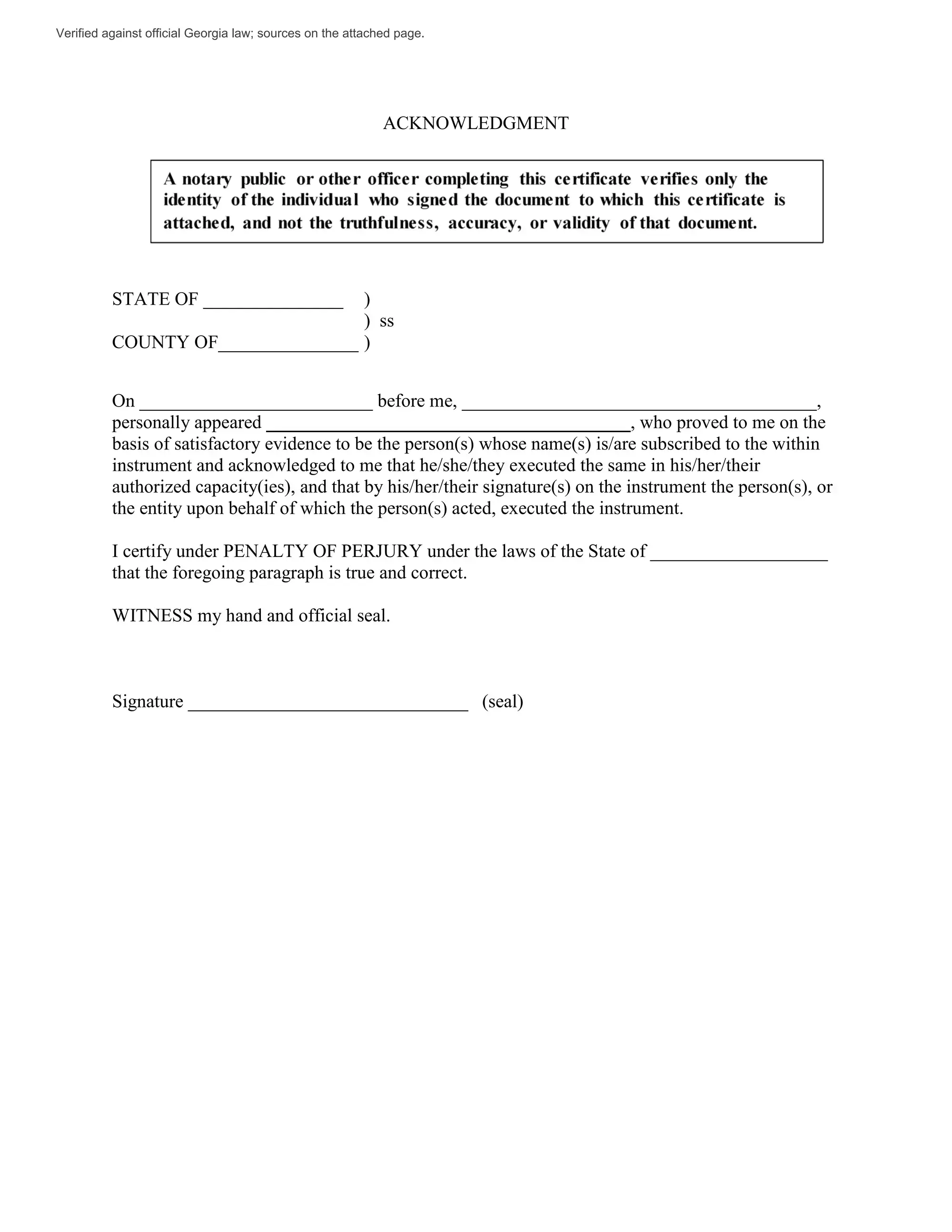
Georgia notary acknowledgement form preview

Create a Personalized Georgia Notary Acknowledgement Form online in under 5 minutes!

Build Your Document

Answer a few simple questions to make your document in minutes

Save and Print

Save progress and finish on any device, download and print anytime

Sign and Use

Your valid, lawyer-approved document is ready

Download the Georgia Notary Acknowledgement: PDF or Word (.docx) or OpenDocument (.odt)

What Does the Georgia Notary Acknowledgment Statute Require?

When a Georgia notary notarizes a document, the notary must sign the certificate by hand in ink. The notary signs only and exactly the name on the notary's commission and records the exact date on the certificate.[2] The rule is in O.C.G.A. § 45-17-8.1(a). These are the requirements for the notary, and the statute's own words are below.

Except as otherwise provided in this Code section, in documenting a notarial act, a notary public shall sign on the notarial certification, by hand in ink, only and exactly the name indicated on the notary's commission and shall record on the notarial certification the exact date of the notarial act.

O.C.G.A. § 45-17-8.1(a)

The date rule has one exception. It does not apply to an attestation of deeds or any other instruments pertaining to real property.[2]

Georgia law also sets limits on what a notarial certificate may say and what the notary's signature proves:

  • A notary may not execute a certificate that contains a statement the notary knows to be false.
  • A notary may not perform any action with an intent to deceive or defraud.
  • A notary's signature is not evidence that the notary had knowledge of the contents of the document. The only exceptions are the contents that make up the notarization itself, such as the signature, execution, acknowledgment, oath, affirmation, affidavit or verification.
  • A notary's certification that a document is a true copy is not evidence that the notary knew its contents either.[1]

Georgia has no statute that sets the wording of an acknowledgment certificate. It also has none for a certificate used by someone signing for a company or another person, or for a verification on oath or affirmation. The certificate on this page is a general acknowledgment wording that you fill in as the steps below describe.

How to Notarize a Document in Georgia

Getting a document notarized in Georgia usually takes one short visit to a notary public. The steps below walk you through that visit. The next section shows how the acknowledgment form itself is filled in.

  1. Choose a notary in Georgia. Many banks, credit unions and shipping stores have a notary on staff. Pick a notary who has no part in your document. A Georgia notary is disqualified when the notary signs the document or is a party to the document or transaction.[1]
  2. Check the document, but wait to sign. Read the document before the visit and fix any mistakes. Many notaries prefer to watch you sign, so leave the signature lines blank unless the notary tells you otherwise.
  3. Bring a government issued photo ID. A Georgia notary confirms the signer's identity by checking a government issued photo ID, such as a valid driver's license, or from personal knowledge.[1] Anyone else who signs the document should come with you and bring an ID too.
  4. Acknowledge your signature. Sign in front of the notary if you have not signed yet, and confirm that the signature on the document is yours.
  5. Let the notary complete the certificate. The notary signs the certificate by hand in ink, using exactly the name on the notary's commission, and records the exact date of the notarization.[2]
  6. Pay the fee and take your papers. Notaries usually charge a fee for their service, so ask about it when you call. Leave with the original document and the completed acknowledgment, and give both to the office that asked for the notarization.

How Do You Fill In the Georgia Notary Acknowledgment Template?

The FormsPal template is a one-page acknowledgment certificate. You fill in the blanks on screen or in print, and the notary completes the certificate. The step below follows the page from top to bottom, so fill in the blanks in the order they appear. You can fill in the downloaded PDF with our online PDF editor.

The screenshots under each step show the FormsPal Georgia notary acknowledgement template filled with sample entries in blue, so you can see where each answer goes. The names, addresses, dates and amounts are examples only.
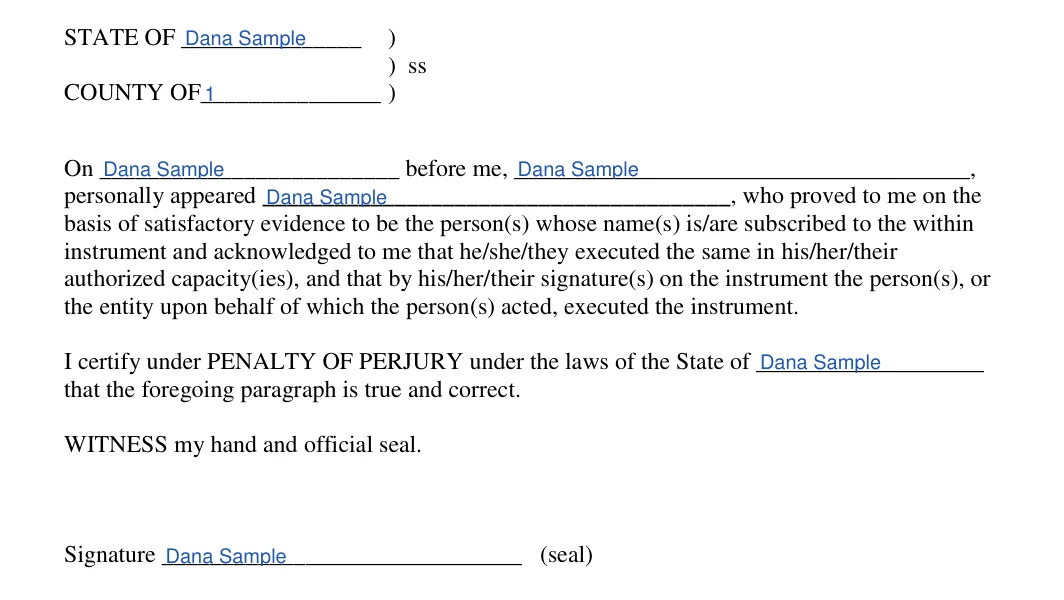
  1. Complete the Georgia notary acknowledgment. On page 1, enter the STATE OF and COUNTY OF lines, then the date after "On", the notary's name after "before me," and the signer's name after "personally appeared." Fill in the state in the penalty-of-perjury sentence. The form ends at "WITNESS my hand and official seal." The notary signs on the Signature line next to the (seal) mark.
    Georgia notary acknowledgement: Notary acknowledgement ga.1.state of, Notary acknowledgement ga.2.county of and more, filled with sample entries
    Step 1: sample entries, not a real document.

Write Georgia on the STATE OF line and the county where the signing takes place on the COUNTY OF line. Print the page or save the PDF when the blanks are filled, and bring it to the notary together with the document you are signing.

Frequently Asked Questions

These answers cover what a Georgia notary may do, when a notary may say no, and how a notary identifies the signer. They come from the state statute O.C.G.A. § 45-17-8 and apply to the FormsPal template on this page. They do not cover other notary forms.

What can a notary do in Georgia?

Under Section 45-17-8 of the O.C.G.A., a Georgia notary public has authority to do the following.[1]

  • Witness or attest the signature or execution of deeds and other written instruments
  • Take acknowledgments
  • Administer oaths and affirmations in all matters incidental to their duties as commercial officers, and all other oaths and affirmations that the law does not require a particular officer to administer
  • Witness affidavits upon oath or affirmation
  • Take verifications upon oath or affirmation
  • Make certified copies, if the document presented is an original that is neither a public record nor a publicly recorded document with certified copies available from an official source other than a notary, and the notary supervised the photocopying
  • Perform other acts that other Georgia laws authorize

Can a notary in Georgia refuse to notarize a document?

Yes. Under Section 45-17-8 of the O.C.G.A., no notary has to perform a notarization the notary feels is:

  • For a transaction the notary knows or suspects is illegal, false or deceptive
  • For a person who is being coerced
  • For a person whose demeanor causes compelling doubts about whether the person knows the consequences of the transaction
  • In a situation that compromises the notary's impartiality[1]

Must a notary in Georgia keep a journal of notarial acts?

Yes, for notarial acts done at the request of a self-filer. A Georgia notary must keep a written or electronic journal with an entry for each of those acts. Each entry includes:

  • The self-filer's name, address and telephone number
  • The date, time and location of the notarization
  • The type of government-issued photo identification the self-filer showed, unless the notary confirmed the identity from personal knowledge, plus its elements such as the identifying number
  • The self-filer's signature
  • The type of document presented for notarization[1]

How must a notary in Georgia verify the identity of a signer?

When notarizing, a Georgia notary must confirm the identity of the document signer, oath taker or affirmant. The notary does that by checking a government-issued photo identification document. Examples are a valid driver's license, an identification card authorized under Code Sections 40-5-100 through 40-5-104, or a military identification card such as a Veterans Health Identification Card issued by the United States Department of Veterans Affairs. The notary may also rely on personal knowledge.[1]

Can a notary in Georgia notarize a document the notary signed?

No. A Georgia notary is disqualified from performing a notarization when the notary is a signer of the document to be notarized. The same is true when the notary is a party to the document or transaction for which the notarization is required. The law treats both situations as compromising the notary's impartiality.[1]

General information, not legal or tax advice.

Sources

Unless noted otherwise, the sources below are from the O.C.G.A.

  1. O.C.G.A. § 45-17-8.
  2. O.C.G.A. § 45-17-8.1(a).
Published: Jun 13, 2022
Mara Erlach
Mara Erlach
Writer & Attorney
Mara has been practicing estate planning and trust law in California since 2003, taking pride in helping clients of all backgrounds and asset profiles form a complete and customized estate plan. Her specialties are: estate planning, wills and trusts, trust and probate administration.