
An Arizona notary acknowledgement is a written certificate in which a notary public confirms that a person acknowledged a signed document before them. Arizona law sets out short form certificates, and one completed in that form is sufficient for the purpose it indicates.[1] This free Arizona notary acknowledgement form gives you that wording to fill in online or download. It is the notarial certificate, not the document you are signing.
Last Updated: October 2026. This guide is reviewed and updated regularly to reflect current Arizona law. If you notice an error or outdated information, please contact us.
Build Your Document
Answer a few simple questions to make your document in minutes
Save and Print
Save progress and finish on any device, download and print anytime
Sign and Use
Your valid, lawyer-approved document is ready
A notary public in Arizona finds the certificate wording in Ariz. Rev. Stat. § 41-265. The section says the short form certificates it lists are sufficient for the purposes indicated, if they are completed with the information that section 41-264, subsections A and B, require.[1] The statute's own words are below.
The following short form certificates of notarial acts are sufficient for the purposes indicated, if completed with the information required by section 41-264, subsections A and B:
Section 41-265 lists six notarial certificates. Each one opens with the state and county. The table shows what each one is for.
| Certificate | Used when | What the wording says |
|---|---|---|
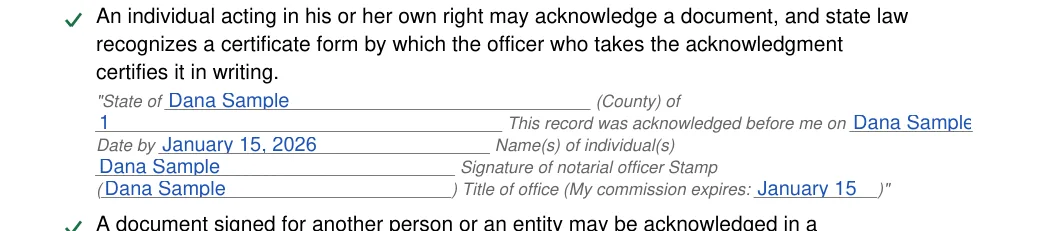
| Individual acknowledgment | A person acknowledges a document in his or her own right. | The document was acknowledged before the officer on a stated date by the named individual. |
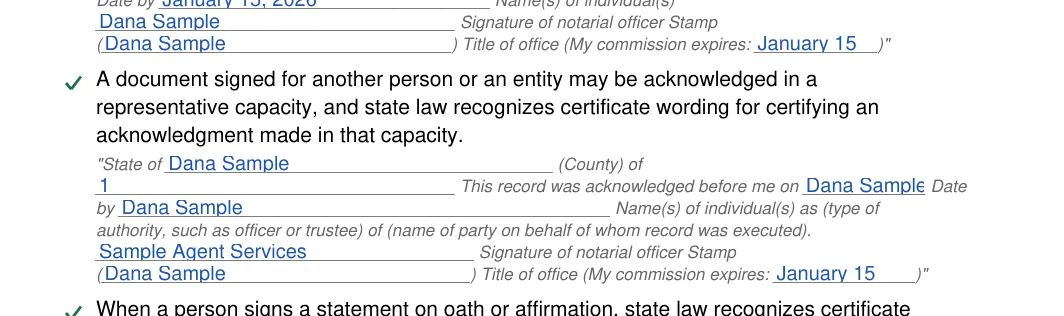
| Representative acknowledgment | A document is signed for another person or an entity. | The same wording, plus the type of authority (such as officer or trustee) and the party on whose behalf the document was executed. |
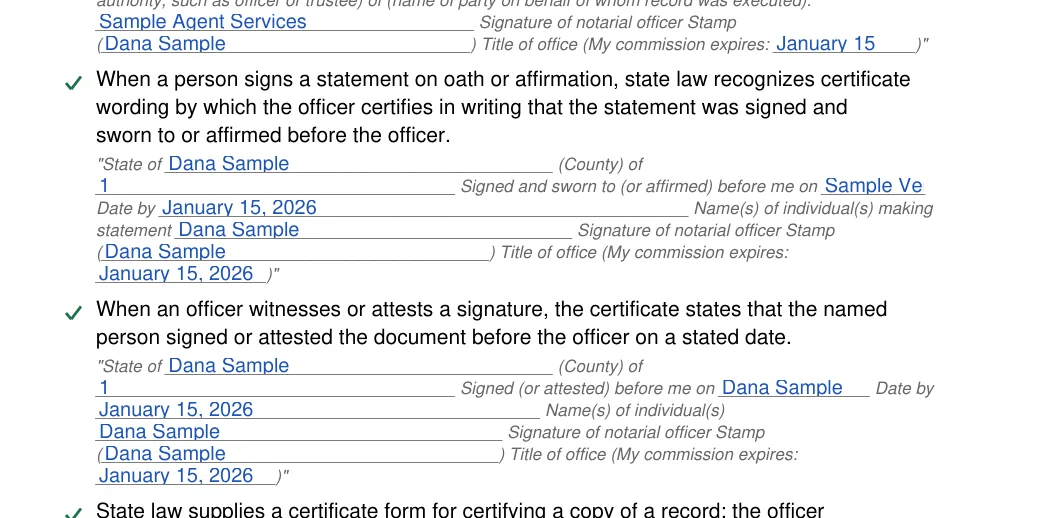
| Verification on oath or affirmation | A person signs a statement on oath or affirmation. | The statement was signed and sworn to (or affirmed) before the officer on a stated date. |
| Witnessing or attesting a signature | An officer witnesses or attests a signature. | The named person signed or attested the document before the officer on a stated date. |
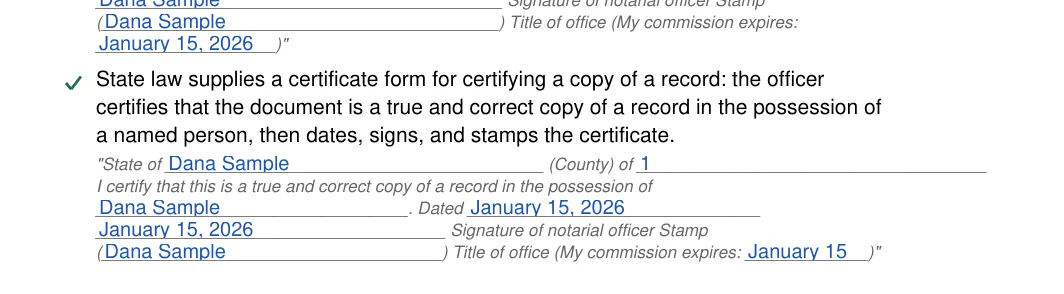
| Certifying a copy | A copy of a document needs certifying. | The document is a true and correct copy of the original held by a named person. |
| Certifying a tangible copy of an electronic record | A paper copy of an electronic record needs certifying. | The copy, identified by its title, date and number of pages, is an accurate copy of the electronic record. |
Pick the certificate that matches what you are asking the notary to do. An acknowledgment, a sworn statement, a witnessed signature and a certified copy each have their own wording.[1]
The notary block closes every one of these certificates. In the statute's wording it has four parts:
Getting a document notarized in Arizona usually takes one short visit to a notary public. The steps below walk you through that visit. The next section shows how the acknowledgment form itself is filled in.
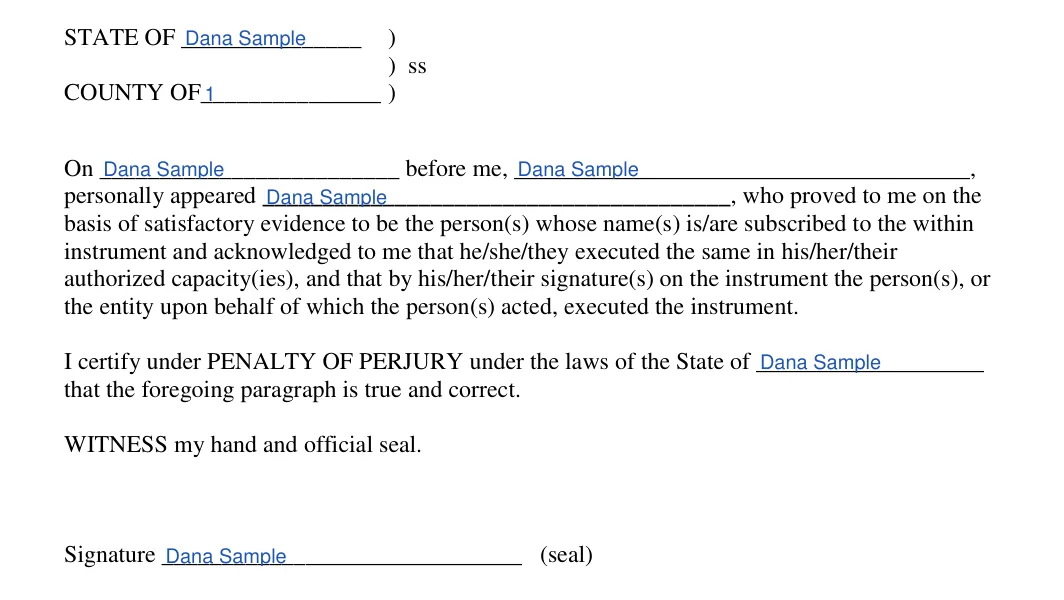
The FormsPal template has two form pages. Page 1 is a general acknowledgment, and page 2 holds five of the six certificates listed in section 41-265. The steps below follow the form from top to bottom and say what goes in the blanks and what is left for the notary. You can fill in the PDF on screen with our online PDF editor.
The screenshots under each step show the FormsPal Arizona notary acknowledgement template filled with sample entries in blue, so you can see where each answer goes. The names, addresses, dates and amounts are examples only.
These answers cover the Arizona notary acknowledgement wording in Ariz. Rev. Stat. § 41-265, the notary block and how a notary public uses the certificates. They apply to the FormsPal template on this page.
Yes. Ariz. Rev. Stat. § 41-265 sets out a certificate for an acknowledgment in an individual capacity. It reads "This record was acknowledged before me on" a date "by" the name of the individual. The notary block follows.[1]
An acknowledgment certificate says the document was acknowledged before the notary. A verification on oath or affirmation, which people often call a jurat, says the statement was signed and sworn to (or affirmed) before the officer. Section 41-265 gives separate wording for each.[1]
Yes. The statute has a certificate for a document signed for another person or an entity. It adds the signer's type of authority, such as officer or trustee, and the name of the party on whose behalf the document was executed.[1]
Each statutory certificate has a stamp line between the notary's signature and the title of office. The stamp is one of the four parts of the notary block.[1]
A notary public offers services in several places:
It is common to call ahead and ask what they charge and what to bring.
General information, not legal or tax advice.
