
A Virginia notary acknowledgement is a written certificate in which a notary confirms that a person acknowledged a signed document. Virginia law lists short certificate forms for this, including one for an individual acting in his or her own right.[2] Every notarization must also show the date and the county or city and state where it was performed.[1.1] This free FormsPal form lets you fill in the acknowledgment online or download it as a PDF.
Last Updated: October 2026. This guide is reviewed and updated regularly to reflect current Virginia law. If you notice an error or outdated information, please contact us.
Build Your Document
Answer a few simple questions to make your document in minutes
Save and Print
Save progress and finish on any device, download and print anytime
Sign and Use
Your valid, lawyer-approved document is ready
Under Section 47.1-16(A) of the Va. Code Ann., every notarization must include the date on which the notarial act was performed and the county or city and state in which it was performed.[1.1] The notarial act is the notary's official act, such as taking an acknowledgment of your signature.
So every Virginia certificate carries at least these details:
Check these lines before you leave the notary. A certificate with the date or the place left blank is missing something Virginia law says every notarization must include.[1.1]
Under Section 47.1-16(C) of the Va. Code Ann., a notary adds an official seal near the notary's official signature on the notarial certificate. On a paper document, the notary affixes a sharp, legible, permanent, and photographically reproducible image of the official seal. On an electronic document, the notary attaches an official electronic seal.[1.2]
Virginia lists short certificate forms in Section 55.1-621 of the Va. Code Ann. This sample notary statement is the form for an individual acting in his or her own right. The words in parentheses are the blanks that get filled in for each signing.[2]
The foregoing instrument was acknowledged before me this (date) by (name of person acknowledged). (Signature of Person Taking Acknowledgment) (Title or Rank) (Serial Number, if any)
Virginia lists four more certificates for people who sign for someone else or for an organization. Each one starts with the same opening words and changes only the part after "by." The table shows how they differ.[2]
| Type of certificate | Used when | Wording after "by" |
|---|---|---|
| Individual | An individual acts in his or her own right. | (name of person acknowledged) |
| Public officer, trustee or personal representative | The person acknowledges in that role. | (name and title of position) |
| Corporation | An officer or agent acknowledges for a corporation. | (name of officer or agent, title of officer or agent) of (name of corporation acknowledging) a (state or place of incorporation) corporation, on behalf of the corporation |
| Attorney-in-fact | An attorney-in-fact signs for a principal. | (name of attorney-in-fact) as attorney-in-fact on behalf of (name of principal) |
| Partnership | A partner or agent acknowledges for a partnership. | (name of acknowledging partner or agent), partner (or agent) on behalf of (name of partnership), a partnership |
Pick the type of certificate that matches who is signing. A person who signs for himself or herself uses the individual form, while an officer signing for a company uses the corporation form. If you are unsure, ask the office that will receive the document whether it prefers a particular type.
Every one of these certificates ends with the same notary block:
An attorney-in-fact is the person a principal names in a power of attorney to sign for them.
The statute adds that the forms of acknowledgment in this section may be used and are sufficient for their respective purposes under any law of the Commonwealth.[2]
Getting a document notarized in Virginia usually takes one short visit to a notary public. The steps below walk you through that visit. The next section shows how the FormsPal form is filled in.
The FormsPal form for Virginia is a one-page form from our notary acknowledgement templates. It has fields for the state, the county, the date, the notary's name and the name of the person who appeared. It ends with a signature line and a place for the seal. You can fill in the PDF on screen with our online PDF editor.
Before you open the form, have these details ready:
The screenshots under each step show the FormsPal Virginia notary acknowledgement template filled with sample entries in blue, so you can see where each answer goes. The names, addresses, dates and amounts are examples only.
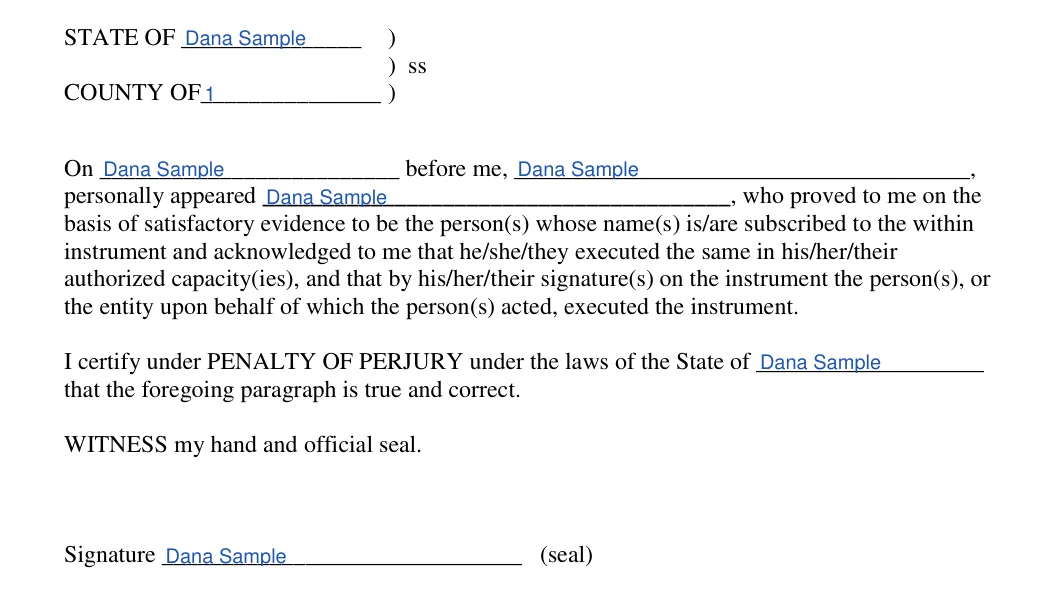
After you fill in the form, print it or save it as a PDF and keep it with the document it belongs to. Show the notary every line before the notary signs and adds the seal. Check the county, the state and the date one more time before you leave.
The template uses its own wording, not the short forms in Section 55.1-621. The statute says its authorization of those forms does not preclude the use of other forms.[2]
These answers cover the certificate wording in Section 55.1-621 of the Va. Code Ann. and a few practical questions about visiting a notary. They apply to the FormsPal form on this page.
Yes. Section 55.1-621 of the Va. Code Ann. sets out a certificate for an individual acting in his or her own right. It reads "The foregoing instrument was acknowledged before me this (date) by (name of person acknowledged)." The notary block follows with the signature, the title or rank, and the serial number, if any.[2]
Yes, the statute does not rule it out. Section 55.1-621 says its authorization of the listed forms does not preclude the use of other forms.[2] If you are unsure, ask the person or office that will receive your document whether it expects particular wording.
Notaries work in several places:
Many people search online ahead of time, call to confirm that the notary is available, and ask what the fee will be.
Many notaries ask for a photo ID such as a passport or a driver's license. It is common to bring the document unsigned and sign it in front of the notary. Everyone who signs the document usually needs to come along with their own ID.
Yes, for an electronic document. Section 47.1-16(C) of the Va. Code Ann. says that, for an electronic document, the notary attaches an official electronic seal. For a paper document, the notary affixes an image of the official seal instead.[1.2]
The notary adds a signature, a title or rank, and a serial number, if any, at the end of the certificate in Section 55.1-621.[2] The notary also makes sure the notarization shows the date and the county or city and state where it was performed.[1.1] The notary seal goes near the notary's official signature.[1.2]
General information, not legal or tax advice.
The statutes cited on this page are listed below. Each marker in the text, such as [1.1], points to the section of the Code of Virginia that supports the sentence before it.
