
A Florida notary acknowledgement is a certificate in which the officer states that a named person acknowledged an instrument before them. Florida law sets out certificate forms for it, called "Statutory Short Forms of Acknowledgment," and says they are sufficient for their purposes under any law of this state.[2] Use the template below to create a free Florida notary acknowledgement form online.
Last Updated: October 2026. This guide is reviewed and updated regularly to reflect current Florida law. If you notice an error or outdated information, please contact us.
Build Your Document
Answer a few simple questions to make your document in minutes
Save and Print
Save progress and finish on any device, download and print anytime
Sign and Use
Your valid, lawyer-approved document is ready
Section 695.25 of the Florida Statutes sets out the Statutory Short Forms of Acknowledgment. The statute says a certificate in one of these forms may be used and is sufficient for its purpose under any law of this state. It also says the authorization of these forms does not preclude the use of other forms.[2]
The forms of acknowledgment set forth in this section may be used, and are sufficient for their respective purposes, under any law of this state.
Every statutory short form closes with the same four lines for the officer who takes the acknowledgment:[2]
Looking for another state? Browse the notary acknowledgement templates for every state we cover.
The statutory short form for an individual acting in his or her own right certifies an acknowledgment before the officer, by physical presence or online notarization, on a stated date. The named person is either personally known to the officer or produced identification.[2]
The foregoing instrument was acknowledged before me by means of ☐ physical presence or ☐ online notarization, this (date) by (name of person acknowledging) , who is personally known to me or who has produced (type of identification) as identification.
In plain words, the individual certificate records four things:
A document signed for another person or an entity may be acknowledged in a representative capacity. The statute gives its own wording for each kind of signer.[2] The table shows what each wording names.
| Who is acknowledging | What the statutory wording names |
|---|---|
| An individual acting in his or her own right | The person acknowledging, who is personally known to the officer or produced identification |
| A corporation | The name and title of the officer or agent, the corporation's name, and its state or place of incorporation |
| A limited liability company | The name and title of the member, manager, officer or agent, the company's name, and its state or place of formation |
| A partnership | The acknowledging partner or agent and the name of the partnership |
| An individual acting as principal by an attorney in fact | The name of the attorney in fact and the name of the principal |
| A public officer, trustee, or personal representative | The name and title of position |
For a corporation, the wording says the officer or agent acknowledged the instrument on behalf of the corporation. He or she is personally known to the officer or has produced identification.[2]
Getting a document notarized in Florida usually takes one short visit to a notary public. The steps below walk you through that visit. The next section shows how the acknowledgment form itself is filled in.
A Florida notary's seal must include the notary's name, the commission expiration date and the commission number, and the certificate must show the exact date of the notarial act (Fla. Stat. § 117.05).[1]
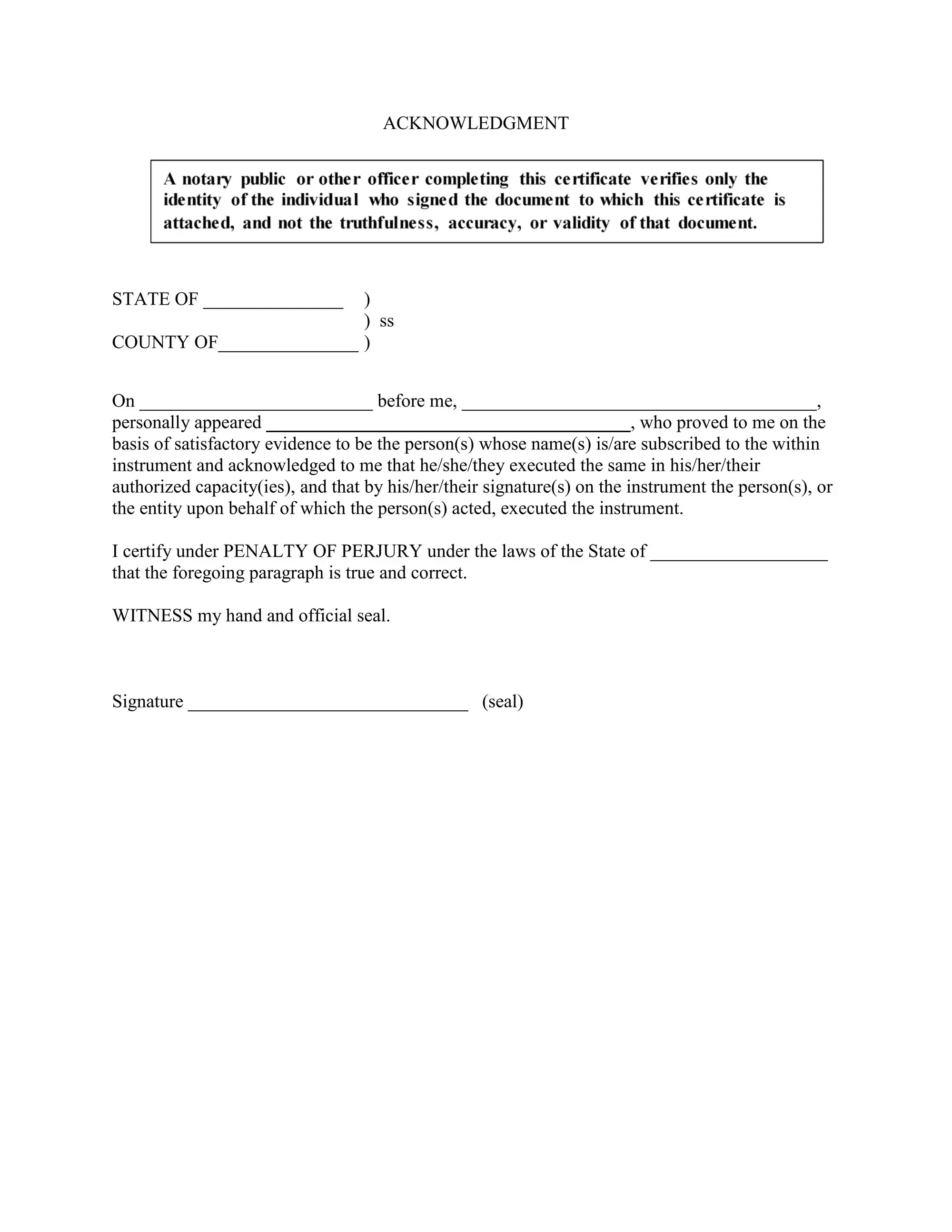
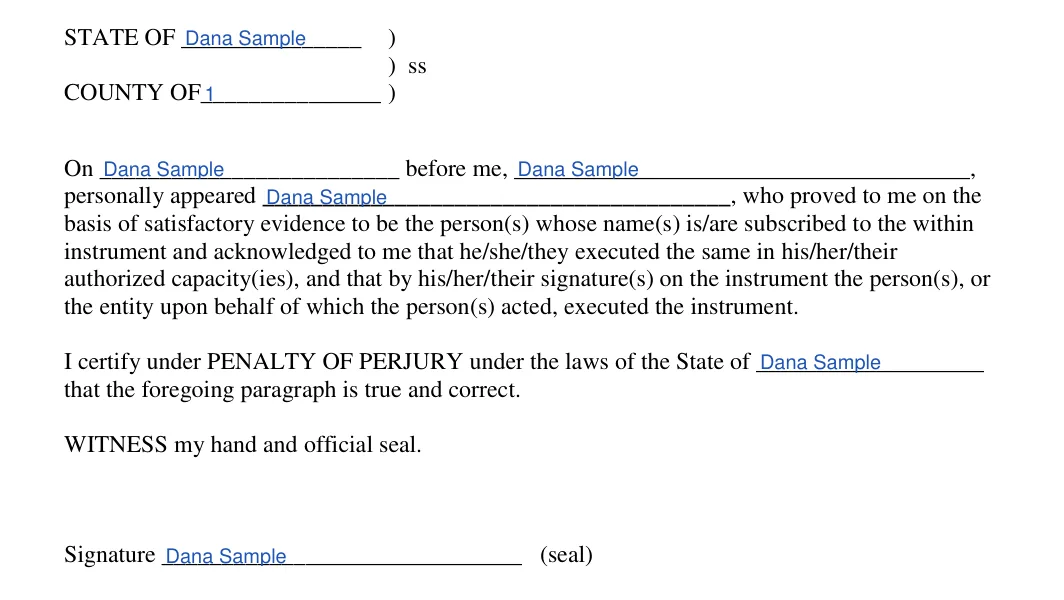
Fill out the FormsPal Florida notary acknowledgement template in one step. The form has one page and seven fields, covering the state and county, the date, the notary's name, the signer's name, the state in the penalty of perjury line, and the notary's signature.
Fill it in with our online PDF editor or print it and complete it by hand. More paperwork is on our Florida PDF forms and Florida affidavit forms pages.
The screenshots under each step show the FormsPal Florida notary acknowledgement template filled with sample entries in blue, so you can see where each answer goes. The names, addresses, dates and amounts are examples only.
The template's wording is its own and differs from the statutory short forms described above. The statute does not preclude the use of other forms.[2]
The answers below cover the individual certificate form, the use of other forms, and the wording for an oath or affirmation. They draw on Fla. Stat. § 695.25 and, for oaths, Fla. Stat. § 117.05.
Yes. Fla. Stat. § 695.25 sets out a statutory short form for an individual acting in his or her own right. The certificate states that a named person acknowledged the instrument before the officer, by physical presence or online notarization, on a stated date. That person is personally known to the officer or produced identification.[2]
No. The statute says the authorization of its forms does not preclude the use of other forms. The statutory forms, for their part, may be used and are sufficient for their respective purposes under any law of this state.[2]
Florida's notary law, Fla. Stat. § 117.05, recognizes certificate wording for a statement signed on oath or affirmation.[1] The wording has these parts:
General information, not legal or tax advice.
Unless noted otherwise, the sources below are from the Fla. Stat..
