Free Massachusetts Notary Acknowledgement Form

A Massachusetts notary acknowledgement is a written certificate in which a notary public states that the signer personally appeared and acknowledged signing the document voluntarily for its stated purpose. The wording comes from Massachusetts General Laws chapter 222, section 15.[1] This page gives you a free template that follows it. It is not a Massachusetts notary application or renewal form.

Last Updated: October 2026. This guide is reviewed and updated regularly to reflect current Massachusetts law. If you notice an error or outdated information, please contact us.
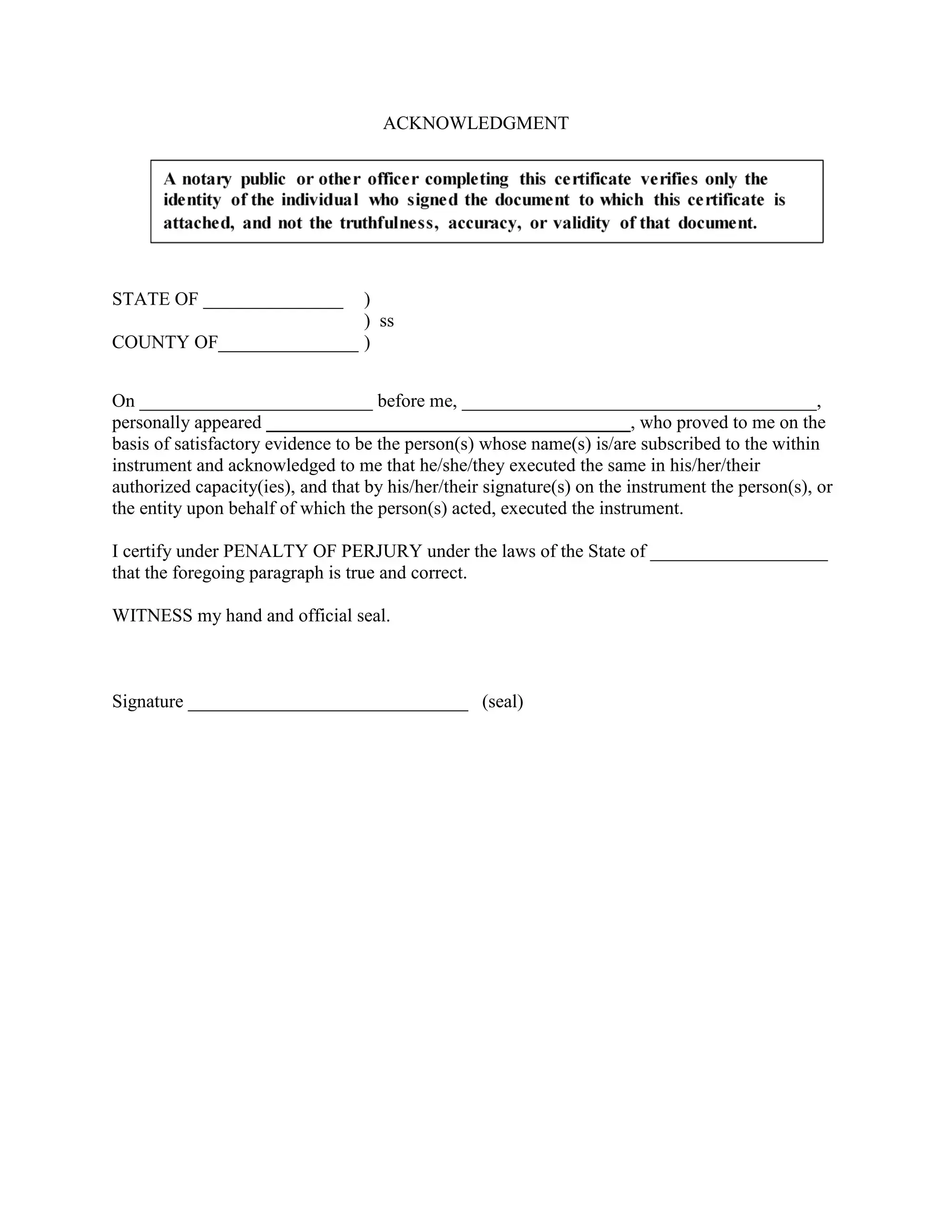
Massachusetts notary acknowledgement form preview

Create a Personalized Massachusetts Notary Acknowledgement Form online in under 5 minutes!

Build Your Document

Answer a few simple questions to make your document in minutes

Save and Print

Save progress and finish on any device, download and print anytime

Sign and Use

Your valid, lawyer-approved document is ready

Download the Massachusetts Notary Acknowledgement: PDF or Word (.docx) or OpenDocument (.odt)

What Is a Massachusetts Notary Acknowledgement?

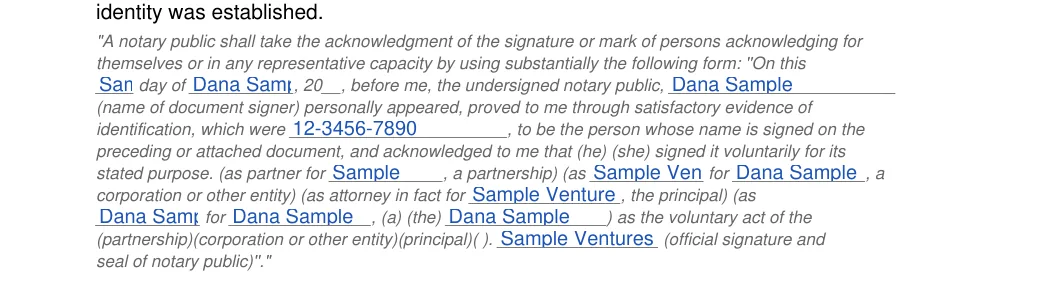
Massachusetts sets the notary acknowledgement certificate in Massachusetts General Laws chapter 222, section 15. A notary public takes the acknowledgment of a signature or mark by using substantially the statutory form. That holds whether the person signs for themselves or in a representative capacity. The certificate ends with a line for the official signature and seal of the notary public.[1]

A notary public shall take the acknowledgment of the signature or mark of persons acknowledging for themselves or in any representative capacity by using substantially the following form:

Mass. Gen. Laws ch. 222, § 15

Under that wording, the certificate records these points about the person who signed:[1]

  • The day, month and year of the acknowledgment, with blanks to fill in.
  • The signer's name, which the notary writes in as the name of the document signer.
  • That the signer personally appeared before the notary.
  • How the signer proved who they are, which the certificate calls satisfactory evidence of identification.
  • That the signer acknowledged signing voluntarily for its stated purpose.
  • Optional lines for a signer acting as a partner, for a corporation or other entity, or as attorney in fact for the principal.

Acknowledgment vs. Jurat Certificates in Massachusetts

Massachusetts law gives two certificate forms that look alike but do different jobs. An acknowledgment certificate covers a person who acknowledges a signature or mark. A jurat certificate covers a signature or mark on an affidavit or other sworn or affirmed written declaration.[1]

PointAcknowledgment certificateJurat certificate
Used forA signature or mark acknowledged by a person for themselves or in a representative capacityA signature or mark on a sworn or affirmed written declaration
SignerPersonally appeared and proved identity through satisfactory evidence of identificationPersonally appeared and proved identity through satisfactory evidence of identification
What the signer didAcknowledged signing it voluntarily for its stated purposeSigned in the notary's presence and swore or affirmed that the contents are truthful and accurate to the best of their knowledge and belief
Ends withOfficial signature and seal of the notary publicOfficial signature and seal of the notary public

When a Massachusetts Notary Can Use Another Form

A Massachusetts notary does not have to use the statutory forms in every case. The statute names two situations where another form of acknowledgment, jurat, signature witnessing or copy certification is fine.[1]

  • A court rule, court form or court directive requires or allows a different form. This includes the rules, forms, directives and guidelines of the land court for documents filed with it.
  • Another general or special law, a federal law or a regulation requires a different form.
  • The document carries an alternative form from another state, and it is to be filed or recorded in that state or governed by its laws.

Where a law or regulation sets an equivalent form, the statutory forms may still be used in its place, unless that law expressly prohibits other forms.[1]

How to Notarize a Document in Massachusetts

Getting a document notarized in Massachusetts usually takes one short visit to a notary public. The steps below walk you through that visit. The next section shows how the acknowledgment form itself is filled in.

  1. Choose a notary in Massachusetts. Many banks, credit unions and shipping stores offer notary services. Call ahead to check the hours and set a time.
  2. Wait to sign until you meet the notary. You can fill in most of the document before the visit. Many notaries prefer to watch you sign, so leave the signature line blank unless the notary tells you otherwise.
  3. Bring a photo ID. The Massachusetts certificate records that you personally appeared before the notary and proved who you are through satisfactory evidence of identification, and it names what you showed.[1] Many notaries ask to see photo ID, such as a driver's license or a passport.
  4. Acknowledge your signature. Sign in front of the notary if you have not signed yet. The certificate records that you acknowledged to the notary that you signed the document voluntarily for its stated purpose.[1]
  5. Let the notary complete the certificate. The notary fills in the date, your name and the identification you showed. The certificate ends with the official signature and seal of the notary public.[1]
  6. Pay the fee and take both papers. Notaries usually charge a fee for their service, so ask about it when you call. Leave with the original document and the completed acknowledgment, and give both to the office that asked for the notarization.

How to Fill Out the Massachusetts Notary Acknowledgement Template

The FormsPal template reproduces the statutory acknowledgment wording on page 1 and quotes the same certificate again on page 2. Each step below matches one part of the form. The notary completes the certificate and adds the official signature and seal.

The screenshots under each step show the FormsPal Massachusetts notary acknowledgement template filled with sample entries in blue, so you can see where each answer goes. The names, addresses, dates and amounts are examples only.
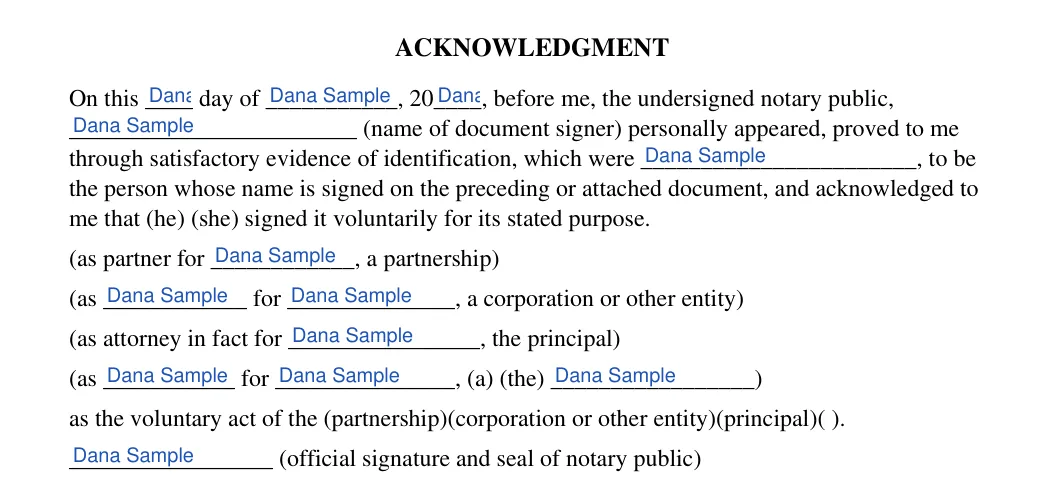
  1. ACKNOWLEDGMENT wording, page 1. Enter the day, month and year, then the signer's name and the identification shown. Complete only the capacity line that fits. The official signature and seal of the notary public go on the last line.
    Massachusetts notary acknowledgement: ACKNOWLEDGMENT, filled with sample entries
    Step 1: sample entries, not a real document.
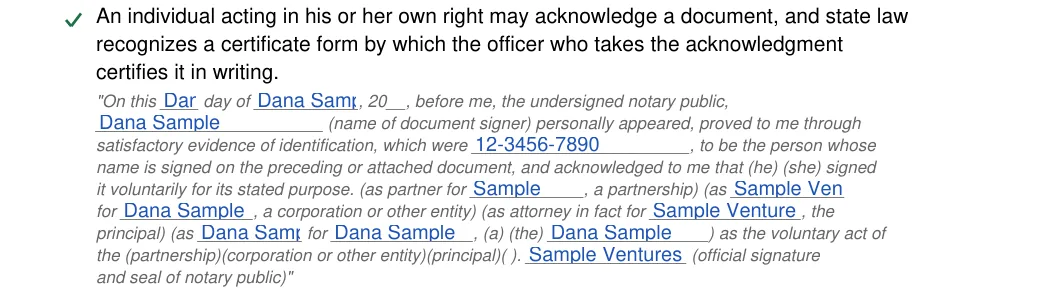
  2. First quoted copy, page 2. Page 2 repeats the acknowledgment wording with its own blanks. If you use this copy, enter the same date, signer, identification and capacity details as on page 1.
    Massachusetts notary acknowledgement: Notary acknowledgement ma.1.on this, Notary acknowledgement ma.2.day of and more, filled with sample entries
    Step 2: sample entries, not a real document.
  3. Second quoted copy, page 2. A second copy sits lower on page 2 with its own blanks for the day, month and year, the signer, the identification and the capacity line. Fill it the same way, and keep your entries consistent with the copy you use.
    Massachusetts notary acknowledgement: Notary acknowledgement ma.13.themselves or in any representative capa, Notary acknowledgement ma.14.day of and more, filled with sample entries
    Step 3: sample entries, not a real document.

Need a different state? Browse all notary acknowledgement forms. Other Massachusetts templates on FormsPal include a Massachusetts power of attorney, a Massachusetts bill of sale and a Massachusetts living will. You can also browse the affidavit forms library.

Frequently Asked Questions

Does Massachusetts provide a statutory individual acknowledgment certificate form for a notary acknowledgement?

Yes. Massachusetts General Laws chapter 222, section 15 sets out a certificate form for a person who acknowledges a document in their own right. The officer who takes the acknowledgment certifies it in writing on that form.[1]

What is the difference between an acknowledgment and a jurat in Massachusetts?

An acknowledgment certificate covers a person who acknowledges signing a document for its stated purpose. A jurat certificate covers a signature on an affidavit or other sworn or affirmed written declaration, where the signer swears or affirms that the contents are truthful. Both end with the official signature and seal of the notary public.[1]

Does a Massachusetts notary always have to use the statutory form?

No. The statute does not require its forms in these cases:[1]

  • A court rule, court form or court directive requires or allows another form.
  • Another law or regulation requires or allows another form.
  • The document carries an alternative form from another state and is to be filed or recorded in that state or governed by its laws.

Can I use this template for a Massachusetts notary application?

No. This template is a notary acknowledgement certificate. It is not a Massachusetts notary application or renewal form.

General information, not legal or tax advice.

Sources

  1. Mass. Gen. Laws ch. 222, § 15.
Published: Jul 9, 2022
Mara Erlach
Mara Erlach
Writer & Attorney
Mara has been practicing estate planning and trust law in California since 2003, taking pride in helping clients of all backgrounds and asset profiles form a complete and customized estate plan. Her specialties are: estate planning, wills and trusts, trust and probate administration.