
A South Carolina notary acknowledgement is a written document in which a notary public certifies that a person appeared in person and confirmed that he or she signed a paper. Use the free FormsPal template below to build your own online, or download it as a PDF, Word or OpenDocument file. The certificate is a short block of wording that goes on or with the document you signed.
Last Updated: October 2026. This guide is reviewed and updated regularly to reflect current South Carolina law. If you notice an error or outdated information, please contact us.

Build Your Document
Answer a few simple questions to make your document in minutes
Save and Print
Save progress and finish on any device, download and print anytime
Sign and Use
Your valid, lawyer-approved document is ready
The sections below cover the certificate wording South Carolina recognizes, the duties the law gives a notary and the parts of the FormsPal form. If you want the general version of this document, see our printable notary acknowledgement form.
South Carolina law sets what a notary acknowledgment certificate must say and what a notary must do when signing one. The certificate wording is in S.C. Code Ann. § 26-3-70, and the notary's own duties are in Title 26, Chapter 1 of the South Carolina Code of Laws.[2.3]
The person taking an acknowledgment must certify two things. The person acknowledging appeared before the notary and acknowledged that he executed the instrument. That person was also known to the notary, or the notary had satisfactory evidence that the person acknowledging was the person described in and who executed the instrument.[2.1]
The certificate used by a person whose authority is recognized under Section 26-3-20 is accepted in this State if it meets any one of three tests:[2.2]
Section 26-3-70 gives short forms. For an individual acting in his own right, the form reads as follows.[2.3]
State of __________ County of __________ The foregoing instrument was acknowledged before me this (date) by (name of person acknowledged). (Signature of Person Taking Acknowledgment) (Title or Rank) (Serial Number, if any)
The same section gives certificate wording for five kinds of signers. A document signed for another person or an entity is acknowledged in a representative capacity, and the certificate shows that capacity.[2.3]
| Individual acting in his own right | The name of the person acknowledged |
| Corporation | The name and title of the officer or agent, the corporation, its state or place of incorporation, and that the act is on behalf of the corporation |
| Partnership | The name of the acknowledging partner or agent and the partnership on whose behalf the document was executed |
| Attorney in fact | The name of the attorney in fact and the name of the principal |
| Public officer, trustee or personal representative | The name and title of the position |
Each of these forms ends with the signature of the person taking the acknowledgment, a title or rank and a serial number, if any. These forms are not the only choice. The authorization of the forms in this section does not preclude the use of other forms.[2.3]
A South Carolina notary has a short list of duties. Some come before the first notarization, such as taking an oath and enrolling the commission. Others apply every time the notary completes a certificate.
Every notarial act must be attested by the following items.[1.4]
The notary must also indicate the date the commission expires below the notary's signature.[1.3] A notary may not execute a certificate that is not written in the English language. Where the record is written in another language, the notary executes only the English language certificate.[1.4]
A notary may not notarize a signature on a blank or incomplete document, or on a document that carries no notarial certificate wording.[1.4]
A person who is physically unable to sign or make a mark may have a disinterested third party sign the person's name. This works only if conditions set by statute are met. Among them, the person must direct the third party to sign in the presence of the notary and two witnesses. The witnesses must be either personally known to the notary or identified by the notary through satisfactory evidence. They must also be unaffected by the document.[1.4]
The South Carolina Secretary of State's Office publishes a Notary Public Reference Manual. Read it next to the statute if you want the office's own guidance on notary duties and procedures.
Getting a document notarized in South Carolina usually takes one short visit to a notary public. The steps below walk you through that visit. The next section shows how the FormsPal form is filled in.
The FormsPal form has three pages and seven parts. Page 1 holds a general acknowledgment, and pages 2 and 3 hold six certificates with State and County lines. Complete the parts that match your signer. You can fill in the downloaded PDF with our online PDF editor.
The screenshots under each step show the FormsPal South Carolina notary acknowledgement template filled with sample entries in blue, so you can see where each answer goes. The names, addresses, dates and amounts are examples only.
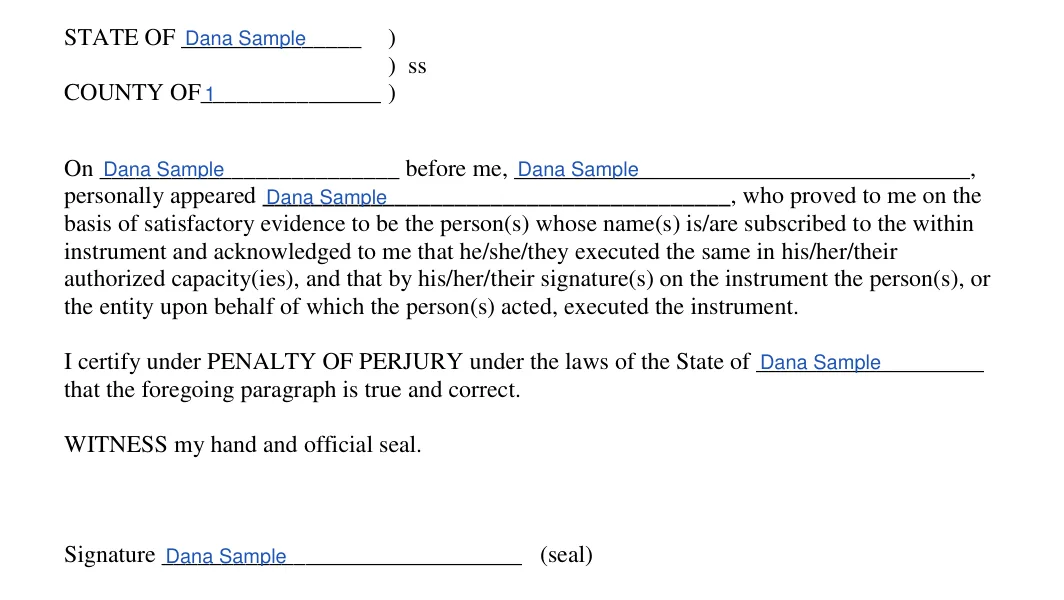






Page 1 already prints the wording about satisfactory evidence and the penalty of perjury. You do not fill in that text.
A notary acknowledgment form is the written certificate in which a notary records that a signer appeared and confirmed the signature. South Carolina recognizes several certificate forms in S.C. Code Ann. § 26-3-70, for individuals, corporations, partnerships, attorneys in fact and public officers.[2.3]
A notary acknowledgment form is a certificate that shows a signer acknowledged a signature before a notary. In South Carolina, the person taking the acknowledgment certifies that the person acknowledging appeared and acknowledged executing the instrument. The notary also certifies that the signer was known or proven by satisfactory evidence.[2.1] The statute gives forms for these signers:
General information, not legal or tax advice.
Unless noted otherwise, the sources below are from the S.C. Code Ann..
