
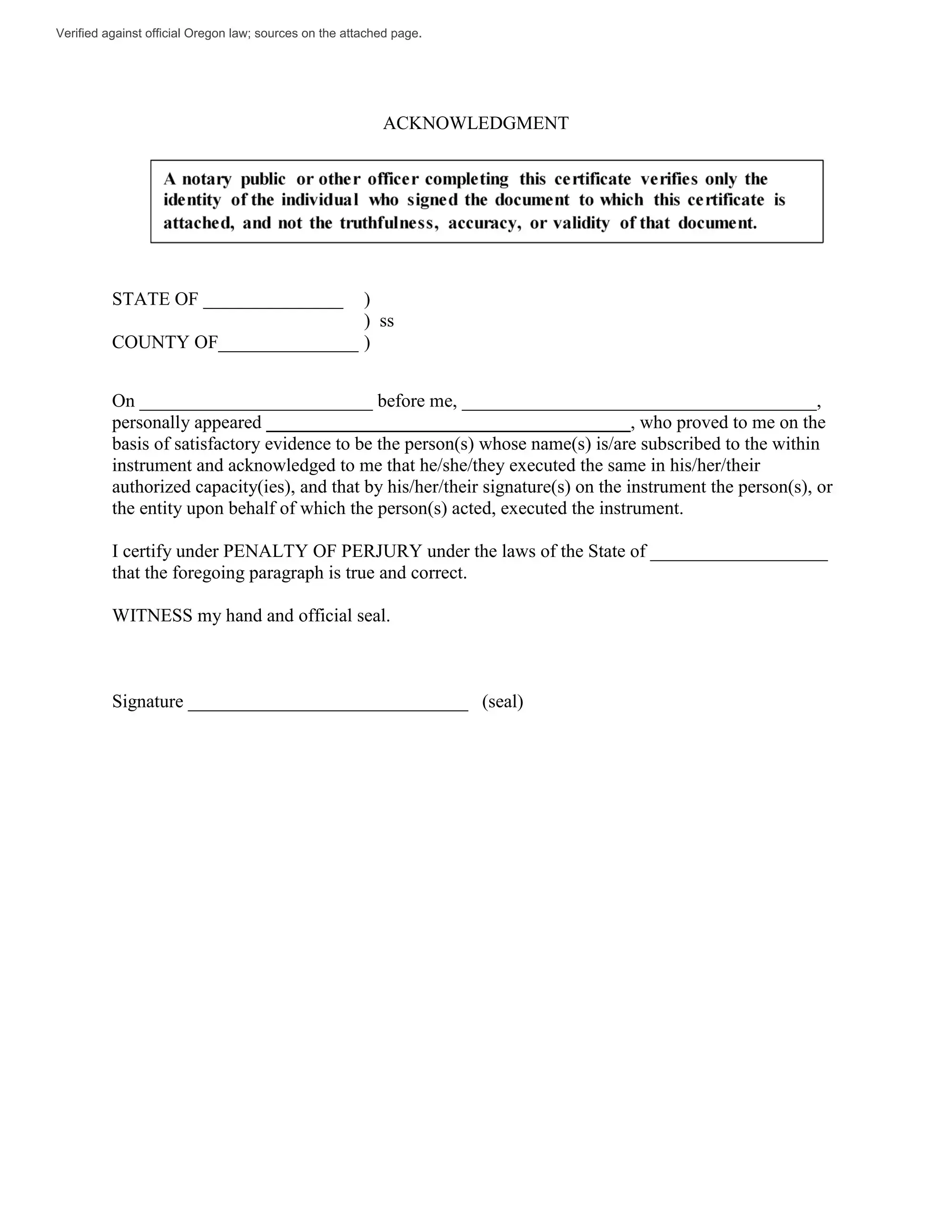
An Oregon notary acknowledgement is a written certificate that a notary public completes to show that a named person acknowledged a document before the notary. Oregon law gives short-form certificate wording for individuals and for people who sign for someone else.[1.2] It also sets what the notary's stamp must show.[1.3] Download the free Oregon notary acknowledgment form above, fill it in, and take it to a notary.
Last Updated: October 2026. This guide is reviewed and updated regularly to reflect current Oregon law. If you notice an error or outdated information, please contact us.
Build Your Document
Answer a few simple questions to make your document in minutes
Save and Print
Save progress and finish on any device, download and print anytime
Sign and Use
Your valid, lawyer-approved document is ready
Need another state? See our printable notary forms for other states.
Oregon law sets what a notary's certificate must do and how the notary's stamp must look. By signing the certificate, the notary states that the legal steps for the notarial act were followed.[1.1]
An Oregon certificate of a notarial act has these requirements:
The official stamp of a notary public has its own rules. The stamp must include the notary public's name, jurisdiction, commission expiration date and other information the Secretary of State requires by rule. It must also be a legible imprint that can be copied together with the record it is affixed or attached to, or logically associated with. Under Oregon law, the official stamp is an official notarial seal for all purposes.[1.3]
Notaries work from the State of Oregon Notary Public Guide, a handbook the Oregon Secretary of State publishes for them. For more examples of certificate wording, see the State of Oregon Notarial Certificate.
Oregon law sets out short-form certificates of notarial acts. A short form is sufficient for the purposes indicated if it is completed with the information required by ORS 194.280 (1) to (3).[1.2] The wording depends on how the person acts:
For an acknowledgment in an individual capacity, the statutory form reads:
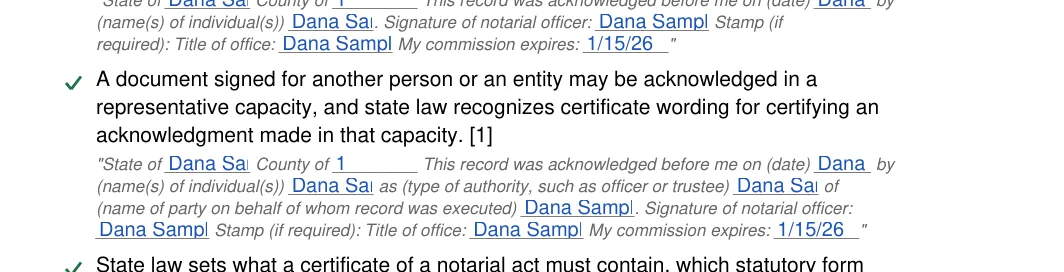
State of _________ County of _________ This record was acknowledged before me on (date) ______ by (name(s) of individual(s)) _________. Signature of notarial officer: ____________ Stamp (if required): Title of office: ____________ My commission expires: _________
The table shows what the wording adds for each type of certificate.[1.2]
| Certificate | What the wording adds | Statute |
|---|---|---|
| Individual capacity | The date and the name(s) of the individual(s) who acknowledged the record | § 194.285[1.2] |
| Representative capacity | The type of authority, such as officer or trustee, and the name of the party on whose behalf the record was executed | § 194.285[1.2] |
| Verification on oath or affirmation | The words "Signed and sworn to (or affirmed) before me" and the name(s) of the individual(s) making the statement | § 194.285[1.2] |
People also call this certificate the notary block or the notarial wording. Whatever the name, it is the part of the page that the notary completes and signs.
Getting a document notarized in Oregon usually takes one short visit to a notary public. The steps below walk you through that visit. The next section shows how the acknowledgment template itself is filled in.
Remote online notarization is available in Oregon. Under ORS 194.277, you can use communication technology to appear before a notary public, and a notary public located in Oregon may perform the notarial act for you when the conditions of that section are met.[1.5]
Before an Oregon notary public performs a first notarial act for a remotely located individual, the notary must notify the Secretary of State and identify the technologies the notary intends to use. The communication technology and identity proofing the notary uses must meet any standards the Secretary of State has set.[1.5]
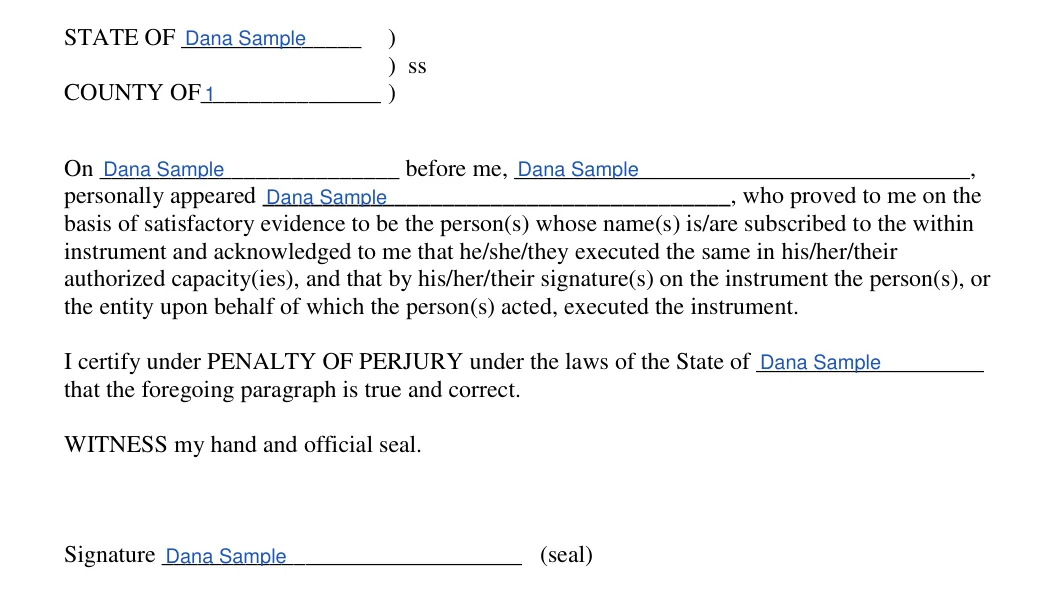
The FormsPal template has three parts: an acknowledgment on page 1, and an individual and a representative block on page 2. Fill in the blanks for the part that fits your situation. The notary completes the signature, seal and commission lines.
The screenshots under each step show the FormsPal Oregon notary acknowledgement template filled with sample entries in blue, so you can see where each answer goes. The names, addresses, dates and amounts are examples only.

Yes. Section 194.285 of the Or. Rev. Stat. gives a short-form certificate for an acknowledgment in an individual capacity. It names the state, the county, the date and the individual who acknowledged the record. It ends with the notarial officer's signature, the stamp if required, the title of office and the commission expiration date.[1.2]
In an acknowledgment, the certificate says the record was acknowledged before the notary on a stated date. In a verification on oath or affirmation, the certificate says the statement was signed and sworn to, or affirmed, before the notary.[1.2]
No. Only a document that calls for a notarization needs a notary public. Check the instructions that come with your legal documents, and ask the office that will receive them if you are unsure.
A loose notary certificate is a certificate printed on its own page instead of on the document being notarized. When the notarial act concerns a paper record, Oregon law requires the certificate to be part of the record or securely affixed to it.[1.1] Ask the notary how to attach the page to your documents.
The notary completes and signs the certificate. Oregon law says the notarial officer may not sign the certificate until the notarial act has been performed.[1.1] Ask the notary which blanks to leave empty until the appointment.
Bring these items to the notarization:
Call ahead to ask about hours and whether the notary needs an appointment.
Many banks, shipping stores and mobile signing services offer notarization. You can also search the 123Notary directory of Oregon notaries by city, county or zip code. You can verify a notary's authority to perform notarial acts in the electronic database of notaries public that the Oregon Secretary of State maintains (ORS 194.345).[1.6] Call ahead to ask about fees and what ID to bring.
General information, not legal or tax advice.
