
A Tennessee notary acknowledgement is a written certificate in which the officer taking an acknowledgment, such as a notary, confirms that the signer acknowledged signing a document. Tennessee sets out the certificate wording in Tenn. Code Ann. § 66-22-107, with versions for people acting in their own right and for people acting through an attorney-in-fact.[1] It often appears on deeds and other property documents.
Last Updated: October 2026. This guide is reviewed and updated regularly to reflect current Tennessee law. If you notice an error or outdated information, please contact us.
Build Your Document
Answer a few simple questions to make your document in minutes
Save and Print
Save progress and finish on any device, download and print anytime
Sign and Use
Your valid, lawyer-approved document is ready
Tennessee law supplies ready-made certificate wording for an acknowledgment. The officer writes the certificate on the instrument or attaches it, and states the officer's official capacity in it.[1] The statute gives three versions:
Each version below is the certificate part of a notary acknowledgement form. The blanks stand for details that change from document to document.
This version is for a person acting in their own right. The officer certifies that the signer appeared in person and is personally known to the officer or proved by satisfactory evidence. The signer acknowledged executing the instrument for the purposes stated in it.[1]
State of Tennessee )
County of )
Personally appeared before me, (name of clerk or deputy), clerk (or deputy clerk) of this county, (bargainor's name), the within named bargainor, with whom I am personally acquainted (or proved to me on the basis of satisfactory evidence), and who acknowledged that such person executed the within instrument for the purposes therein contained.
Witness my hand, at office, this day of , 20.
As an alternative, Tennessee supplies a certificate for natural persons acting in their own right. It recites that the person appeared before the officer and was known to be the person described in the instrument. The person acknowledged executing it as a free act and deed.[1]
State of Tennessee )
County of )
On this day of , 20, before me personally appeared , to me known to be the person (or persons) described in and who executed the foregoing instrument, and acknowledged that such person (or persons) executed the same as such person's (or persons') free act and deed.
When an attorney-in-fact acknowledges a document signed on behalf of a principal, the certificate names both the attorney-in-fact and the principal. It states that the acknowledgment was made before the officer who certifies it. A document signed for another person or an entity may also be acknowledged in a representative capacity, and the statute's wording covers acknowledgments made that way.[1]
State of Tennessee ) County of ) On this day of , 20, before me personally appeared , to me known (or proved to me on the basis of satisfactory evidence) to be the person who executed the foregoing instrument in behalf of acknowledged that such person executed the same as the free act and deed of .
This example fills the blanks of the natural persons version with made-up details. It is a sample for illustration, not a real document.
State of Tennessee
County of ExampleOn this 5th day of May, 2026, before me personally appeared Anna Baker, to me known to be the person described in and who executed the foregoing instrument, and acknowledged that such person executed the same as such person's free act and deed.
Each blank takes one kind of detail:
Getting a document notarized in Tennessee usually takes one short visit to a notary public. The steps below walk you through that visit. The next section shows how the FormsPal form is filled in.
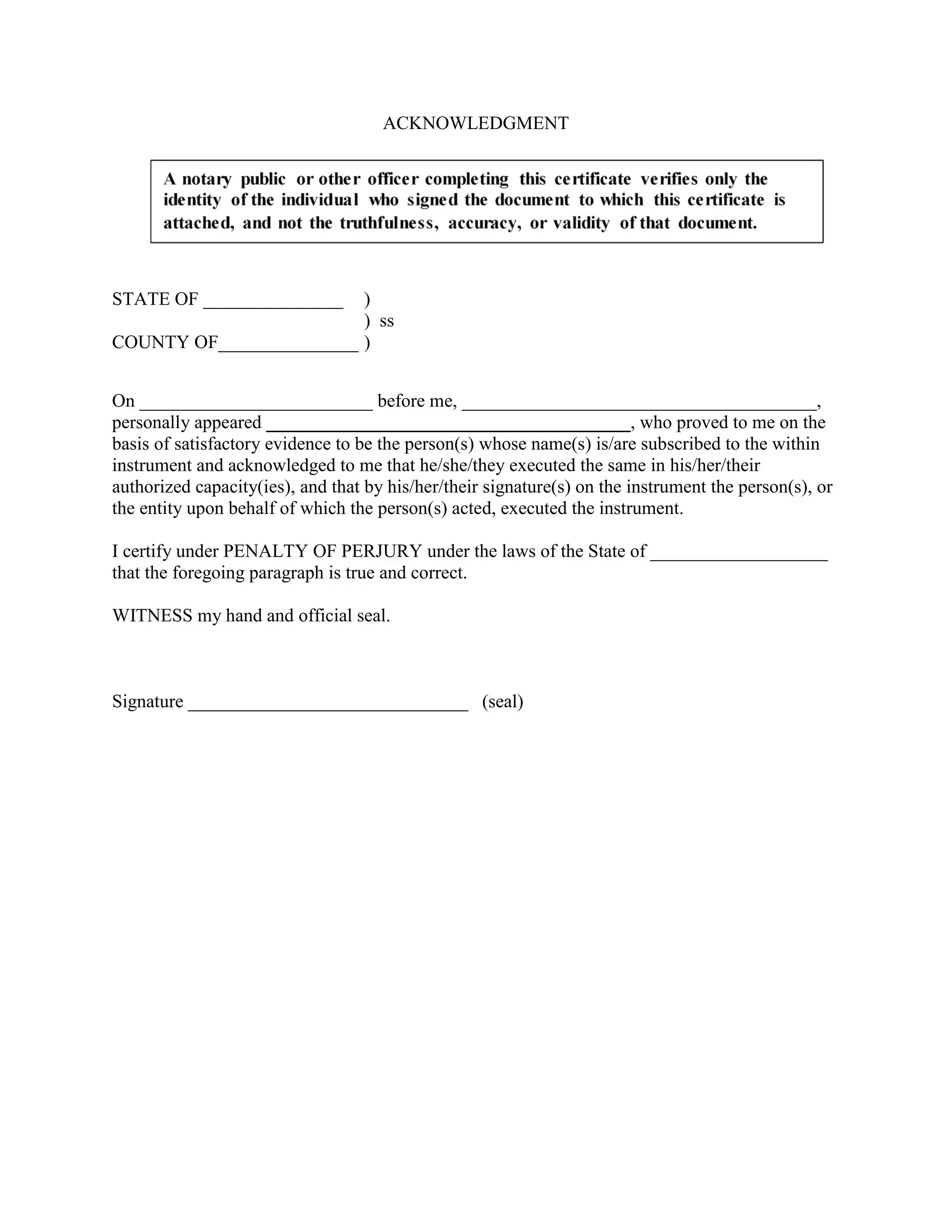
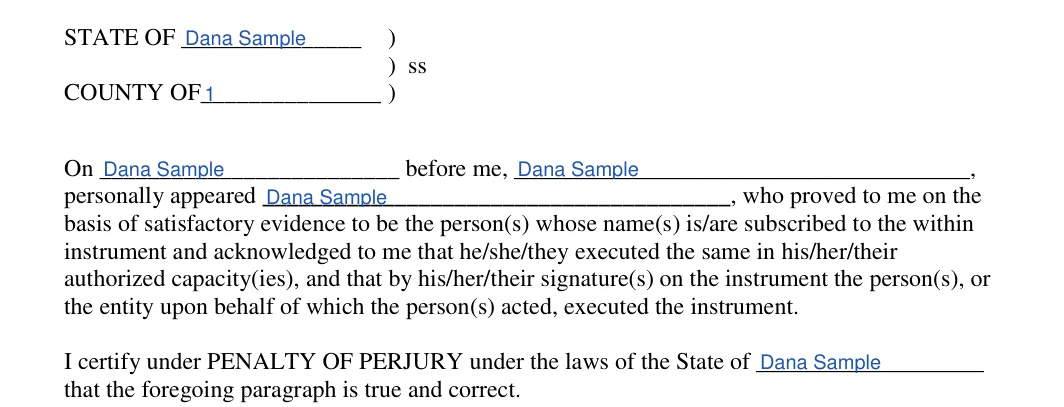
The FormsPal template is a one-page form with two parts to complete. Download it as a PDF, Word or OpenDocument file, or build it online with the Create My Document button above. You can also fill in the PDF with our online PDF editor. Each step below matches one part of the form, from top to bottom.
The screenshots under each step show the FormsPal Tennessee notary acknowledgement template filled with sample entries in blue, so you can see where each answer goes. The names, addresses, dates and amounts are examples only.

Tennessee's acknowledgment statute, Tenn. Code Ann. § 66-22-107, provides certificate wording for individuals, for natural persons acting in their own right, and for people acting by attorney. The officer writes the certificate and states the officer's official capacity in it. The answers below cover the wording, who writes the certificate, and what a notary block contains.[1]
Yes. Tenn. Code Ann. § 66-22-107 includes an individual acknowledgment certificate. The certificate does three things:[1]
The officer does. The statute says the officer writes the certificate on the instrument or annexes it to the instrument, and sets forth the officer's official capacity in it.[1]
A Tennessee notary block is the certificate wording the officer completes. Each statutory version starts with "State of Tennessee" and a county line. It then recites that the person appeared before the officer and acknowledged executing the instrument.[1]
General information, not legal or tax advice.
