
A New Jersey notary acknowledgement is a written certificate in which a notarial officer records that a person acknowledged a record before the officer on a stated date. State law gives certificate wording for an individual and for a signer acting for another person or an entity.[2] This page shows the statutory wording and the certificate rules. It also offers a free template you can download as a PDF, Word or OpenDocument file, or create online.
Last Updated: October 2026. This guide is reviewed and updated regularly to reflect current New Jersey law. If you notice an error or outdated information, please contact us.
Build Your Document
Answer a few simple questions to make your document in minutes
Save and Print
Save progress and finish on any device, download and print anytime
Sign and Use
Your valid, lawyer-approved document is ready
A New Jersey notary acknowledgement follows the notarial law in N.J.S.A. 52:7-10.1 et seq. That law covers how the certificate is attached to a record, where the notary's official stamp goes, and when the notary may refuse to act.[1] Separate statutory short form certificates set the wording for an acknowledgment.[2]
The statute's short form certificates are sufficient for the purposes indicated, if the requirements of section 10 of P.L.1979, c.460 (C.52:7-19) are satisfied.[2] An individual acting in their own right may acknowledge a document. The officer then certifies the acknowledgment in writing with this wording:
For an acknowledgment in an individual capacity: State of ________________________________________ County of ___________________________________ This record was acknowledged before me on __________ (date) by __________________________________ (Name(s) of individual(s)) __________________________________ Signature of notarial officer Stamp __________________________________ Title of office (My commission expires: _________)
A document signed for another person or an entity can be acknowledged in a representative capacity. The statute's wording for that case adds the signer's type of authority, such as officer or trustee, and the name of the party on whose behalf the record was executed.[2]
The downloadable template uses its own acknowledgment wording and adds a line where the state is named under penalty of perjury. Compare it with the statutory wording above if the office receiving your document asks for a specific form.
The rules differ for a tangible record, such as a paper document, and an electronic record.
| Type of record | Certificate | Official stamp of a notary public |
|---|---|---|
| Tangible record | The certificate must be part of the record or attached to it. | The stamp must be affixed to or embossed on the certificate near the notary's signature, so as to be clear and readable.[1] |
| Electronic record | The certificate must be affixed to, or logically associated with, the electronic record. | The stamp must be attached to or logically associated with the certificate.[1] |
A notarial officer may refuse to perform a notarial act if the officer is not satisfied that:
In practice, many notaries ask to see a current photo ID at the appointment, so bring one with you.
Getting a document notarized in New Jersey usually takes one short visit to a notary public. The steps below walk you through that visit. The next section shows how the acknowledgment form itself is filled in.
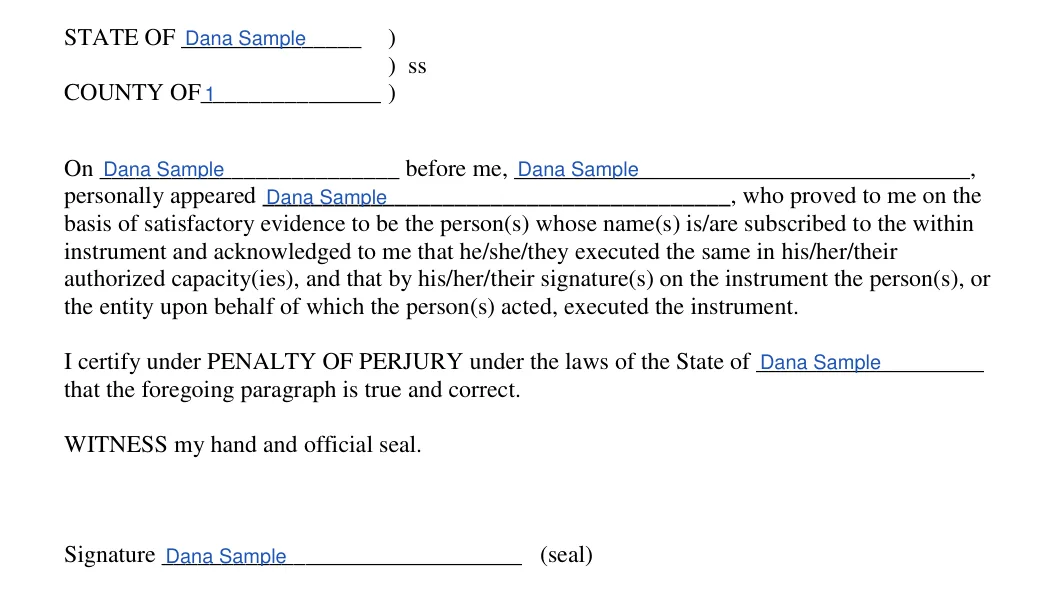
The free FormsPal template for a New Jersey notary acknowledgement is a one-page certificate with seven fields. They cover the state, the county, the date, the notary's name, the signer's name, the state on the penalty-of-perjury line, and the notary's signature line. Fill in the first six and leave the signature and seal for the notary public.
The screenshots under each step show the FormsPal New Jersey notary acknowledgement template filled with sample entries in blue, so you can see where each answer goes. The names, addresses, dates and amounts are examples only.
To type the entries on a downloaded copy, you can open the PDF in our online PDF editor.
In practice, people often have a New Jersey power of attorney or a New Jersey bill of sale notarized this way. The FormsPal template is one of our printable notary forms.
These two questions cover how a notary signs the certificate and what happens when a signer is unable to sign the record. Both answers follow the statutes cited in the Sources section at the end of this page.
A notarial officer may not affix the officer's signature to, or logically associate it with, a certificate until the notarial act has been performed.[1] The notary signs the certificate only after the act is done.
If an individual is physically unable to sign a record, two steps apply:
General information, not legal or tax advice.
The certificate wording, stamp rules and refusal grounds on this page come from the state statutes listed below. Each numbered marker in the text points to one of these two sources, so you can check the exact language.
