
A Louisiana notary acknowledgement is a written certificate in which a notary public confirms that a person acknowledged signing an instrument. Louisiana notary laws in La. Rev. Stat. § 35:511 set out certificate wording for an individual, for a person acting for someone else, for a person acting by attorney and for a corporation or association.[1] This free template gives you that wording to fill in online or download. It is the certificate, not the paper you are signing.
Last Updated: October 2026. This guide is reviewed and updated regularly to reflect current Louisiana law. If you notice an error or outdated information, please contact us.
Build Your Document
Answer a few simple questions to make your document in minutes
Save and Print
Save progress and finish on any device, download and print anytime
Sign and Use
Your valid, lawyer-approved document is ready
Louisiana notary laws put the acknowledgment certificate wording in La. Rev. Stat. § 35:511. The section gives wording for four situations. In all cases, the certificate begins with a caption that names the state and the place where the acknowledgment is taken.[1]
For an individual, the statute's wording is:
On this _______ day of ________, 20__, __________ before me personally appeared A B (or A B and C D), to me known to be the person (or persons) described in and who executed the foregoing instrument, and acknowledged that he (or they) executed it as his (or their) free act and deed.
In plain words, the person named appeared before the officer and was known to the officer. That person then acknowledged signing the instrument as a free act and deed.[1]
An instrument signed for another person or an entity uses the representative wording. It names the person who signed and the party on whose behalf the instrument was executed:
On this _______ day of _______, 20__, before me personally appeared A B, to me known to be the person who executed the foregoing instrument in behalf of C D, and acknowledged that he executed it as the free act and deed of said C D.
For natural persons acting by attorney, the statute lists the same words as a separate form. The attorney-in-fact is the person who executed the instrument, and the principal is the party named after "in behalf of."[1] If you sign for someone else under a power of attorney, see our Louisiana power of attorney forms.
A corporation or association has its own wording. The person who appears says, after being sworn (or affirmed), which office he or she holds. The statute's wording is:
On this ________ day of ________, 20__, before me appeared A B, to me personally known, who, being by me duly sworn (or affirmed) did say that he is the president (or other officer or agent of the corporation or association), of (describing the corporation or association), and that the seal affixed to said instrument is the corporate seal of said corporation (or association) and that the instrument was signed and sealed in behalf of the corporation (or association) by authority of its Board of Directors (or trustees) and that A B acknowledged the instrument to be the free act and deed of the corporation (or association).
The statute also covers a corporation that has no corporate seal:
In case the corporation or association has no corporate seal, omit the words "the seal affixed to said instrument is the corporate seal of the corporation (or association), and that" and add, at the end of the affidavit clause, the words "and that the corporation (or association) has no corporate seal".
In all cases, acknowledgments taken in Louisiana must be signed in conformity with R.S. 35:12 and either Article 1836 of the Louisiana Civil Code or R.S. 13:3720.[1]
Getting a document notarized in Louisiana usually takes one short visit to a notary public. The steps below walk you through that visit. The next section shows how the acknowledgment form itself is filled in.
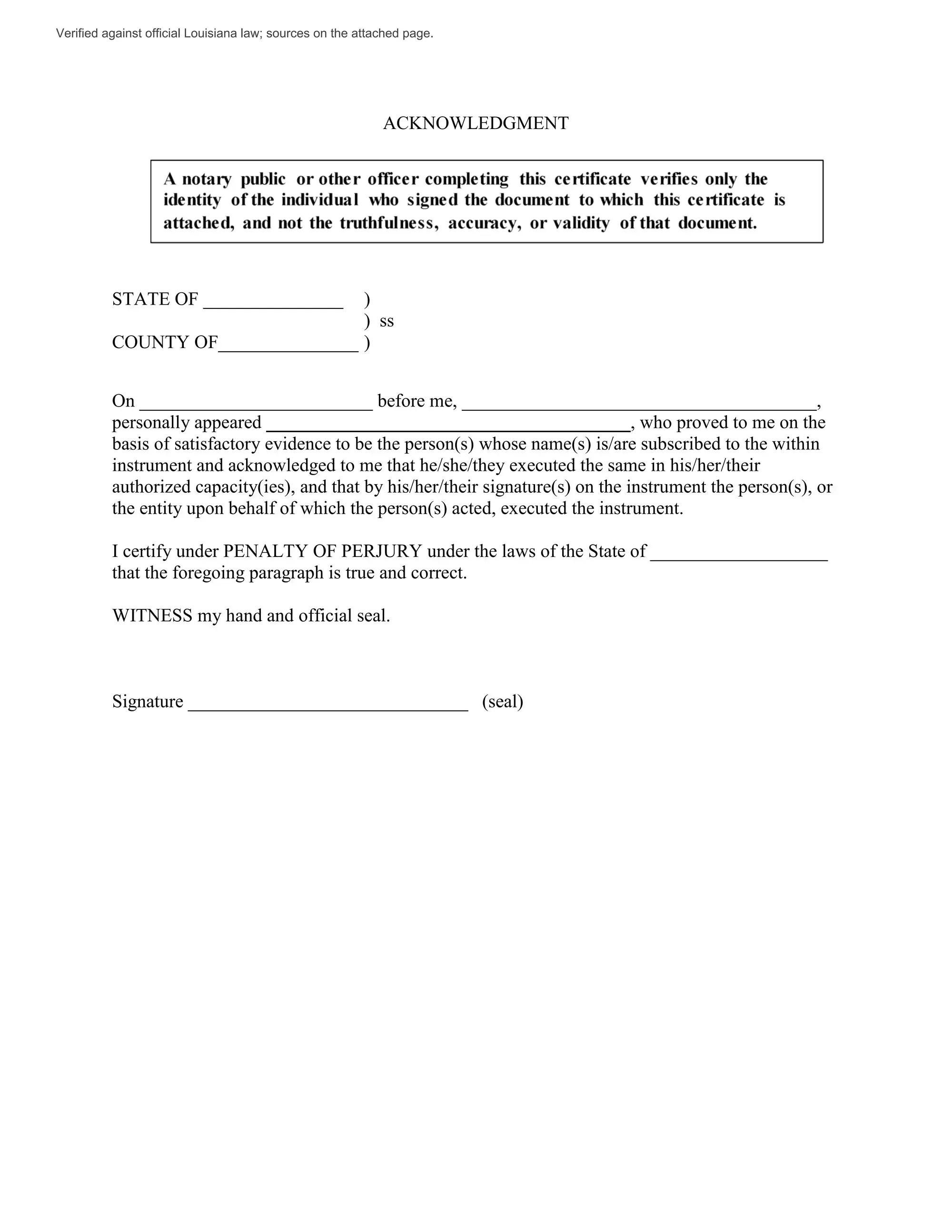
The FormsPal template has two form pages. Page 1 is a general acknowledgment. Page 2 shows the statute's wording for an individual, a representative and a corporation, with blanks for the date. The steps below follow the form from top to bottom. You can fill in the PDF on screen with our online PDF editor.
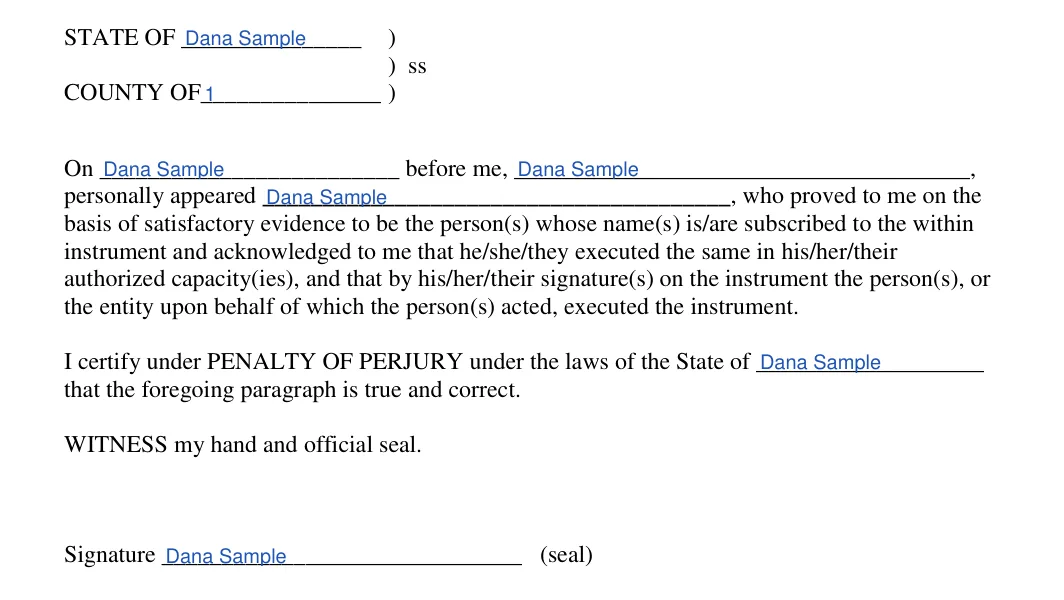
The screenshots under each step show the FormsPal Louisiana notary acknowledgement template filled with sample entries in blue, so you can see where each answer goes. The names, addresses, dates and amounts are examples only.



Need a different state? Our hub lists the notary public acknowledgement forms for each state. Other Louisiana forms on FormsPal include a bill of sale, a lease agreement and a promissory note.
These answers come from La. Rev. Stat. § 35:511, the section that sets out Louisiana's acknowledgment certificate wording. Each answer covers one part of that wording: the individual certificate, the certificates for a representative or a corporation, and the caption that opens every certificate.[1]
Yes. La. Rev. Stat. § 35:511 sets out a certificate for an individual acting in his or her own right. The wording says the person appeared before the officer and acknowledged executing the instrument as a free act and deed.[1]
Yes. The statute has wording for a document signed for another person or an entity, and separate wording for a corporation or association. A natural person acting by attorney has a form too. Each one names the person who appeared and the party on whose behalf the instrument was executed.[1]
In all cases, it begins with a caption that names the state and the place where the acknowledgment is taken.[1]
General information, not legal or tax advice.
