
A Texas notary acknowledgement is the written certificate that an officer makes, signs and seals after taking a person's acknowledgment of a document.[1.2] The ordinary certificate must be substantially in the form that Section 121.007 of the Tex. Civ. Prac. & Rem. Code gives.[1.6] This page shows that wording for each kind of signer and walks you through the free FormsPal template.
Last Updated: October 2026. This guide is reviewed and updated regularly to reflect current Texas law. If you notice an error or outdated information, please contact us.
Build Your Document
Answer a few simple questions to make your document in minutes
Save and Print
Save progress and finish on any device, download and print anytime
Sign and Use
Your valid, lawyer-approved document is ready
After the officer completes the certificate, keep the original document together with the acknowledgment form. The office or person who asked for the notarization may want to see both.
The rules for a Texas acknowledgment sit in Chapter 121 of the Tex. Civ. Prac. & Rem. Code. They cover what the officer puts in the certificate, how the officer confirms who is signing, and which certificate wording Texas recognizes. The points below come from that chapter.
In Texas, an instrument concerning real or personal property may be recorded if it has been acknowledged, sworn to with a proper jurat, or proved according to law. An instrument conveying real property may not be recorded unless the grantor acknowledges or swears to it before two or more credible subscribing witnesses or before an authorized officer who certifies it (Tex. Prop. Code § 12.001).[3.1]
Before you go, bring a government-issued photo ID and the document you want acknowledged. Many banks, credit unions and shipping stores have a notary on staff, so call ahead to check.
Texas gives the ordinary certificate of acknowledgment as a short form, with a version for each kind of signer. Each version names the state and county, the date, and the person who appeared. It ends with the officer's signature, title and commission expiration date.[1.7] The version for an individual reads as follows.
For a natural person acting in his own right: State of Texas County of ____________ This instrument was acknowledged before me on (date) by (name or names of person or persons acknowledging). (Signature of officer) (Title of officer) My commission expires: ________
Section 121.008 of the Tex. Civ. Prac. & Rem. Code gives the other versions in this table.[1.7]
| Who is acknowledging | What the certificate names |
|---|---|
| A person acting as attorney-in-fact for a principal (see the Texas power of attorney forms) | The attorney-in-fact, and the principal on whose behalf the attorney-in-fact acts |
| A partnership | The acknowledging partner, partners, authorized officer or agent, and the partnership on whose behalf the document was executed |
| A corporation | The officer and the officer's title, the corporation, and its state of incorporation, on behalf of the corporation |
| A limited liability company | The acknowledging member, manager, authorized officer or agent, and the limited liability company on whose behalf the document was executed |
| A public officer, trustee, executor, administrator, guardian or other representative | The representative and the representative's title, and the entity or person represented |
Getting a document notarized in Texas usually takes one short visit to a notary public. The steps below walk you through that visit. The next section shows how the acknowledgment form itself is filled in.
Texas allows online notarization under Government Code chapter 406, subchapter C. An online notary public may perform an online notarization even if the signer is not physically located in Texas at the time. The online notary must verify the signer's identity during the notarization by two-way video and audio conference technology (Tex. Gov't Code § 406.110).[4.1]
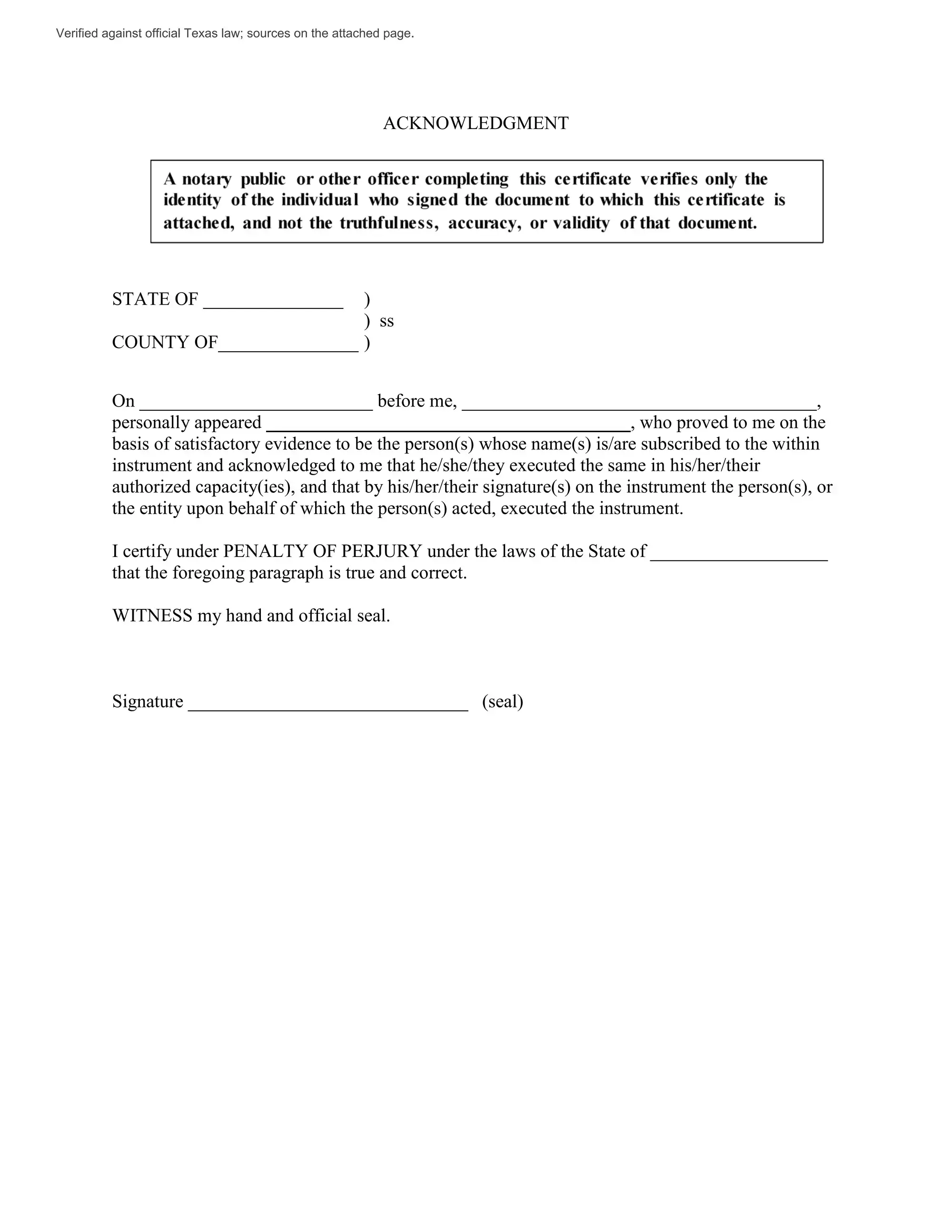
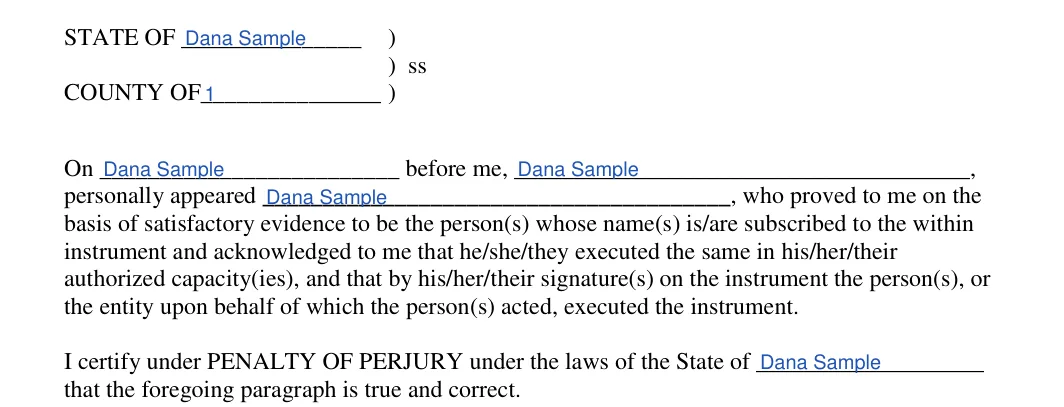
The FormsPal template has three pages, and each step below follows one part of the form in its own order. You fill in some lines and the notary public completes the others at the signing. Bring the document you want acknowledged, and fill in the county and the names before the appointment so the notary can check them against your ID.
The screenshots under each step show the FormsPal Texas notary acknowledgement template filled with sample entries in blue, so you can see where each answer goes. The names, addresses, dates and amounts are examples only.




Need a different notary statement? FormsPal also has state versions such as the California notary acknowledgement, the Florida notary acknowledgement and the New York notary acknowledgement. Other Texas forms on FormsPal include the Texas affidavit forms, the Texas bill of sale, the Texas living will and the Texas DNR form.
These short answers come from Chapter 121 of the Tex. Civ. Prac. & Rem. Code. Each one covers a question people often ask about a Texas notary acknowledgement certificate, from the seal to changing the wording.
The officer makes a certificate of the acknowledgment, signs it, and seals it with the seal of office.[1.2] Before taking the acknowledgment, the officer must know or have satisfactory evidence that the person acknowledging is the person who executed the instrument.[1.4] The certificate then follows the Texas wording for the signer, such as an individual or an attorney-in-fact.[1.7]
Yes, the officer must seal the certificate with the seal of office.[1.3] Texas law adds three related rules.
Yes. An acknowledgment form provided by Chapter 121 may be altered as circumstances require, and the authorization of a form does not prevent the use of other forms.[1.5] The statutory forms may also be used as alternatives to other authorized forms, and they may be called "statutory forms of acknowledgment."[1.7]
The officer must establish the identity of the person acknowledging before taking the acknowledgment. The officer can rely on personal knowledge, satisfactory evidence, or a government issued photo identification document.[1.4] This is why you bring a photo ID to the notary public, along with the document you want acknowledged.
Texas recognizes separate certificate wording for each kind of signer, so pick the version that matches who is signing. A corporation certificate names the officer and title, while a partnership certificate names the acknowledging partner or authorized agent and the partnership. A limited liability company certificate names the member, manager or other authorized person and the company. The table in the wording section above lists each version.[1.7]
General information, not legal or tax advice.
