
An Oklahoma notary acknowledgement is a written certificate in which a notary (the notarial officer) certifies that a person acknowledged a document before the officer.[1.2] Oklahoma law requires the certificate to be signed and dated by the notarial officer.[1.1] People often attach it to deeds, trusts, mortgages and other important documents. Use the free form below to create your own certificate, then take it to a notary.
Last Updated: October 2026. This guide is reviewed and updated regularly to reflect current Oklahoma law. If you notice an error or outdated information, please contact us.
Build Your Document
Answer a few simple questions to make your document in minutes
Save and Print
Save progress and finish on any device, download and print anytime
Sign and Use
Your valid, lawyer-approved document is ready
This page covers Oklahoma only. For other states, see our printable notary acknowledgement forms.
Under Okla. Stat. tit. 49, § 118, a notarial act must be evidenced by a certificate. The notarial officer must sign the certificate and date it. The certificate must also name the jurisdiction in which the act is performed and give the title of the officer's office.[1.1]
When the officer executes the certificate, the officer certifies that the officer has made the determinations Section 3 of the act requires. In plain words, the officer confirms that the checks the law requires were made.[1.1]
A certificate is sufficient if it meets the requirements above and it does one of the following:
In short, a valid Oklahoma certificate has three working parts: the signature and date of the officer, the place of the act, and the title of the office.[1.1]
In taking an acknowledgment, the notarial officer must determine, from personal knowledge or satisfactory evidence, that the person appearing before the officer and making the acknowledgment is the person whose true signature is on the document (Okla. Stat. tit. 49, § 113).[2.1]
Okla. Stat. tit. 49, § 119 recognizes certificate wording for three situations: an individual, a person acting in a representative capacity, and a statement made on oath or affirmation. The text of each wording below is quoted from the statute.[1.2]
Each wording ends with the same lines:
Use this wording when a person acknowledges a document in his or her own right.[1.2]
This instrument was acknowledged before me on (date) by (name(s) of person(s)). (Signature of notarial officer) (Seal, if any) Title (and Rank) (My commission expires: )
Use this wording when a person signs for another person or for an entity and acknowledges the document in a representative capacity.[1.2]
This instrument was acknowledged before me on (date) by (name(s) of person(s)) as (type of authority, e.g., officer, trustee, etc.) of (name of party on behalf of whom instrument was executed). (Signature of notarial officer) (Seal, if any) Title (and Rank) (My commission expires: )
When a person signs a statement on oath or affirmation, the officer certifies in writing that the statement was signed and sworn to or affirmed before the officer.[1.2]
State of County of Signed and sworn to (or affirmed) before me on (date) by (name(s) of person(s) making statement). (Signature of notarial officer) (Seal, if any) Title (and Rank) (My commission expires: )
The statutory text is a template with blanks in parentheses. The text in each pair of parentheses tells the officer what to fill in. Here is what each blank asks for:
The oath wording also opens with a State and County line, which names the place of the act.[1.2]
Okla. Stat. tit. 49, § 119 recognizes three wordings, and the right one depends on who signs and in what role. Think of it as a choice of signer type. The table below puts them side by side so you can match your document to the wording.[1.2]
| Wording | Fits when | What it adds |
|---|---|---|
| Individual capacity | A person acknowledges a document in his or her own right | The date and the name of each person |
| Representative capacity | A person acknowledges a document signed for another person or an entity | The type of authority and the party on whose behalf the document was executed |
| Oath or affirmation | A person signs a statement that is sworn to or affirmed | A State and County line and the words "signed and sworn to (or affirmed)" |
If you are not sure which wording your document needs, ask the office or person who asked for the document.
Getting a document notarized in Oklahoma usually takes one short visit to a notary public. The steps below walk you through that visit. The next section shows how the acknowledgment form itself is filled in.
The free Oklahoma notary acknowledgment form is a one-page certificate with two parts. The first part records where the acknowledgment took place, the date and the names. The second part holds the notary's signature, the seal area and the title of office.
The screenshots under each step show the FormsPal Oklahoma notary acknowledgement template filled with sample entries in blue, so you can see where each answer goes. The names, addresses, dates and amounts are examples only.
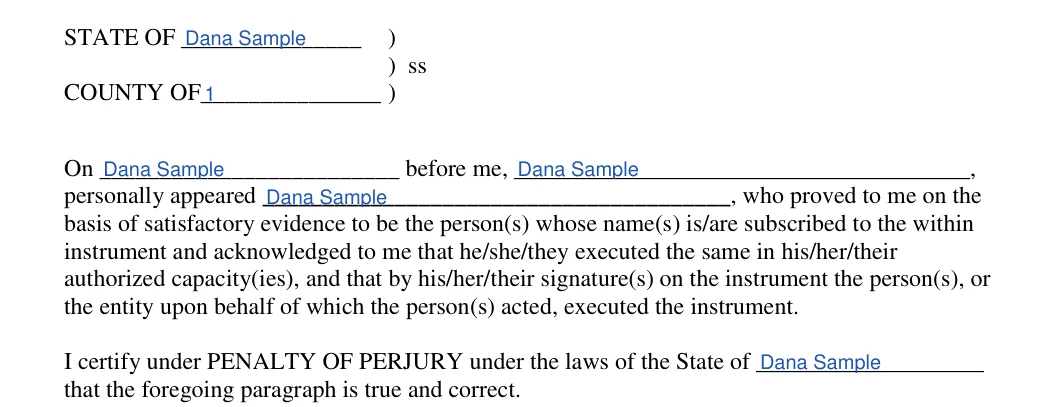

These lines match what Oklahoma law asks a certificate to show. The State and County lines identify the jurisdiction, and the Title of office line gives the title of the notarial officer's office.[1.1]
This section answers a common question about this form. The answer is based on the certificate wording in Okla. Stat. tit. 49, § 119, which is the same wording quoted earlier on this page.[1.2]
A notary acknowledgment form is the certificate, also called the notary statement, by which the officer who takes an acknowledgment certifies it in writing. Oklahoma law recognizes a certificate form for an individual acting in his or her own right: "This instrument was acknowledged before me on (date) by (name(s) of person(s))."[1.2]
General information, not legal or tax advice.
