
A Pennsylvania notary acknowledgement is a written certificate in which a notary public certifies that a person acknowledged a document before the notary. In Pennsylvania, a notary can take your acknowledgment that you have already signed a document, or witness your signature as you sign the document in front of the notary.[2] The officer who takes the acknowledgment certifies it in writing, and the statute gives short-form wording for that certificate.[1] Download the free Pennsylvania notary acknowledgement form PDF below, or build a personalized copy online.
Last Updated: October 2026. This guide is reviewed and updated regularly to reflect current Pennsylvania law. If you notice an error or outdated information, please contact us.
Build Your Document
Answer a few simple questions to make your document in minutes
Save and Print
Save progress and finish on any device, download and print anytime
Sign and Use
Your valid, lawyer-approved document is ready
The short-form notary certificates are in Section 316 of the 57 Pa.C.S. Each one is sufficient for the purposes indicated when it is completed with the information that section 315(a) and (b) requires for a certificate of a notarial act.[1] The statute gives wording for individual and representative acknowledgments, oaths, witnessing a signature, copies and deposition transcripts, plus one certificate for a lawyer.
An individual acting in their own right may acknowledge a document. The officer who takes the acknowledgment certifies it in writing, and the statute's certificate for an individual reads:
State of County of This record was acknowledged before me on (date) by (name(s) of individual(s)) Signature of notarial officer Stamp Title of office My commission expires:
Each of the short forms in this section ends with the same lines for the notary.[1] They are:
The same section supplies six more certificates.[1] The table shows what each one says.
| Certificate | What the officer certifies |
|---|---|
| Acknowledgment in a representative capacity | The named individual(s) acknowledged the record as an officer, trustee or other type of authority, and represent that they are authorized to act on behalf of the named party. |
| Verification on oath or affirmation | The named individual(s) signed and swore to (or affirmed) the statement before the officer. |
| Witnessing or attesting a signature | The named individual(s) signed (or attested) before the officer. |
| Certifying a copy of a record | The officer certifies that the document is a true and correct copy of a named record in the possession of a named holder. |
| Acknowledgment by an attorney | A named lawyer gives a Supreme Court identification number as a member of the bar of the Pennsylvania Supreme Court. The lawyer certifies being personally present when the named individual(s) signed the record for the purposes contained in it. |
| Certifying a deposition transcript | The officer certifies that the document is a true and correct copy of the transcript of a named deposition. |
Need wording for a different state? See FormsPal's printable notary acknowledgement forms.
Getting a document notarized in Pennsylvania usually takes one short visit to a notary public. The steps below walk you through that visit, and they are general practice unless a source is cited. The next section shows how the acknowledgment form itself is filled in.
A notary public located in Pennsylvania may also perform a notarial act by communication technology for a signer who is located remotely (57 Pa.C.S. § 306.1).[2]
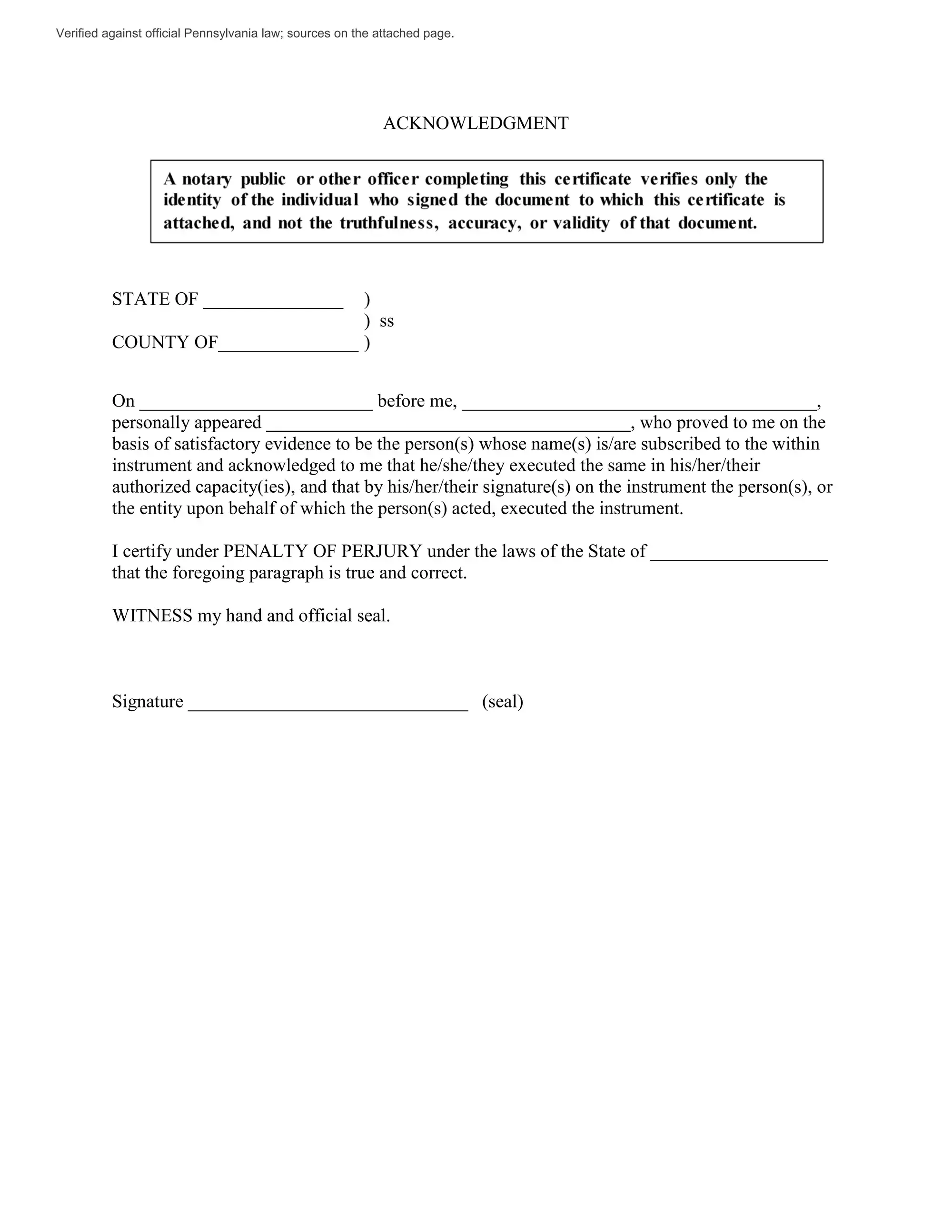
The free Pennsylvania notary acknowledgement form PDF is a one-page acknowledgment with seven fill-in lines. It has a state and county heading, one paragraph for the person who signed, a sentence under penalty of perjury and a signature line with a seal mark. You can fill it out online and download it as a PDF or Word file.
The template paragraph says the person who appeared proved to the notary, on the basis of satisfactory evidence, to be the person who signed the document. It is not the short form quoted in Section 316. That form has lines for the notary's stamp, title of office and commission details. The template has a seal mark instead.
Ask the person who requested your document whether the template wording is acceptable before you visit the notary public.
The screenshots under each step show the FormsPal Pennsylvania notary acknowledgement template filled with sample entries in blue, so you can see where each answer goes. The names, addresses, dates and amounts are examples only.
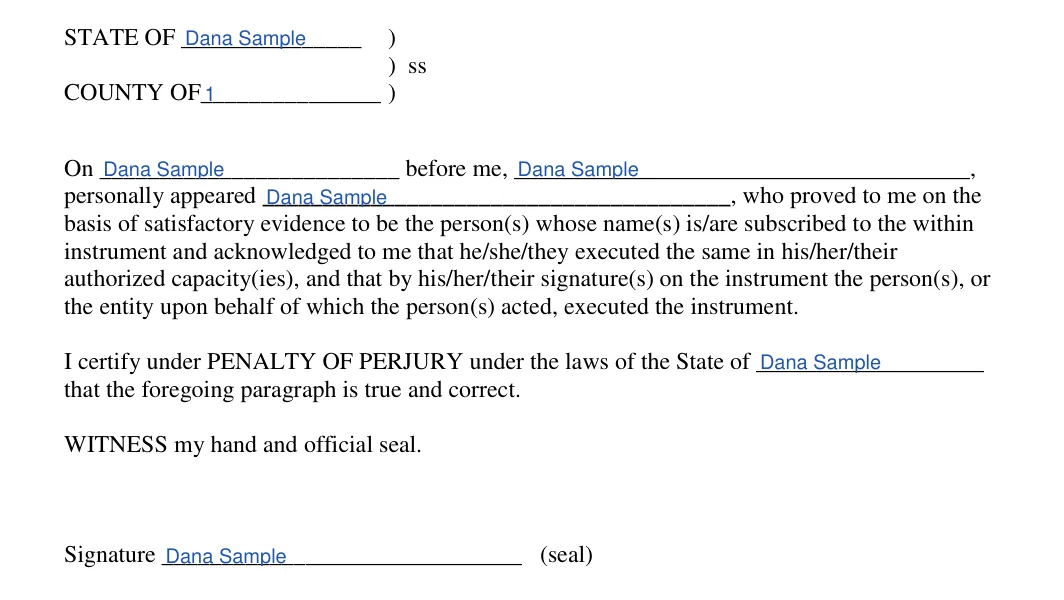
When the notary has completed the acknowledgment, check that every line is filled in and that the signature and seal are present before you send the document on.
The statute gives a short-form certificate for an acknowledgment by an individual. It covers the state and county, the date, the person who signed, and the notary's signature, stamp, title of office and commission expiration date. The question below points to the statute section that sets this wording.
Yes. Section 316 of the 57 Pa.C.S. includes a short-form certificate for an acknowledgment in an individual capacity. It is the wording quoted above.[1]
General information, not legal or tax advice.
This page relies on the Pennsylvania consolidated statutes. Section 316 of title 57 sets out the short-form notary certificates that are quoted and summarized above. The links open the statute text on the websites of the Pennsylvania General Assembly.
