
A notary acknowledgement is the notary's signed certificate, on or attached to a document, stating that the signer appeared, was identified and acknowledged signing it. The certificate confirms who signed, not that the document is true or valid. Most states publish their own certificate wording, so pick your state below or create a notary acknowledgement form online.
Last Updated: October 2026. This guide is reviewed and updated regularly to reflect current law. If you notice an error or outdated information, please contact us.
A notary public is a person commissioned under state law to verify the signing of documents. The notary checks who the signer is and, in many states, may refuse to act when the signer seems pressured or confused. A document is notarized when the notary completes a notarial certificate, signs it and, where the state requires it, adds a stamp or seal.
Documents commonly notarized include a power of attorney, deeds and affidavits. Whether a document must be notarized depends on the document and the state.
Notarization helps deter fraud by confirming who is signing and that they are signing willingly. Notaries perform several kinds of notarial acts, and the right one depends on the document and what it asks of the signer. The five covered here are:
In a jurat, the signer swears or affirms before the notary that the contents of the document are true. The signer must appear in person, and the notary administers the oath or affirmation. A false sworn statement can be treated as perjury.
Sometimes a signer takes an oath or affirmation out loud instead of giving it in writing, as in a jurat. An oath is sworn, while an affirmation is a solemn promise made on one's honor. Both have the same effect, and the signer chooses which one to take.
Copy certification confirms that a copy is a true and accurate reproduction of the original. The holder brings the original to the notary, who compares it with the copy and certifies it. Not every state lets notaries certify copies, and copies of public records such as birth certificates normally come from the office that keeps them.
Acknowledgment is one of the most common types of notarization. The signer appears before the notary, in person or by remote online notarization where the state allows it. The notary identifies the signer through personal knowledge or satisfactory evidence, usually a current government photo ID. The signer then confirms the signature is theirs and was made voluntarily.
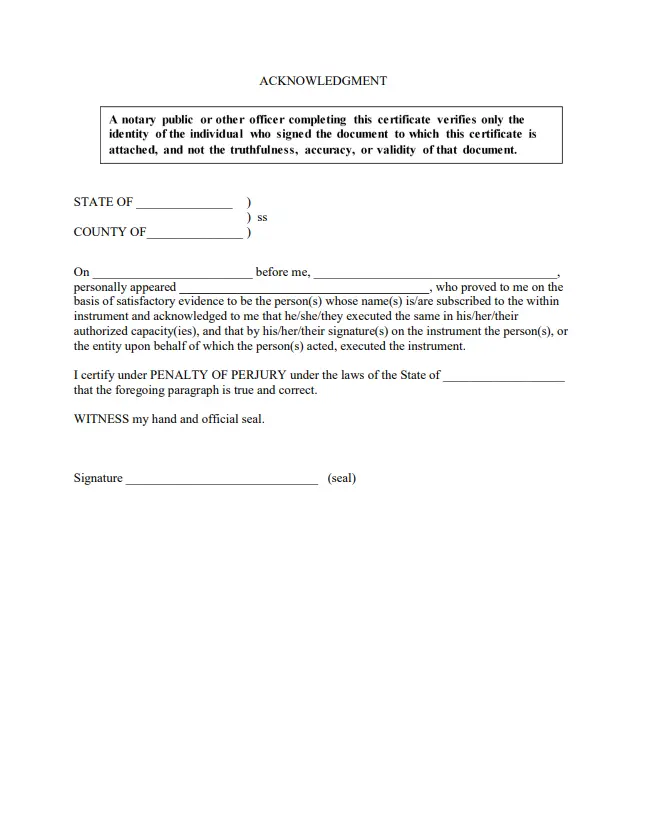
A notary confirms who signed, not that the document is true or valid.
Signature witnessing is similar to an acknowledgment. The difference is that the signer signs the document in front of the notary, who identifies the signer and watches the signing. It is available in states that provide for it.
A notary acknowledgement form is the certificate a notary completes when a signer acknowledges a signature. It records what the notary confirmed, so a reader can see who appeared, where and when. The certificate is written on the document or attached to it as a separate page. Most state forms include:
An acknowledgment certificate says the document was "acknowledged before me." A jurat says it was "signed and sworn to (or affirmed) before me," because the signer took an oath. Many certificates also say how the signer was identified, by personal knowledge or satisfactory evidence.
When someone signs for another person or an entity, as an officer, trustee, partner or attorney-in-fact, many states use a representative-capacity form that names who the signer acts for. Wording differs by state, so use the certificate wording of the state where the notarization happens. The state forms listed above show each one.
To get a proper notarization, prepare the document and find a commissioned notary. Then appear before the notary with a current government photo ID and let the notary complete and sign the certificate. The steps below take you through it in order. If you are unsure which notarial act your document needs, ask the office that requested it.
A notary certifies who signed and how the signing happened, not what the document says. These answers cover finding a notary, what one charges, whether a handwritten document can be notarized and how an acknowledgment differs from a jurat. Rules differ by state, so check the details where the notarization happens.
Start with places you already use, or search for one nearby:
Ask about the fee and which ID the notary accepts before the appointment.
Each state sets or limits what a notary may charge, so the cost varies. It also depends on the number of signatures or notarial acts. Mobile and online notaries may add a travel or platform charge, and some states require a notary who charges to show the fee schedule. Ask for the total before the appointment.
Yes, a handwritten document can usually be notarized. Notarization does not make a document valid, and a court or other proper authority decides that. The notary only certifies who signed and that the signer acknowledged the signature. The notary's certificate is written on the document or attached to it.
In an acknowledgment, the signer confirms the signature is theirs, and the certificate says the document was acknowledged before the notary. In a jurat, the signer swears or affirms the contents are true, and the certificate says it was signed and sworn to before the notary. For a jurat, the signer usually signs in front of the notary.
General information, not legal or tax advice.
