
Updated:
An Oregon power of attorney is a written document naming an agent. Under Or. Rev. Stat. § 127.005(1)(a), the document takes effect when executed unless its terms delay it. This page covers Oregon forms for money, health care, property, vehicles, taxes and children.
Key facts
Build Your Document
Answer a few simple questions to make your document in minutes
Save and Print
Save progress and finish on any device, download and print anytime
Sign and Use
Your valid, lawyer-approved document is ready
Each Oregon power of attorney form covers one kind of decision, from bank accounts and health care to a child's care. The chart below lists each Oregon template with its other names, signing notes and download links. It includes the Advance Directive form, Delegation of Parental/Guardian Powers, Form 735-500 for vehicles and Form 150-800-005 for taxes.
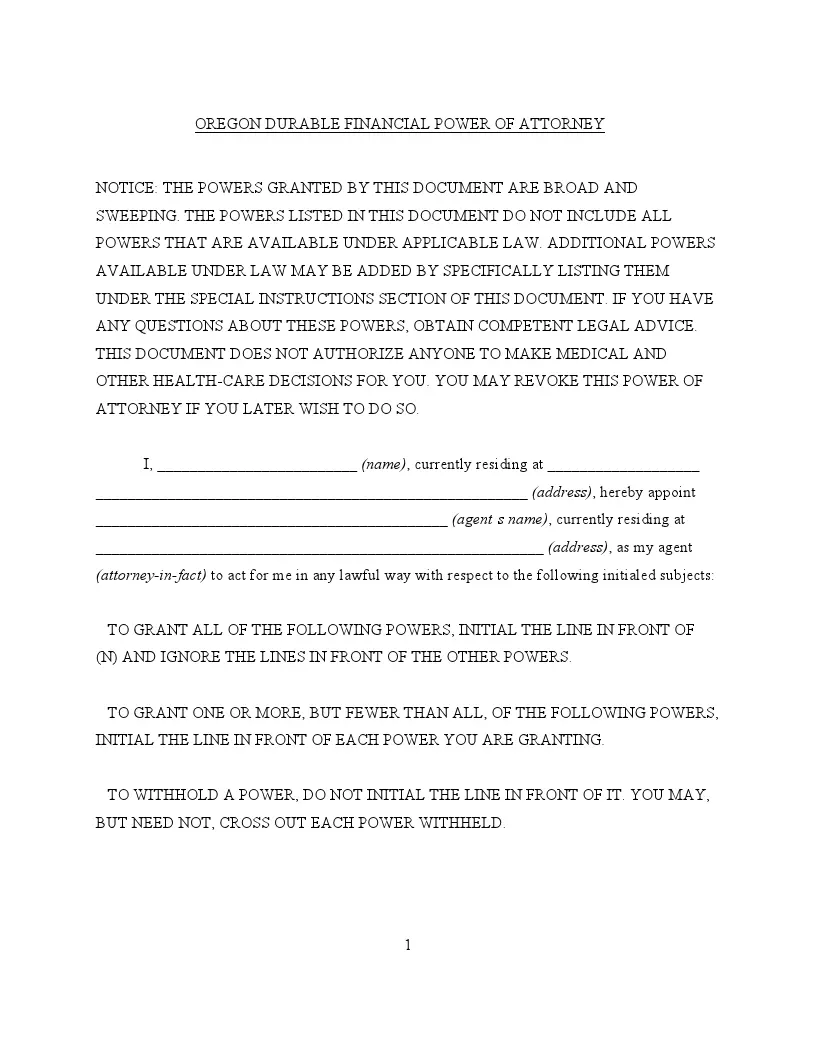
Durable power of attorney names an agent for the principal's money and property matters. Unless its terms say otherwise, the agent's powers continue even if the principal becomes financially incapable (ORS 127.005).
| Also Known As | Oregon DPOA |
| Signing Requirements | Grantor Only |
| Download | PDF Template |

Medical power of attorney (Advance Directive form in Oregon) appoints a health care representative who makes treatment decisions when the principal cannot decide. The form covers talks with medical staff and choices about life-sustaining treatment.
| Also Known As | Health Care POA or MPOA |
| Signing Requirements | Notary Public or Two (2) Witnesses |
| Download | PDF Template | Oregon Advance Directive |

General power of attorney gives an agent broad authority over the principal's finances and property. The agent's authority ends when the principal dies (ORS 127.015).
| Also Known As | Generic Financial POA |
| Signing Requirements | Grantor Only |
| Download | PDF Template |

Limited power of attorney gives an agent authority for one task or a short period. A principal who is away during a sale, for example, can name an agent to close it.
| Also Known As | Special POA |
| Signing Requirements | Notarization Is Advised |
| Download | PDF Template |

Child power of attorney (Delegation of Parental/Guardian Powers in Oregon) lets a parent name another person to care for a child while the parent is away. Unless the parent is a servicemember or the delegate is a school administrator, the delegation lasts no more than 6 months (Or. Rev. Stat. § 109.056).
| Also Known As | Minor POA |
| Signing Requirements | Notarization Is Advised |
| Download | PDF Template | Oregon Delegation of Parental/Guardian Powers |

Real estate power of attorney appoints an agent to manage the principal's real property, including sales and rentals.
| Also Known As | Limited Real Estate POA |
| Signing Requirements | Notarization Is Required in Specific Cases |
| Download | PDF Template |

State tax power of attorney (Form 150-800-005 in Oregon) appoints a representative for the principal's Oregon tax matters, including contact with the Department of Revenue.
| Also Known As | Tax POA |
| Signing Requirements | Grantor Only |
| Download | Form 150-800-005 |

Vehicle power of attorney (Form 735-500 in Oregon) lets an agent handle paperwork for the owner's vehicle at Oregon Driver & Motor Vehicle Services (DMV).
| Also Known As | DMV POA |
| Signing Requirements | Vehicle Owner Only |
| Download | PDF Template | Form 735-500 |

Revocation power of attorney ends an earlier power of attorney or removes an agent. The principal gives the former agent a copy, since an agent who acts in good faith without actual knowledge of an ending event still binds the principal (ORS 127.015).
| Also Known As | POA Termination Form |
| Signing Requirements | Notarization Is Advised |
| Download | PDF Template |
Power of attorney forms for other states.

Other Oregon forms for wills, small estates, sales, leases and evictions.
The right Oregon power of attorney form depends on what the agent will handle and for how long. Start with the goal, then match it to one of the types in the chart.
Many people need more than one document. Someone who owns a home and travels often, for example, might look at a durable form for money matters and a medical form for health care.
Getting an Oregon power of attorney means completing the right form, naming an agent and signing it in the way that form calls for. Or. Rev. Stat. § 127.005 governs the document when a principal designates an agent in writing.
An Oregon advance directive or a form appointing a health care representative needs two adult witnesses or a notary public (Or. Rev. Stat. § 127.515).
| Form | Signing rule | Source |
|---|---|---|
| Advance directive (medical POA) | Witnessed and signed by at least two adults, or notarized by a notary public | Or. Rev. Stat. § 127.515 |
| Advance directive witnesses | On the signing date, not the attending physician, attending provider, health care representative or alternate representative | Or. Rev. Stat. § 127.515 |
| Durable, general, limited, tax and vehicle forms | No witness or notary rule in the sources behind this page; see the signing note in the chart | None |
| Real estate form | The chart notes that notarization is required in specific cases; the sources behind this page do not name those cases | None |
On the day the form is signed or acknowledged, the witnesses may not be the principal's attending physician or attending health care provider (Or. Rev. Stat. § 127.515). The witnesses also may not be the principal's health care representative or alternate health care representative (Or. Rev. Stat. § 127.515).
The durable, general, limited, tax and vehicle forms carry no witness or notary rule in the sources this page relies on. For the real estate form, those sources do not say which cases need a notary. A bank or office that will accept the document can say what it expects before the signing.
The agent in an Oregon power of attorney is the person who acts for the principal, the adult who signs the document and grants the authority. The document sets what the agent may decide and what the principal keeps.
Unless the power of attorney provides otherwise, the agent must use the principal's property for the principal's benefit (Or. Rev. Stat. § 127.045).
If a conservator is appointed for the principal, the agent accounts to the conservator rather than to the principal for as long as the conservatorship lasts (Or. Rev. Stat. § 127.005). The conservator has the same power the principal would have to revoke, suspend or terminate all or any part of the power of attorney (Or. Rev. Stat. § 127.005).
A good agent is someone the principal trusts, who is organized and easy to reach. A talk before signing tells the agent what the principal expects. A backup agent, where the form has room for one, steps in if the first choice is not able to serve.
An Oregon durable power of attorney keeps working if the principal becomes financially incapable, unless its own terms delay or limit it (ORS 127.005).
A durable form fits money matters such as bank accounts, bills and property that need care during an illness. The Oregon durable power of attorney page covers this form in detail.
A springing power of attorney is written to take effect only when the principal becomes financially incapable. If the document names no one to make that determination, or no named person is willing or able, any physician may make it (Or. Rev. Stat. § 127.005). When a physician makes the determination, it must be in writing (Or. Rev. Stat. § 127.005).
The Oregon advance directive is the form that names a health care representative to make treatment decisions when the principal cannot decide.
Under Or. Rev. Stat. § 127.505, a principal includes an adult who has executed an advance directive and a person of any age who has a health care representative. The advance directive follows the witness and notary rule in the signing section above. An Oregon living will form sets out treatment wishes in writing.
The Oregon Delegation of Parental/Guardian Powers lets a parent or guardian give another person care, custody or property powers over a minor child (Or. Rev. Stat. § 109.056).
| Delegation to | Longest term | Source |
|---|---|---|
| Another person | 6 months | Or. Rev. Stat. § 109.056 |
| A school administrator | 12 months | Or. Rev. Stat. § 109.056 |
| A delegate of a servicemember-parent | The term of active duty service plus 30 days | Or. Rev. Stat. § 109.056 |
The delegation covers every such power except the power to consent to adoption of a minor ward (Or. Rev. Stat. § 109.056). The Oregon child power of attorney form page covers the form itself.
The authority of an agent under an Oregon power of attorney ends on any of five events listed in ORS 127.015.
The power of attorney itself remains in effect until the principal revokes it, its terms end it or the authority of all agents has ended (Or. Rev. Stat. § 127.005(1)(a)).
An agent who acts in good faith without actual knowledge of the principal's death or another ending event still binds the principal and the principal's heirs, unless the act is otherwise invalid (ORS 127.015).
A revocation form puts the principal's decision to end a power of attorney in writing.
Most problems with an Oregon power of attorney come from a form that does not match the task or a signing step left out.
Oregon power of attorney rules sit in Chapter 127 of the Oregon Revised Statutes, with the delegation of parental powers in Chapter 109. The official Oregon Legislature website has the full text of both chapters.
An Oregon power of attorney is made by completing the form for the job, naming an agent and signing it, with two adult witnesses or a notary for an advance directive (Or. Rev. Stat. § 127.515). The steps above list each action.
An Oregon advance directive needs a notary public or, instead, two adult witnesses (Or. Rev. Stat. § 127.515). The sources behind this page set no notary rule for the financial forms.
An Oregon power of attorney stays in effect if the principal becomes financially incapable, unless its terms delay or limit it (ORS 127.005).
An Oregon power of attorney remains in effect until the principal revokes it, its terms end it or all agents' authority ends, unless its terms say otherwise (Or. Rev. Stat. § 127.005(1)(a)). A delegation of parental powers is the exception, lasting no more than 6 months unless the delegate is a school administrator or the parent is a servicemember (Or. Rev. Stat. § 109.056).
An Oregon agent must use the principal's property for the principal's benefit, unless the power of attorney provides otherwise (Or. Rev. Stat. § 127.045).
No person, a bank included, may refuse to recognize an agent's authority based solely on the time passed since the power of attorney was executed (Or. Rev. Stat. § 127.025).
General information, not legal or tax advice.
