
A Wisconsin LLC operating agreement is the agreement that governs a limited liability company's internal affairs, such as how the business is run and how the agreement is amended.[1.2] The free FormsPal template on this page is for a one-owner LLC. Fill it out online, or download it as a PDF, Word or OpenDocument file.
Last Updated: October 2026. This guide is reviewed and updated regularly to reflect current Wisconsin law. If you notice an error or outdated information, please contact us.
Build Your Document
Answer a few simple questions to make your document in minutes
Save and Print
Save progress and finish on any device, download and print anytime
Sign and Use
Your valid, lawyer-approved document is ready
Popular Local Operating Agreement Forms
An operating agreement is an instrument that describes the LLCs’ ownership, management, and every member’s obligations and rights. Check other printable operating agreement templates regularly downloaded by our users.
Chapter 183 of the Wisconsin Statutes is the state's LLC statute. It lets an operating agreement govern the internal affairs of an LLC in Wisconsin. Under Wis. Stat. § 183.0105, the agreement controls the matters listed below, within the limits the statute sets.[1.2]
Except as subsections (3) and (4) of § 183.0105 provide otherwise, the operating agreement of a Wisconsin LLC governs all of the following:[1.2]
To the extent the agreement does not provide for one of these matters, Chapter 183 governs the matter.[1.2]
An LLC is bound by its operating agreement and may enforce it. This is true whether or not the LLC has itself manifested assent to the agreement. A person who becomes a member is deemed to assent to the operating agreement.[1.3]
Two or more people who intend to become the initial owners may make an agreement providing that it becomes the operating agreement when the LLC is formed.[1.3] The obligations of the LLC and its owners to a transferee, or to a person dissociated as a member, are governed by the operating agreement.[1.4]
The statute defines a written operating agreement in § 183.0102.[1.1]
"Written operating agreement" means an operating agreement, or part thereof, that is set forth in a record.
Wisconsin also requires the LLC to keep a copy of all written operating agreements, and any amendments to and restatements of them, at its principal office (Wis. Stat. § 183.01075(5)).[1.5]
Wis. Stat. § 183.0105 limits what an operating agreement can do. Three of the limits are listed below. The agreement may not:
A court decides as a matter of law whether a term of an operating agreement is manifestly unreasonable. The court decides as of the time the challenged term became part of the agreement, and it considers only circumstances existing at that time.
It may invalidate the term only in a narrow case. In light of the LLC's purposes, activities, and affairs, it must be readily apparent that the objective of the term is unreasonable. It may also invalidate the term if the term is an unreasonable means to achieve its objective.[1.2]
A written agreement for an LLC in Wisconsin usually sets out how the LLC is run and how its owners deal with each other. The topics below are common in practice. They are general suggestions, not legal requirements in Wisconsin, so adapt them to your LLC.
If an owner makes a contribution, it may be money or property transferred to the LLC, services performed for it, or another benefit provided to it (Wis. Stat. § 183.0402(1)). By default, distributions are shared in proportion to the value of the contributions each member made (Wis. Stat. § 183.0404(1)).[1.6]
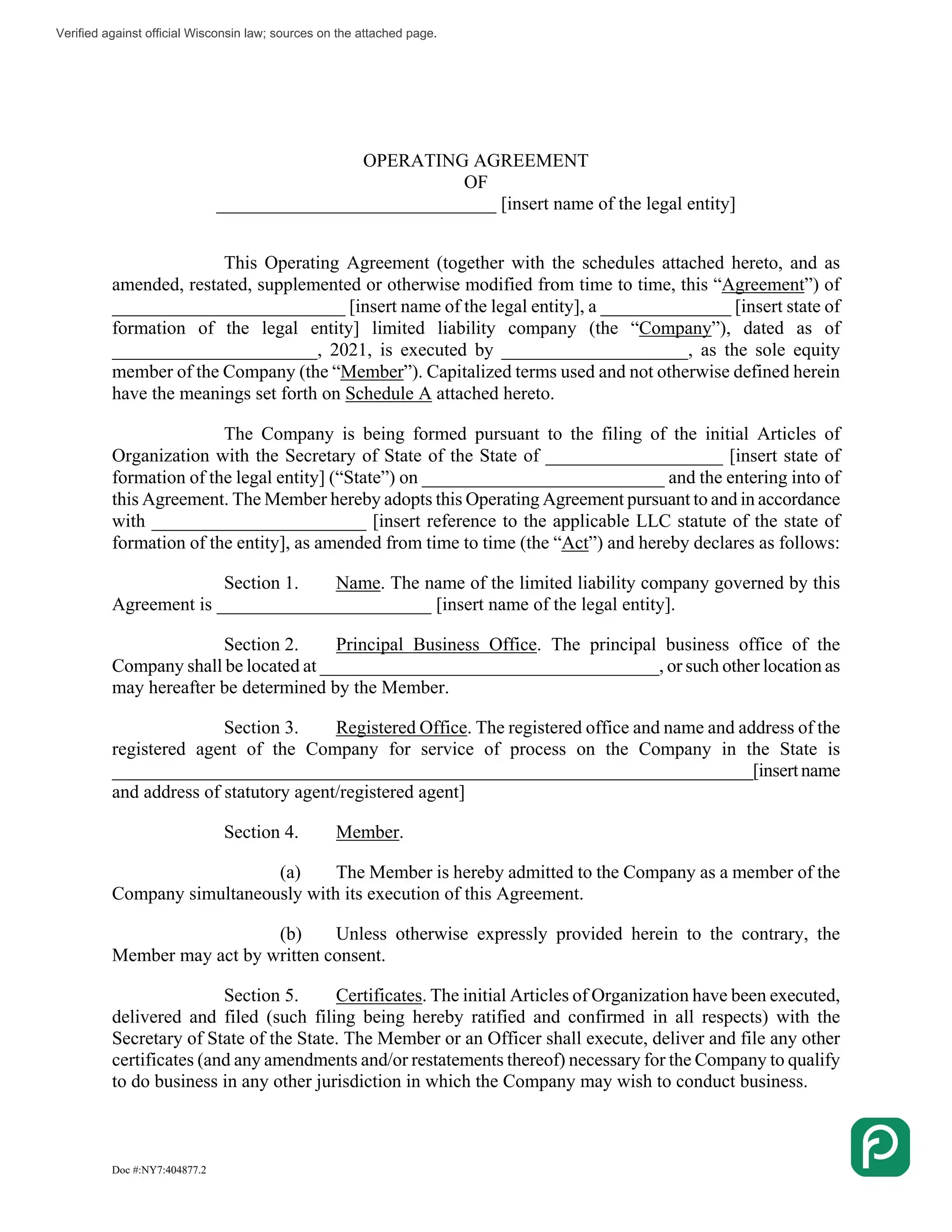
The FormsPal LLC operating agreement template for Wisconsin is a 31-section agreement for a Wisconsin LLC with one owner, followed by three schedules. The table below groups the sections by what they do, and the preamble has a field for the state. This lets you see what the agreement covers before you fill it out. Schedules A, B and C hold the definitions, the owner, Managers and Officers, and the initial capital contribution.
| Sections | Topic | What it covers |
|---|---|---|
| Sections 1 to 5 | LLC details | The LLC's legal name, principal business office, registered office and agent, the owner, and the initial Articles of Organization (the template's term for the formation filing). |
| Sections 6 to 9 | Purposes and management | The purposes of the business, its powers, and the Managers and Officers. The template is manager-managed, with a Board of one or more Managers. |
| Sections 10 to 17 | Money and responsibility | Liability protection, capital contributions, profits and losses, distributions, the fiscal year, other business, and exculpation and indemnification. |
| Sections 18 to 22 | Changes in ownership | Assignment, resignation, admitting additional members, dissolution and waiver of partition. |
| Sections 23 to 29 | Closing clauses | The standard closing clauses, from third-party rights through notices, including how the agreement is amended. |
| Sections 30 and 31 | Effectiveness and tax status | The agreement takes effect when the initial Articles of Organization are filed, and states the intent that the LLC be treated as a disregarded entity for federal tax purposes. |
One owner only. This Wisconsin single member LLC template names one owner in the preamble, in Section 4 and on Schedule B. If your LLC has more than one owner, this template does not fit as written.
The FormsPal template is a single-member agreement, signed by one owner as the sole equity member of the LLC. It has 31 numbered sections and three schedules, but you only fill in the blanks and tick the boxes listed below. Work through them in the order they appear on the page.
Gather these details first, so you can complete the agreement in one sitting.
Wisconsin law sets rules for two of these details. The LLC's name must contain the phrase "limited liability company" or "limited company" or the abbreviation "LLC" or "LC", and it must be distinguishable on the records of the Department of Financial Institutions (Wis. Stat. § 183.0112). You or another member can be the registered agent if you live in Wisconsin and your business office is the registered office, and the agent must have an e-mail address and a place of business or activity in Wisconsin (Wis. Stat. § 183.0115).[1.7]
To edit the downloaded PDF on screen, use our online PDF editor.
The answers below cover what an operating agreement may govern, what applies when it is silent and whether the LLC is bound by it. Each answer comes from Chapter 183 of the Wisconsin Statutes, the state's LLC statute, and the sources are listed at the end of this page.
Yes, the statute lets the agreement of a Wisconsin LLC govern the LLC's internal affairs. That covers the members' relations, a manager's rights and duties, the LLC's activities and the means for amending the agreement.[1.2]
To the extent the operating agreement of a Wisconsin LLC does not provide for a matter it may govern, Chapter 183 governs the matter.[1.2]
Yes. An LLC is bound by and may enforce the operating agreement, whether or not the LLC has itself manifested assent to it.[1.3]

General information, not legal or tax advice.
