
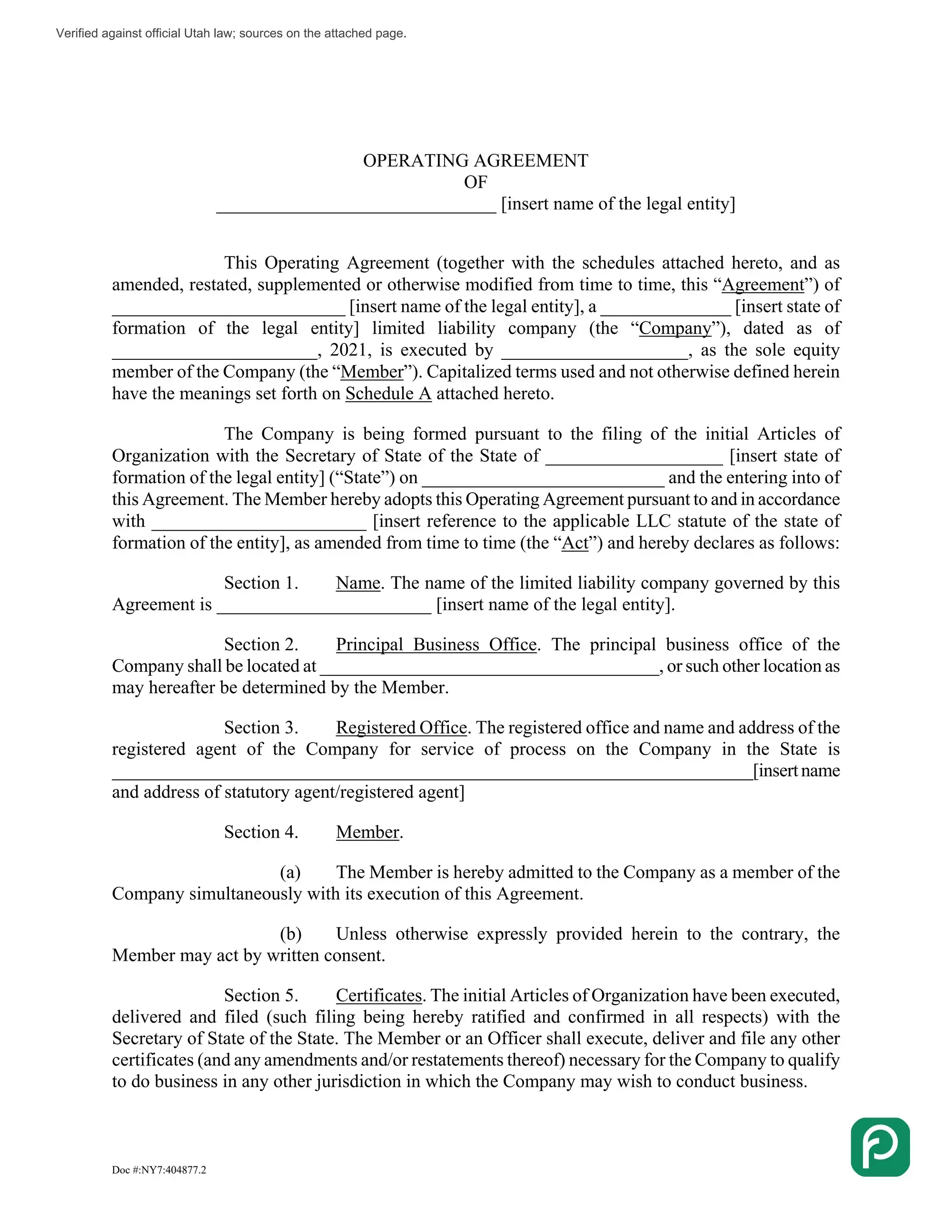
A Utah LLC operating agreement is an agreement among the members of a limited liability company, including a sole member, that sets the company's internal rules. Under Utah's LLC Act, it governs how the members deal with each other and the company, how managers act, how the business is run and how the agreement is amended.[2] It can be oral, implied or written.[1] This FormsPal template is for a Utah LLC with one member, and you can fill it out online or download it.
Last Updated: October 2026. This guide is reviewed and updated regularly to reflect current Utah law. If you notice an error or outdated information, please contact us.
Build Your Document
Answer a few simple questions to make your document in minutes
Save and Print
Save progress and finish on any device, download and print anytime
Sign and Use
Your valid, lawyer-approved document is ready
Utah's LLC Act, found in Chapter 3a of Title 48 of the Utah Code, lets the members of an LLC write their own operating agreement. The statute defines the agreement as the agreement of all the members, including a sole member, whether oral, implied, in a record or any combination of these.[1] Where the agreement is silent, the statute governs the matter.[2]
Under Utah Code § 48-3a-304, a debt, obligation or other liability of a Utah LLC is solely the company's own. A member or manager is not personally liable for it solely by reason of being or acting as a member or manager.[3]
Under Utah Code § 48-3a-112, the operating agreement governs four things, except where the statute says otherwise.[2]
The statute also says what happens to a matter the agreement does not cover.
To the extent the operating agreement does not provide for a matter described in Subsection (1), this chapter governs the matter.
Members can reshape the fiduciary duties they owe, but only if the change is not unconscionable or against public policy. Within that limit, the agreement may do four things.
In a member-managed LLC, the agreement can also move a responsibility from one member to others. Suppose it expressly relieves a member of a responsibility the member would otherwise have under the chapter and imposes that responsibility on one or more other members. The agreement may then also eliminate or limit any fiduciary duty that came with it, to the benefit of the member it relieves.[2]
The agreement may also set a method for approving an act that would otherwise violate the duty of loyalty. One or more disinterested and independent persons can authorize or ratify the act after full disclosure of all material facts.[2]
A court can strike a term of an operating agreement only in narrow cases. It judges the term as of the time it became part of the agreement and considers only the circumstances that existed then. It may invalidate the term only if one thing is readily apparent, given the company's purposes, activities and affairs. The term's objective, or the means to reach it, must be unconscionable or against public policy. The court decides that question as a matter of law.[2]
Because a Utah operating agreement can be oral or implied, a signed written copy is the clearest record of what the members agreed. Keep it with the company's records.
Popular Local Operating Agreement Forms
An LLC operating agreement is a document that customizes the terms of a limited liability company by the specific requirements of its owners and details the principles of internal decision-making in an organized fashion. Discover more about the most popular US states searched by our visitors when it comes to operating agreements.
The Utah LLC operating agreement template is a form of about 15 pages for an LLC with one member, whom the form calls the Member. The company is manager-managed, so the form also names the Managers and sets out its management structure. Work through it in order. The first page holds the name and address blanks, and the rest are checkboxes, dates and the schedules at the end.
Have these business details ready before you open the form, and check each one against your state filing.
When every blank is complete, read the agreement once from the first page to the last, sign the Member line, and keep a copy with the LLC's business records. To complete the downloaded PDF on screen, use our PDF editor.
Need a template for another state? Start from our LLC operating agreement template page.
In Utah, the filing that forms the LLC is a certificate of organization, which the organizers deliver to the Division of Corporations and Commercial Code. It states the LLC's name, its principal office address and the registered agent information that Utah Code § 16-17-203(1) requires, while the operating agreement itself is not filed with the state (Utah Code § 48-3a-201).[4]
Under Utah Code § 48-3a-108, the company name must be distinguishable on the division's records from the actual, reserved, or fictitious or assumed name of any entity registered with the division.[5]
These questions cover writing your own agreement, what happens without one, whether it can be oral, what it can change about the duties members owe, and when a court can strike a term. Each answer comes from the Utah LLC Act.
Yes, within the limits the statute sets. Utah's LLC Act makes the operating agreement the members' own agreement. It governs how the members deal with each other and the company. It also covers the rights and duties of managers, how the company's activities and affairs are carried on, and how the agreement is amended.[2]
To the extent an operating agreement does not provide for a matter it can govern, the Utah LLC Act governs that matter. In other words, where the agreement is silent, the statute covers it.[2]
Yes. The statute defines an operating agreement as the agreement of all the members, including a sole member. It counts whether or not it is called an operating agreement and whether it is oral, implied, in a record or any combination of these.[1] Many LLCs still put the terms in writing so the members can see exactly what they agreed.
Yes, but only if the change is not unconscionable or against public policy. Within that limit, the agreement may do these things.
The law section above gives the details.[2]
Only in narrow cases. The court looks at the term as of the time it became part of the agreement. It may invalidate the term only if it is readily apparent that the term's objective, or the means to reach it, is unconscionable or against public policy. The court decides that question as a matter of law.[2]

General information, not legal or tax advice.
