
A South Dakota non-compete agreement is a written promise by a worker not to compete with an employer for a set time. The state allows it on the terms of S.D. Codified Laws § 53-9-11, which limit it to two years from the date the agreement ends and tie it to a specified county, municipality, or other area.[2] You can make a South Dakota non-compete agreement below, then fill it in, print it, and sign it.
Last Updated: October 2026. This guide is reviewed and updated regularly to reflect current South Dakota law. If you notice an error or outdated information, please contact us.
Build Your Document
Answer a few simple questions to make your document in minutes
Save and Print
Save progress and finish on any device, download and print anytime
Sign and Use
Your valid, lawyer-approved document is ready
A non-compete agreement, also called a covenant not to compete, is a written contract in which a worker promises not to take part in a competing line of work for a set time and in a set place. Non-compete agreements usually come up when someone takes a job, keeps a job, or leaves one. The agreement should say what the worker may not do, where the limit applies, and how long it lasts.
The sections below cover the statute and walk through the FormsPal form, clause by clause.
State law lets employees and employers agree to a non-compete, on conditions. Under S.D. Codified Laws § 53-9-11, an employee may agree with an employer, at the time of employment or at any time during employment, not to engage directly or indirectly in the same business or profession as the employer. The agreement can last no more than two years from the date the agreement ends, and only while the employer continues a like business.[2]
The statute reads:
An employee may agree with an employer at the time of employment or at any time during employment not to engage directly or indirectly in the same business or profession as that of the employer for any period not exceeding two years from the date of termination of the agreement and not to solicit existing customers of the employer within a specified county, first- or second-class municipality, or other specified area for any period not exceeding two years from the date of termination of the agreement, if the employer continues to carry on a like business therein.
In plain words, the statute sets these conditions for non-compete agreements between employees and employers:[2]
A non-compete has only the force the law gives it. Where the law permits the restraint, it is enforceable only on the conditions the law attaches.[2]
Outside the exceptions in Sections 53-9-9 to 53-9-12, the general rule applies. Under S.D. Codified Laws § 53-9-8, any contract that restrains someone from a lawful profession, trade or business is void to that extent.[3]
Under § 53-9-11, an employee may agree not to engage directly or indirectly in the same business or profession as the employer. An employee may also agree not to solicit the employer's existing customers within a specified county, first- or second-class municipality, or other specified area. Each promise may last for any period not exceeding two years from the date of termination of the agreement.[2]
The FormsPal form has a Non-Competition clause and a Non-Solicitation clause. Check each one against the limits above before you sign.
The state has a separate rule for the sale of a business. Under S.D. Codified Laws § 53-9-9, a person who sells the good will of a business may agree with the buyer to refrain from carrying on a similar business within a specified county, city, or other specified area. This holds as long as the buyer, or the person who gets title to the good will from the seller, carries on a like business within that area.[1]
This promise is made between the seller and the buyer. The form on this page is written for a worker (the Agent) and a business (the Company), not for a sale.
Partners have a similar rule. Under S.D. Codified Laws § 53-9-10, partners may, upon or in anticipation of the dissolution of the partnership, agree that none of them will carry on a similar business within the same municipality where the partnership did business, or within a specified part of it.[4]
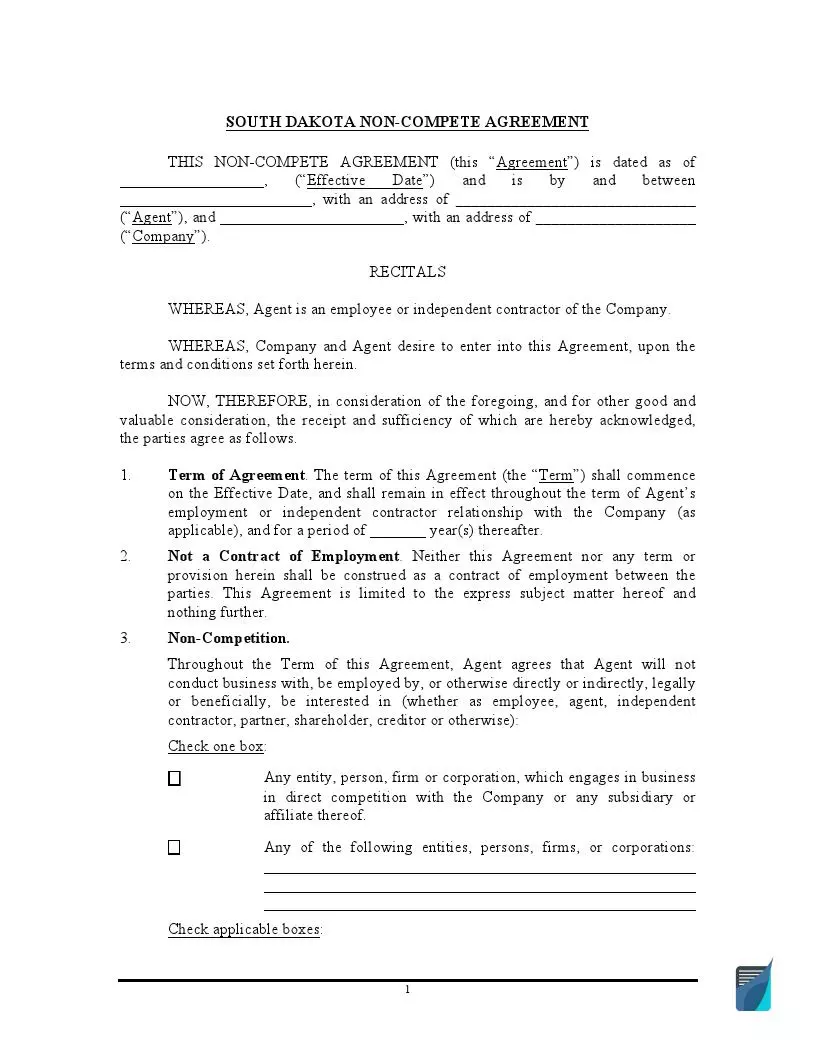
The FormsPal South Dakota non-compete agreement is a three-page form between a worker, called the Agent, and a business, called the Company. The Agent can be an employee or an independent contractor. You enter the names, addresses, and Effective Date at the top, then work through the numbered clauses below.
FormsPal also has a general non-compete agreement template. If you download the PDF, you can fill it in and sign it with our PDF editor.
Other FormsPal templates cover related needs, such as an independent contractor agreement, an employment contract, and a confidentiality agreement.
Both sides should read the agreement closely before signing it. These checks are practical tips, not legal rules. They help you spot gaps and unclear terms, so ask an attorney about anything specific to your situation.
A non-compete holds only on the conditions the statute attaches. Under S.D. Codified Laws § 53-9-11, an employee may agree with an employer, at the time of employment or at any time during employment, not to engage directly or indirectly in the same business or profession as the employer.[2]
No more than two years from the date the agreement ends.[2]
The statute speaks of a restraint within a specified county, first- or second-class municipality, or other specified area.[2] The form lets you write the area in the Non-Competition clause.
Yes. The statute lets an employee agree with an employer at the time of employment or at any time during employment.[2]
The restraint holds only so long as the employer continues to carry on a like business in the area the agreement covers.[2]
General information, not legal or tax advice.

Unless noted otherwise, the sources below are from the South Dakota Codified Laws, published by the South Dakota Legislature.
