
A Rhode Island non compete agreement is a written contract in which a worker agrees not to work for a competitor during the job and for a set number of years after it. Rhode Island's Noncompetition Agreement Act, chapter 59 of title 28, says which workers it cannot bind.[2] Build it online or download the free PDF below.
Last Updated: October 2026. This guide is reviewed and updated regularly to reflect current Rhode Island law. If you notice an error or outdated information, please contact us.
Build Your Document
Answer a few simple questions to make your document in minutes
Save and Print
Save progress and finish on any device, download and print anytime
Sign and Use
Your valid, lawyer-approved document is ready
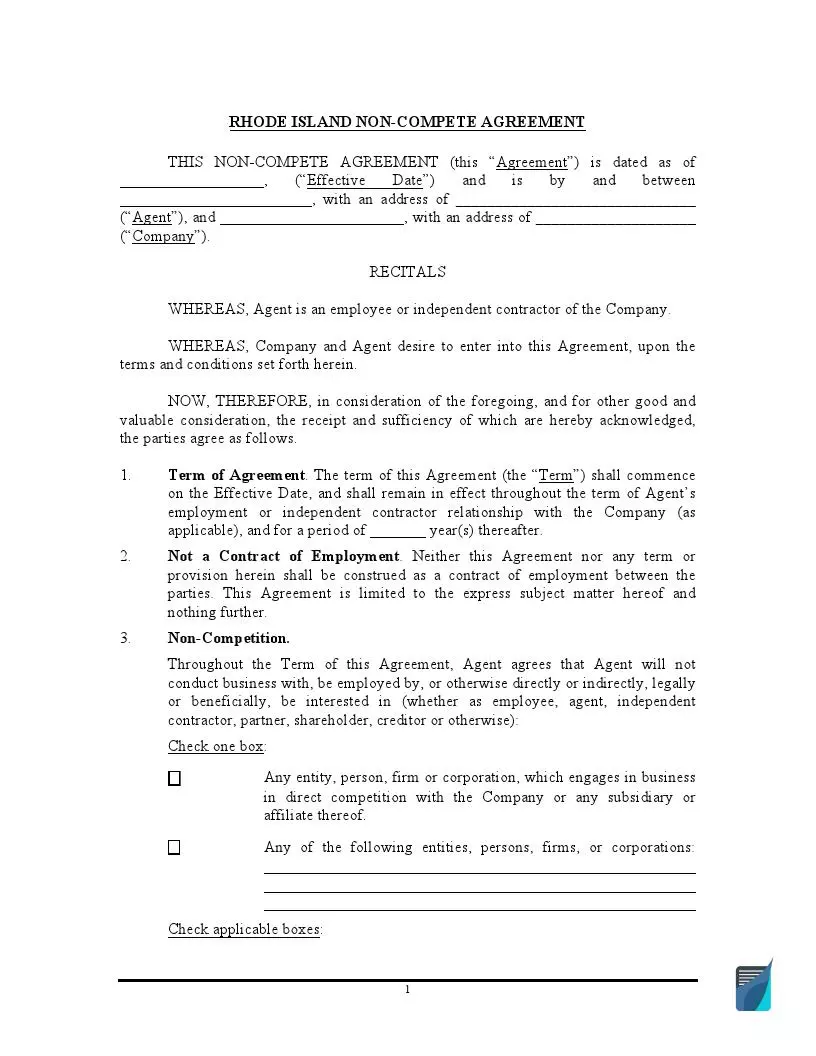
The FormsPal Rhode Island non compete agreement is a form between a company and a worker, who can be an employee or an independent contractor. It is the Rhode Island version of our general non compete agreement template. Fill it in with the online builder or on the downloaded PDF.
The form has these parts:
In practice, employers often use agreements like this to protect:
Before an employer tries to enforce non compete agreements in Rhode Island, it should check who the worker is. Under the state's noncompetition law, a noncompetition agreement is not enforceable against four kinds of workers. They are nonexempt employees, student interns, employees age eighteen or younger, and low wage employees.[2]
Signing non compete agreements does not make them enforceable against these workers. Check the worker's status before you rely on the agreement.[2]
The four groups:
The statute defines a low wage employee by average annual earnings. The cutoff is not more than two hundred fifty percent (250%) of the federal poverty level for individuals. The level comes from the poverty guidelines of the United States Department of Health and Human Services.[1]
Earnings means wages or compensation paid to an employee in the first forty (40) hours of work in a given week. Hours paid at an overtime, Sunday, or holiday rate are not included.[1]
For these protections, an employee is an individual who works for hire, including someone in a supervisory, managerial, or confidential position. An independent contractor is not an employee under the statute.[1]
The statute treats three arrangements separately: a company sale, a separation from employment with a rescission period, and covenants not to solicit. The table gives each one in the statute's own words.[1]
| Arrangement | What the statute says |
|---|---|
| Sale of a business | Noncompetition agreements made in connection with the sale of a business entity or all or substantially all of its operating assets, or otherwise disposing of the ownership interest of a business entity or partnership, are covered by their own rule. It applies when the restricted party is a significant owner of, or member or partner in, the business entity who will receive significant consideration or benefit from the sale or disposal.[1] |
| Separation from employment | The statute's noncompetition restrictions do not reach an agreement made in connection with the cessation of or separation from employment if the employee is expressly granted seven (7) business days to rescind acceptance.[1] |
| Non-solicitation covenants | Covenants not to solicit or hire employees of the employer, and covenants not to solicit or transact business with customers, clients, or vendors of the employer, are not included in the definition of a noncompetition agreement.[1] |
If your situation involves a company sale or a severance package, read the statute text linked in the Sources below before you use the form.
Rhode Island sets the threshold as a percentage of the poverty level for individuals. An employee is low wage when average annual earnings are not more than 250 percent of that level.[1] A noncompete between an employer and a low wage employee is void and unenforceable.[2]
No. The statute's definition of noncompetition agreements leaves out covenants not to solicit or hire employees. It also leaves out covenants not to solicit or do business with customers, clients, or vendors.[1]
No. For these protections, the statute defines an employee as an individual who works for hire. It says an employee does not include an independent contractor.[1]

General information, not legal or tax advice.
Unless noted otherwise, the sources below are from the R.I. Gen. Laws.
