
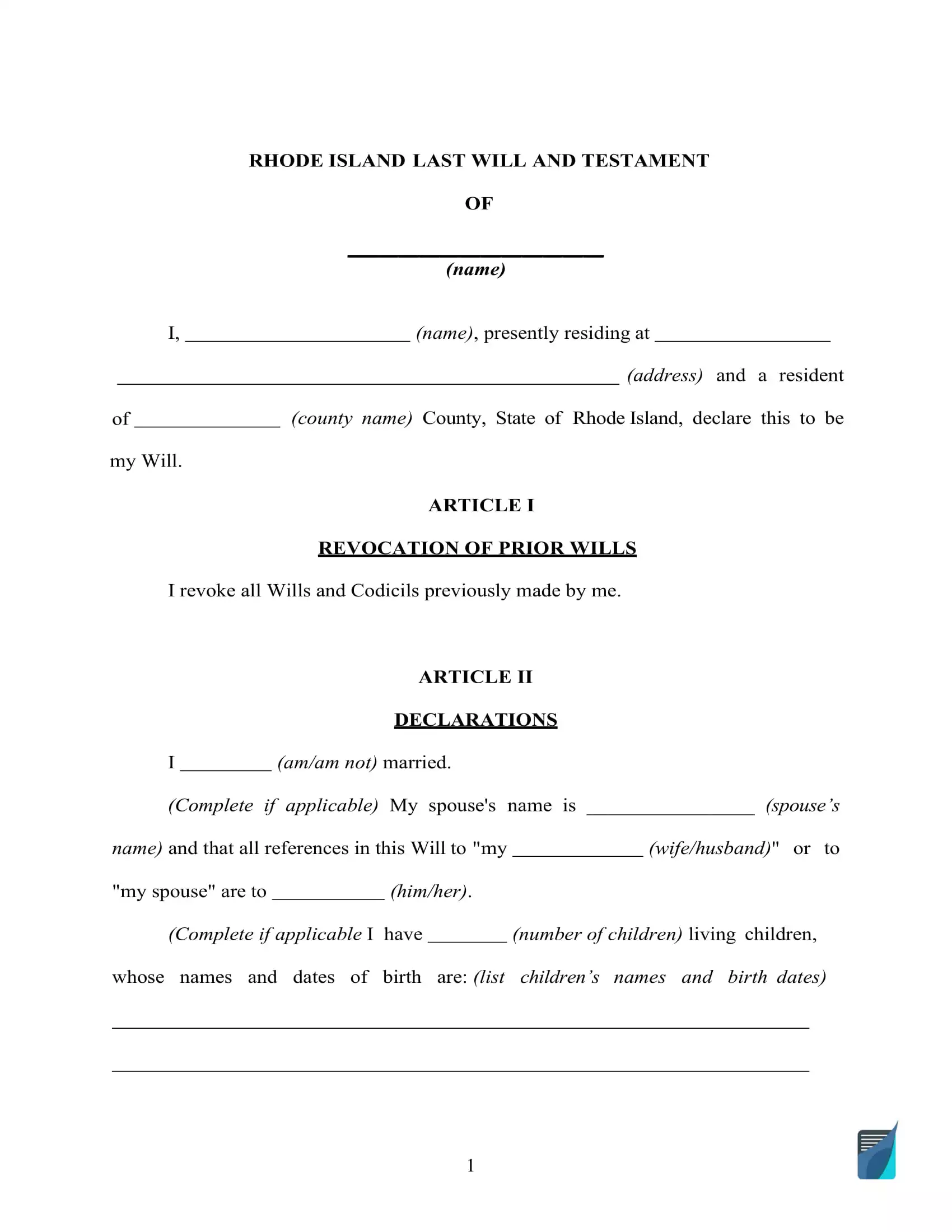
A Rhode Island last will and testament is a written document. In it, a person (the testator) states how their property should be distributed after death, and names who should carry out those instructions.
Last Updated: September 2026. This guide is reviewed and updated regularly to reflect current Rhode Island law. If you notice an error or outdated information, please contact us.
Build Your Document
Answer a few simple questions to make your document in minutes
Save and Print
Save progress and finish on any device, download and print anytime
Sign and Use
Your valid, lawyer-approved document is ready
Rhode Island law sets specific rules for a will to be valid, including how it must be signed and how many witnesses are needed, covered in detail below. After your death, a will usually goes through probate, the court process that confirms it and allows your property to reach the people you named to receive it. Use the free, fillable Rhode Island last will and testament form on this page to create and download your document.
Rhode Island law sets out the formalities a will must meet to be valid. The document must be in writing and signed by the testator, or by someone else in the testator’s presence and at the testator’s express direction. At least two witnesses must watch the testator sign (or acknowledge the signature) and then sign the will themselves in the testator’s presence.[2]
| Requirements | State laws | |
| Statutes | Chapter 33-5 – Execution and Revocation of Wills | |
| Signing requirement | Two (2) or more witnesses[2] | R.I. Gen. Laws § 33-5-5 |
| Age of testator | 18 or older[1] | R.I. Gen. Laws § 33-5-2 |
| Revocation by marriage | A prior will is revoked by a later marriage, unless the will was made in contemplation of that marriage[3] | R.I. Gen. Laws § 33-5-9 |
The witnesses do not need to follow any specific form of attestation, but they must sign the will while the testator is present.[2] The testator must be at least eighteen (18) years old to make a valid will in Rhode Island.[1]
A Rhode Island last will and testament is also called a “last will,” a “will,” or a “last will and testament form.” They all refer to the same document.
Marriage can change an earlier will. Under Rhode Island law, a will made before a later marriage is revoked by that marriage, unless the will itself shows it was made with the marriage in mind.[3]
the marriage of a person shall act as a revocation of a will made by him or her previous to the marriage, unless it appears from the will that it was made in contemplation thereof
A handwritten will is valid in Rhode Island only when it is signed and attested by two or more witnesses like any other will, so an unwitnessed (holographic) will executed in the state is not recognized (Section 33-5-5).[2]
The one exception is for a soldier or airman in actual military service, or a mariner or sailor at sea, who may dispose of personal estate by will without the usual formalities, which is the only opening for an oral will (Section 33-5-6).[4]
A will executed outside Rhode Island in the manner required by the law of the place where it was signed, or of the testator's domicile, is valid here as long as it is in writing and signed by the testator (Section 33-5-7).[5]
Follow these steps to fill out a Rhode Island last will and testament, from choosing an executor to signing the document with your witnesses. Each step below matches a section of the free template on this page.


Other Rhode Island Forms
To make a valid will in Rhode Island, put your wishes in writing and sign it yourself, or direct someone else to sign it for you in your presence. At least two witnesses must then watch you sign, or watch you acknowledge your signature, and sign the will themselves while you are present.[2] You must be at least eighteen (18) years old to make a will in Rhode Island.[1]
Rhode Island does not require a will to be notarized. The only formalities are a signed writing and two or more witnesses, present at the same time, who attest and subscribe the will in your presence, and no particular form of attestation is needed (Section 33-5-5).[2]
A self-proving affidavit is optional. Absent an objection, the probate court may admit the will on the oral testimony of any one subscribing witness, or on an affidavit the witnesses sign before an officer authorized to administer oaths at any time after the will is executed (Section 33-7-26).[6]
Yes. You can generally amend or revoke your last will and testament whenever you want, unless a contract you signed says otherwise. If your beneficiaries or your property change, updating the document keeps it matching what you actually want them to receive.
It is common to revise your will after a major life change, such as:
Marriage can also change an older will automatically. Under Rhode Island law, a will made before a later marriage is revoked by that marriage, unless the will itself shows it was made with the marriage in mind.[3]
Apart from revocation by a later marriage, a will is revoked only by a later will or codicil, by a writing declaring an intention to revoke that is executed like a will, or by burning, tearing or otherwise destroying it with the intention of revoking it, by you or by someone in your presence and at your direction (Section 33-5-10).[7]
If the original will is lost, a certified copy kept on the court's files can be proved in its place and has the same effect as the original (Section 33-7-24).[8]
Yes. Rhode Island law requires a will to be in writing and signed by the testator. Someone else may sign it instead, but only in the testator’s presence and at the testator’s express direction.[2]
Children and other relatives can be left out of your will, and many people add a clear disinheritance clause that names the person and states the exclusion. A child born after the will who is not provided for can still take an intestate share, unless the omission was intentional (Section 33-6-23).[10]
It is still wise to talk with an estate planning attorney before finalizing these decisions. A surviving spouse in Rhode Island is entitled to a life estate in the real estate you owned at death, and a spouse who is left something in the will keeps that gift unless, within six months after the first publication of the executor's qualification, the spouse files a written waiver of the will and claims the life estate instead (Sections 33-25-2 and 33-25-4).[11]
Rhode Island law allows someone other than the testator to sign the will on the testator’s behalf, as long as they do so at the testator’s express direction and in the testator’s presence.[2] This lets a person who is physically unable to sign have someone else complete the signature while they watch and direct the process.
| Related documents | When to make one |
| Codicil | Your will requires one or a couple of minor changes. |
| Self-proving affidavit | You need to expedite the probate later on. |
| Living will | You want to declare your wishes regarding the end-of-life health care and life-prolonging measures. |
| Living trust | You would like to deal with your end-of-life affairs without probate. |
General information, not legal or tax advice.
Unless noted otherwise, the sources below are from the R.I. Gen. Laws.
