
An Oklahoma non-compete agreement is a written contract in which a worker promises an employer not to compete after the job ends. A contract that restrains a lawful profession, trade or business is void to that extent, unless a statutory exception applies.[1.1] A former employee may work in the same or a similar business, as long as they do not directly solicit the employer's established customers.[1.3]
Last Updated: October 2026. This guide is reviewed and updated regularly to reflect current law. If you notice an error or outdated information, please contact us.
Build Your Document
Answer a few simple questions to make your document in minutes
Save and Print
Save progress and finish on any device, download and print anytime
Sign and Use
Your valid, lawyer-approved document is ready
It is a written promise between two parties, called the Company and the Agent on the form. The Agent may be an employee or an independent contractor. The worker agrees to limit competing work and not to solicit the Company's staff, customers or vendors for a set period.
The signatories are usually new employees, partners or new owners. Employers often present the agreement before employment begins, so nobody is surprised later.
Need a different version? Browse our non-compete agreement templates.
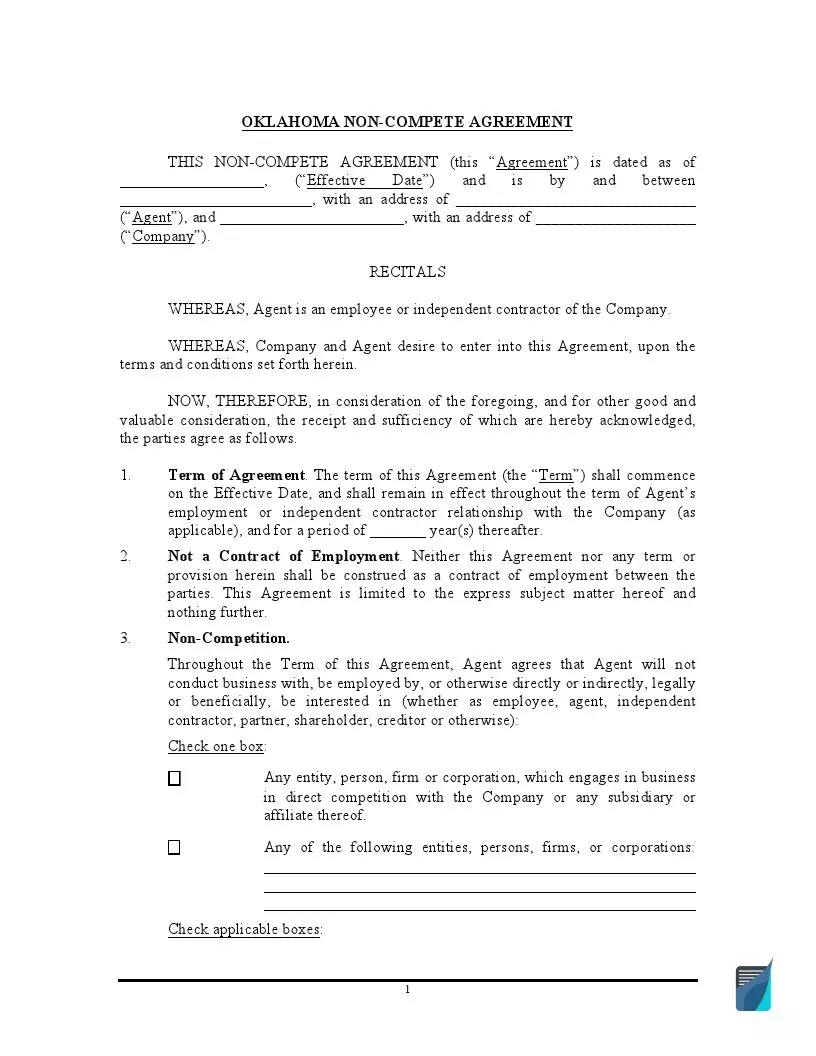
The FormsPal template names two parties, the Agent and the Company, and sets an effective date. It then runs through seven numbered parts. You fill in the blanks and check the boxes that fit your employment arrangement.
The Agent and the Company each sign with a printed name and title. If you download the PDF, you can fill it in and sign it with our online PDF editor.
The state regulates non-compete agreements by statute, in Okla. Stat. tit. 15, §§ 217 to 219b. Section 217 voids contracts that restrain a lawful profession, trade or business, except as the statutes allow.[1.1] Sections 218, 219a and 219b cover sales, employees and soliciting staff.
| Section | Covers | Rule in plain words |
|---|---|---|
| § 217 | General rule | A contract that restrains a lawful profession is void to that extent, except as the statutes allow.[1.1] |
| § 218 | Sale of a business | The seller of the goodwill may agree with the buyer not to carry on a similar line of work in a specified county and its contiguous counties, or a specified city or town.[1.2] |
| § 219a | Employees | An employee who has left may work in the same or a similar field, as long as they do not directly solicit the employer's established customers.[1.3] |
| § 219b | Soliciting staff | A term that bars soliciting the employer's employees or independent contractors is not treated as a restraint on a lawful profession.[1.4] |
Every contract that restrains anyone from exercising a lawful profession, trade or business of any kind is void to that extent. The exceptions are the ones in Sections 218 and 219 of the title and in Section 2 of the act.[1.1] A restriction that fits none of those exceptions is void to that extent.
Section 219a is the statute that speaks directly to employees. Here is what it says.
A person who makes an agreement with an employer, whether in writing or verbally, not to compete with the employer after the employment relationship has been terminated, shall be permitted to engage in the same business as that conducted by the former employer or in a similar business as that conducted by the former employer as long as the former employee does not directly solicit the sale of goods, services or a combination of goods and services from the established customers of the former employer.
In plain words, the rule is the same whether the agreement is written or spoken. After the job ends, the employee may work in the same or a similar business. The one limit is direct solicitation of sales from the former employer's established customers.[1.3]
The statute outranks the form. Any provision in a contract between an employer and an employee that conflicts with Section 219a is void and unenforceable.[1.3]
A sale has its own rule. Someone who sells the goodwill of a business may agree with the buyer to refrain from carrying on a similar business. The statute sets the limits in four points.[1.2]
Section 219b deals with a contract term that bars an employee or independent contractor from soliciting the business's employees or independent contractors. The bar covers soliciting them, directly or indirectly, actively or inactively, to become employees or independent contractors of another business. The statute says such a term is not construed as a restraint from exercising a lawful profession, trade or business of any kind.[1.4]
It depends on the state. Under Section 219a, an employee who has left may work in the same or a similar field, as long as they do not directly solicit the employer's established customers.[1.3]
The rules sit in Okla. Stat. tit. 15, §§ 217 to 219b, and each section does a different job.
Only as far as the statutes allow. A clause that conflicts with Section 219a is void and unenforceable, and a clause that restrains a lawful trade is void to that extent.[1.3]
The law permits an employee who has left to work in the same or a similar field, with one limit on directly soliciting the employer's established customers.[1.3] The seller of a business may also promise the buyer not to carry on a similar line of work. The promise stays within a specified county and its contiguous counties, or a specified city or town.[1.2]
General information, not legal or tax advice.

