
An Oklahoma small estate affidavit is a sworn written statement that lets a person claiming to be the decedent's successor collect property when the estate is small. Under Okla. Stat. tit. 58, § 393, the property must be worth no more than $50,000, less liens and encumbrances. Anyone who owes the decedent money or holds the decedent's belongings can hand them to the successor who presents the affidavit.[1] FormsPal offers the form as a free PDF and an online builder.
Last Updated: October 2026. This guide is reviewed and updated regularly to reflect current Oklahoma law. If you notice an error or outdated information, please contact us.
Build Your Document
Answer a few simple questions to make your document in minutes
Save and Print
Save progress and finish on any device, download and print anytime
Sign and Use
Your valid, lawyer-approved document is ready
Oklahoma's small estate affidavit rules sit in Okla. Stat. tit. 58, § 393. The law sets a $50,000 value limit and a waiting period of ten days after death. It also lists what the successor's affidavit must state about pending appointments, taxes, and debts.[1]
The limit counts the fair market value of Oklahoma property that the decedent owned and that passes by will or intestate succession (the state's default inheritance rules). It is measured at the time of death, less liens and encumbrances.[1]
The fair market value of property located in this state owned by the decedent and subject to disposition by will or intestate succession at the time of the decedent's death, less liens and encumbrances, does not exceed fifty thousand dollars ($50,000.00).
The law applies ten (10) or more days after the date of death. From that point, a person who owes the decedent money must pay it to a person claiming to be the successor who presents the affidavit. A person holding the decedent's tangible personal property or an instrument evidencing a debt, obligation, or stock must deliver it to the successor.[1] Count the ten days with our deadline calculator.
The affidavit, made by or on behalf of the successor, must state that:
A personal representative is the person who manages an estate. In plain words, no one has applied to be appointed in Oklahoma or in any other state. Time limits for collecting a debt can also run out, which is what barred by limitations means.
| Max. Estate | $50,000, less liens and encumbrances[1] |
| Min. Time to Wait After Death | 10 or more days[1] |
| State Laws | Okla. Stat. tit. 58, § 393 and § 394 |

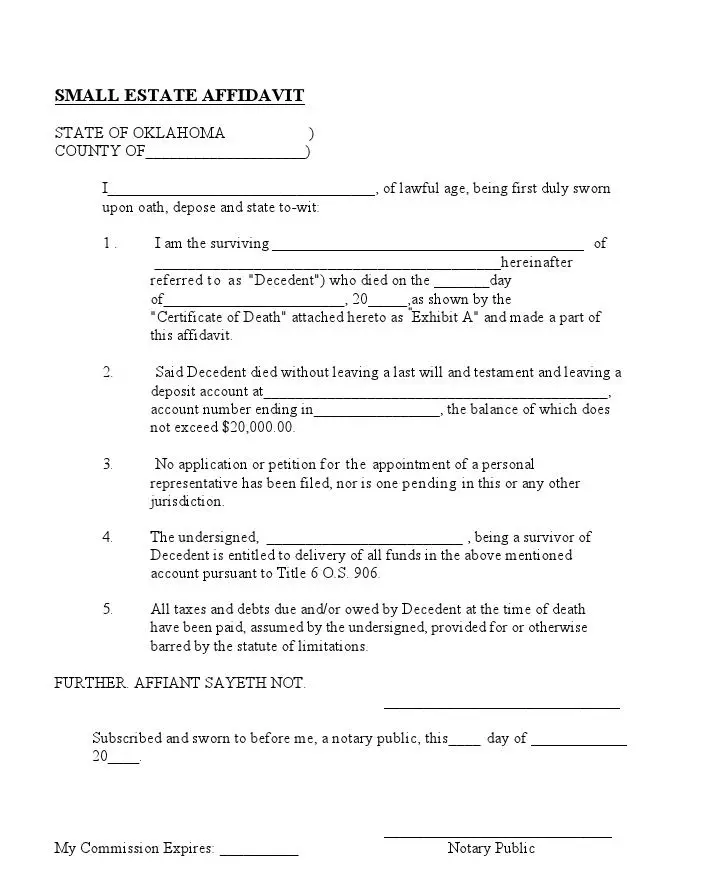
The Oklahoma small estate affidavit form is one page with four parts. You enter the county and your name, your relationship to the decedent and the date of death, the bank account details, and the signing block. Fill in the free PDF below, or build the form online, and sign it only after every blank is complete.
The screenshots under each step show the FormsPal Oklahoma small estate affidavit template filled with sample entries in blue, so you can see where each answer goes. The names, addresses, dates and amounts are examples only.

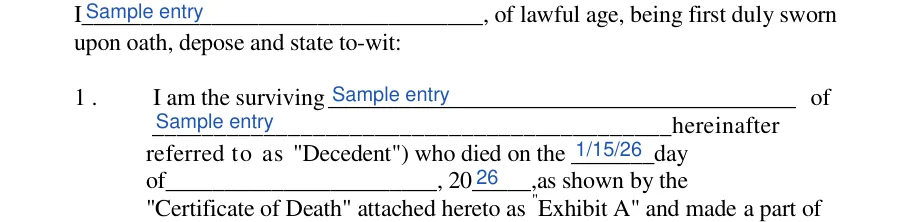
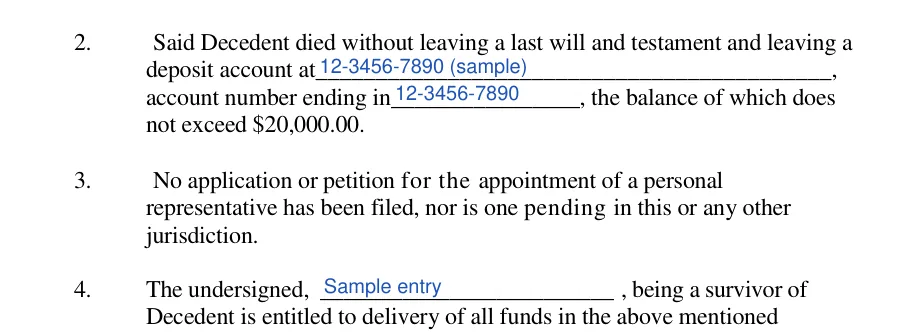
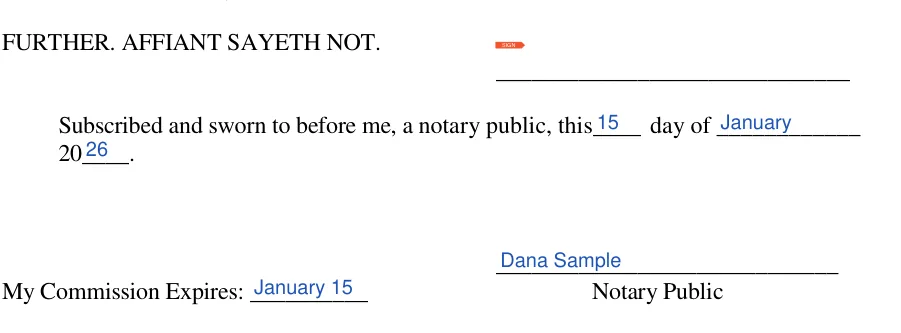
Fill in every blank before you print, and keep a copy of the signed affidavit. You can type into the downloaded PDF with the FormsPal PDF editor. Other states use their own versions, and the small estate affidavit overview lists them.
Before you fill out the Oklahoma small estate affidavit, gather the details the form asks for. The form is one page and asks for the county, your name, your relationship to the decedent, the date of death, a bank account, and a notary signature. Having each item ready lets you finish every blank in one sitting.
Check each blank against this list before you print, then sign where the form tells you to.
An Oklahoma small estate affidavit uses a few legal words that are easy to misread. The plain-language meanings below help you follow the form and the statute, and they match how this guide uses each word. Read them once before you fill out the form.
The Oklahoma small estate affidavit has one dollar limit, $50,000, set in Okla. Stat. tit. 58, § 393.[1] The answers below all rest on that one rule, so it helps to know what the limit measures. It measures three things:
Oklahoma's small estate affidavit procedure covers an estate only when the fair market value of the decedent's Oklahoma property, less liens and encumbrances, does not exceed $50,000.[1]
The amount is $50,000. That is the most the estate can be worth, less liens and encumbrances, for a small estate affidavit under Okla. Stat. tit. 58, § 393.[1]
The Oklahoma limit is $50,000. The law measures property located in Oklahoma that the decedent owned and that passes by will or by intestate succession, at the time of death.[1]
The small estate affidavit procedure stops at $50,000, so an estate worth more than that does not fit it.[1]
General information, not legal or tax advice.
This page relies on one primary source, the Oklahoma statute below. It sets the $50,000 limit, the ten-day wait, and the points the successor's affidavit must state, and each numbered note above points to it.
