
An Idaho non-compete agreement is a written contract in which a worker promises not to compete with an employer after the job ends. Are non-compete agreements in Idaho enforceable? Yes, for a key employee or key independent contractor, if the agreement is reasonable and no broader than the employer needs.[1] Build a free agreement with the builder below, or download the PDF template.
Last Updated: October 2026. This guide is reviewed and updated regularly to reflect current Idaho law. If you notice an error or outdated information, please contact us.
Build Your Document
Answer a few simple questions to make your document in minutes
Save and Print
Save progress and finish on any device, download and print anytime
Sign and Use
Your valid, lawyer-approved document is ready
Employers use a non-compete agreement (NCA sample) to protect confidential information, such as company data, customer details, and internal processes. The form calls the employer the Company. It calls the worker the Agent, whether that person is hired as staff or as an independent contractor. An employment contract or an independent contractor agreement is a separate document that can sit alongside it.
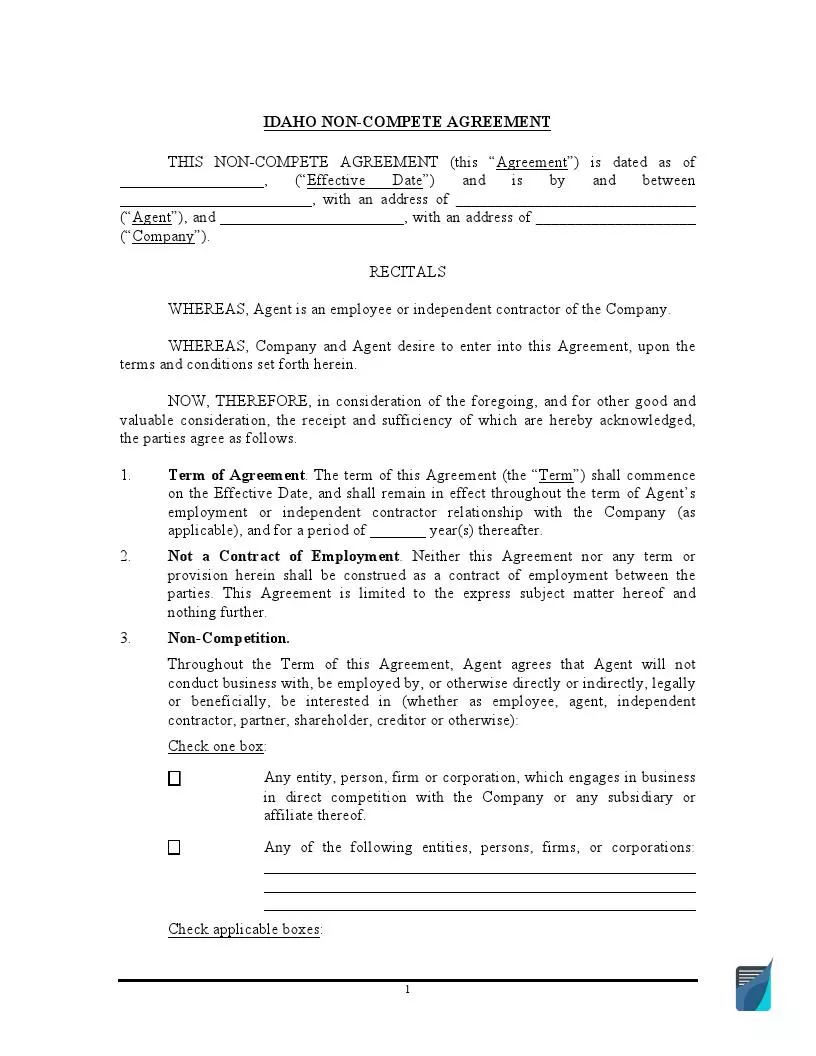
The Idaho template is a short non-compete agreement between a Company and an Agent. It sets how long the restrictions last, what the Agent may not do, and where they apply. You fill in the blanks and tick the boxes that match your arrangement. You can also download the PDF and complete it with the online PDF editor.
Section 1 starts the agreement on the Effective Date. It stays in effect for as long as the Agent works for the Company, whether as an employee or a contractor. It then continues for the number of years you enter after that relationship ends. Section 2 adds that the agreement is not a contract of employment.
Idaho state law looks at how long the restrictions last, so choose a number of years that fits the role.[1]
Section 3 bars the Agent from doing business with, working for, or holding an interest in a competing business during the term. The form gives you these choices:
State law also looks at the geographic area and the type of work, so describe both as narrowly as the job allows.[1]
The template names two parties and one date. The Agent is the worker, and the Company is the employer. Enter each party's name and address in the opening paragraph on page 1, then add the Effective Date, which is the day the agreement starts.
The last page has a signature block for each party, with lines for a signature, a printed name, and a title. Section 7 of the form says an amendment must be in writing and signed by both the Company and the Agent.
Four more sections finish the agreement. They protect the Company's employees and customers, let a court adjust a restriction that is too broad, pick Idaho law, and cover general terms. These sections are already written in the template, so you only enter the county in Section 6.
Before the Company and the Agent sign, check each blank on the template against your arrangement. The list below follows the form from the first page to the last. Idaho Code Section 44-2701 speaks of a key employee or key independent contractor, so also confirm that the role of the Agent fits that description.[1]
Keep a signed copy for the Company and one for the Agent, so both sides can see the same terms in writing. If the worker is based in another state, use the template for that state, such as Utah, Washington, or Oregon.
Idaho state law on this topic is Section 44-2701 of the Idaho Code. It lets a key employee or key independent contractor sign a written non-compete agreement. The agreement can stop the worker from taking a job or line of business in direct competition with the employer after employment ends. The agreement is enforceable if it meets the standard below.[1]
Section 44-2701 of the Idaho Code says:
A key employee or key independent contractor may enter into a written agreement or covenant that protects the employer's legitimate business interests and prohibits the key employee or key independent contractor from engaging in employment or a line of business that is in direct competition with the employer's business after termination of employment, and the same shall be enforceable, if the agreement or covenant is reasonable as to its duration, geographical area, type of employment or line of business, and does not impose a greater restraint than is reasonably necessary to protect the employer's legitimate business interests.
In plain words, the restrictions must fit each of these:
The restrictions also may not go further than needed to protect the employer's legitimate business interests.[1]
Section 44-2701 is part of title 44, chapter 27 of the Idaho Code, which covers agreements and covenants protecting legitimate business interests and runs from Section 44-2701 to Section 44-2704.[2]
Section 44-2702 defines key employees and key independent contractors. They are workers who, through the employer's investment of time, money, trust or exposure to its business, have gained a high level of inside knowledge, influence, credibility, reputation or public persona as the employer's representative, and so can harm the employer's legitimate business interests.[3]
Section 44-2704 adds limits. A restriction may not run longer than 18 months after the worker leaves unless the worker receives something in addition to employment or continued employment, and a term of 18 months or less is presumed reasonable as to duration. The highest paid five percent of an employer's employees or independent contractors are presumed to be key employees or key independent contractors, and a worker can rebut that by showing no ability to harm the employer's legitimate business interests.[4]
Yes, in the situation Section 44-2701 covers. Written non-compete agreements with a key employee or key independent contractor are enforceable if they are reasonable and go no further than needed to protect the employer's legitimate business interests.[1]
It depends on whether the agreement meets the statute's test. A court looks at these points:[1]
This page covers Idaho, and the answer comes from state law. A written agreement with a key employee or key independent contractor is enforceable if it is reasonable. That means how long it lasts, where it applies, and the type of employment or line of business.[1] Choose the terms of your agreement with that test in mind.
A non-competition agreement is another name for a non-compete agreement. Under state law, Idaho Code Section 44-2701 allows a written agreement that bars direct competition after employment ends. The same test applies to it as to any other non-compete agreements.[1]
General information, not legal or tax advice.

