
A Nebraska non-compete agreement is a written contract in which a worker agrees not to work for a competitor or solicit the employer's customers for a set time. Nebraska courts enforce a covenant not to compete only if it is reasonable. FormsPal's free Nebraska non-compete agreement template covers the term, the competitors and the area. Make it online or download the PDF.
Last Updated: October 2026. This guide is reviewed and updated regularly to reflect current Nebraska law. If you notice an error or outdated information, please contact us.
Build Your Document
Answer a few simple questions to make your document in minutes
Save and Print
Save progress and finish on any device, download and print anytime
Sign and Use
Your valid, lawyer-approved document is ready
A non-compete agreement is a promise by a worker not to compete with the employer after the work ends. In Nebraska, a business uses one to protect what the worker learns on the job, such as client relationships and confidential business information.
Before using the form, a business can ask itself a few practical questions:
These questions are about the business, not about the law. The Nebraska legal rules are covered further down. A Nebraska LLC also has its own operating agreement, which is a separate document from a worker's non-compete.
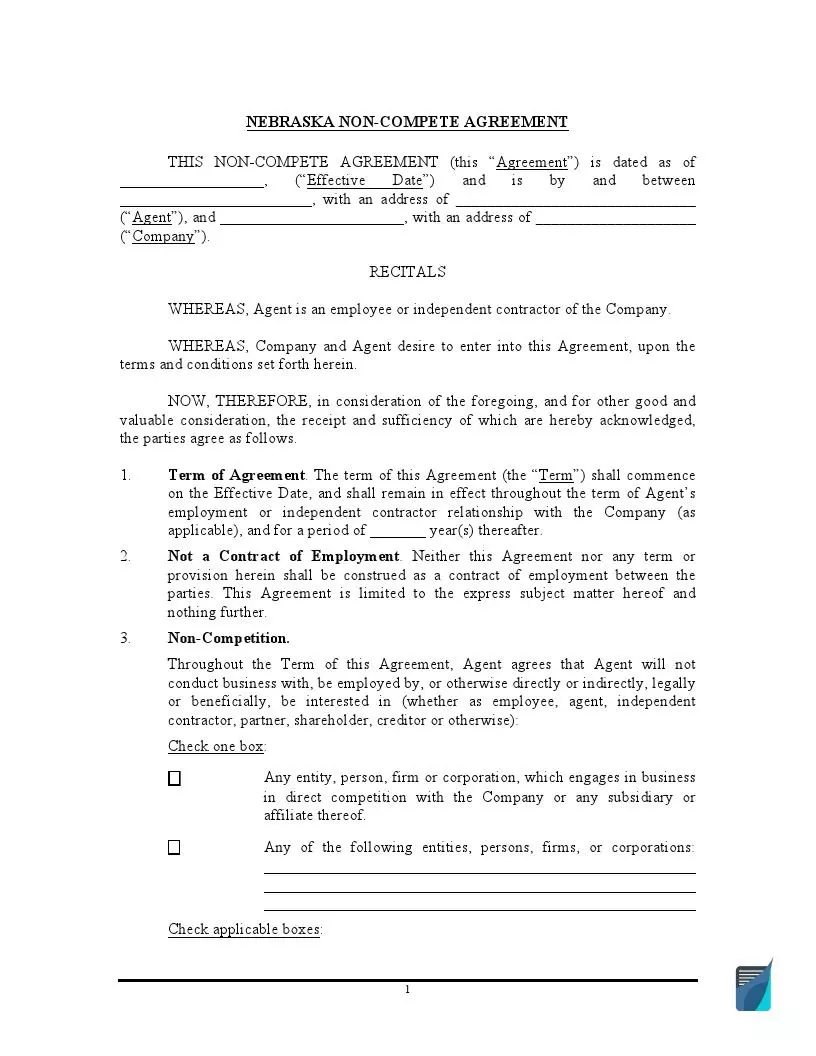
The FormsPal Nebraska non-compete agreement calls the worker the "Agent" and the employer the "Company". It sets how many years the restriction lasts after the work relationship ends, which competitors it covers and where it applies. Both sides sign at the end.
The form has these parts:
Check one box in the non-competition section and fill in every blank that applies. A form with open blanks leaves both sides guessing what they agreed to.
In practice, name what you want to protect. Employers commonly use this form to protect:
FormsPal also offers a general non-compete agreement template that is not specific to Nebraska.
A non-compete agreement works best when both sides understand it before signing. In practice, the business fills in the blanks, the worker reads the whole agreement, and each side keeps a signed copy. The habits below are practical tips, not legal requirements.
Contractors can sign a restriction too. See the non-compete for independent contractors.
If the facts are unusual or a lot of money is at stake, ask a Nebraska attorney for legal advice before anyone signs.
A Nebraska court enforces a covenant not to compete only if it is reasonable and protects a legitimate interest of the employer. Nebraska's highest court explained what reasonable means in Professional Business Services Co. v. Rosno, quoted below. Nebraska also has a statute on franchise noncompetes, covered in the questions further down.[1]
To determine whether a covenant not to compete is valid, a court must determine whether a restriction is reasonable in the sense that it is not injurious to the public, that it is not greater than is reasonably necessary to protect the employer in some legitimate interest, and that it is not unduly harsh and oppressive on the employee.
In plain words, the court checks three things.
Nebraska has no statute on these points:
In practice, pick a duration and an area that match what the business actually needs to protect. Before offering the form, many employers also think through practical points like these, which are not part of the court's three-part test:
A covenant can also be signed after the job has started if it is supported by consideration, such as the employer's promise of severance pay. In Aon Consulting, Inc. v. Midlands Financial Benefits, Inc. (2008), the Nebraska Supreme Court enforced an agreement that an employee signed while already employed because the agreement recited that kind of consideration.[2]
Neb. Rev. Stat. § 87-404 is the Nebraska statute on franchise noncompete agreements. It tells an arbitrator or court to reform restrictions found unreasonable in restraining competition, and then to enforce the reformed terms.[1] These words help with the answers below:
Yes. If an arbitrator or court finds the restrictions in a noncompete agreement unreasonable in restraining competition, it must reform the terms. It reforms them only to the extent needed to make the restrictions reasonable and enforceable.[1]
Yes. An arbitrator or a court may reform and enforce the restrictions in a noncompete agreement as part of an order for preliminary or temporary relief. That is an order that applies while the case is still going on.[1]
After reforming the terms, the arbitrator or court must enforce the noncompete agreement as reformed. It can be enforced against the franchisee, the guarantor, or any person with a direct or indirect beneficial interest in the franchise.[1]
Unless the franchisor and franchisee agree otherwise, these rules also apply to any noncompete agreement entered into by a franchisor headquartered in Nebraska.[1]
Some franchisors are also sellers of a seller-assisted marketing plan. Suppose one has already filed a disclosure document with the Department of Banking and Finance. If it later signs a noncompete agreement with a franchisee, its annual updated disclosure document must include a disclosure of that agreement.[1]

General information, not legal or tax advice.
