
A Nebraska small estate affidavit is a sworn statement that a successor of someone who has died gives to anyone who owes the decedent money or holds the decedent's personal property. Section 30-24,125 of the Nebraska Revised Statutes sets the rules. The personal property in the estate must be worth no more than one hundred thousand dollars ($100,000) after liens and encumbrances. No application for a personal representative may be pending or granted.[1]
Last Updated: October 2026. This guide is reviewed and updated regularly to reflect current Nebraska law. If you notice an error or outdated information, please contact us.
Build Your Document
Answer a few simple questions to make your document in minutes
Save and Print
Save progress and finish on any device, download and print anytime
Sign and Use
Your valid, lawyer-approved document is ready
Under Neb. Rev. Stat. § 30-24,125, a person claiming to be the successor of a decedent can collect the decedent's personal property by presenting an affidavit. The affidavit has to show that each of the conditions below is met.[1]
The statute puts the acknowledgment this way:
The person or persons claiming as successors under the affidavit swear or affirm that all statements in the affidavit are true and material and further acknowledge that any false statement may subject the person or persons to penalties relating to perjury under section 28-915
The one hundred thousand dollar limit applies to personal property, which covers belongings and papers that show a debt or stock.[1] Real property has its own affidavit under Neb. Rev. Stat. § 30-24,129: thirty days after the death, a successor may file it with the register of deeds of a county where the property is located when the decedent's interest in all Nebraska real property is worth no more than one hundred thousand dollars ($100,000). That affidavit must state that no other person has a right to the decedent's interest in the property.[2]
Check the dollar limit against the statute. Older guides and forms may print a lower figure. The limit in Neb. Rev. Stat. § 30-24,125 is one hundred thousand dollars ($100,000) of personal property. Form CC 15:40 (Rev. 07/2022), the PDF on this page, prints $100,000.00 in statement 3.
| Max. Estate | $100,000 in personal property, after liens and encumbrances |
| Min. Time to Wait After Death | 30 days |
| Death Certificate | Certified or authenticated copy attached to the affidavit |
| Personal Representative | No application or petition pending or granted |
| State Laws | Neb. Rev. Stat. § 30-24,125 |

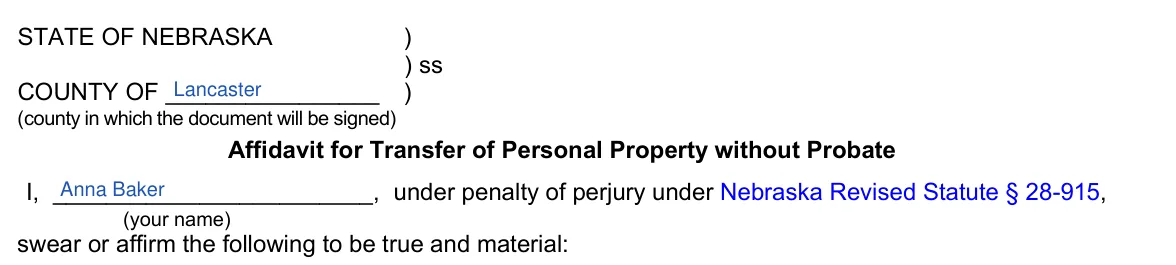
The PDF on this page is the official Nebraska Supreme Court form CC 15:40 (Rev. 07/2022), headed "Affidavit for Transfer of Personal Property without Probate". It fits on one page. You fill in the county, your name, the deceased person's name, your relationship to the deceased, the date and your address. Fill it in with our online PDF editor, or print it and write the answers by hand. The form says not to sign until a notary is present. The steps below follow the order of the form.
The screenshots under each step show form CC 15:40, the official Nebraska form, filled with sample entries in blue, so you can see where each answer goes. The names, addresses and dates are examples only.
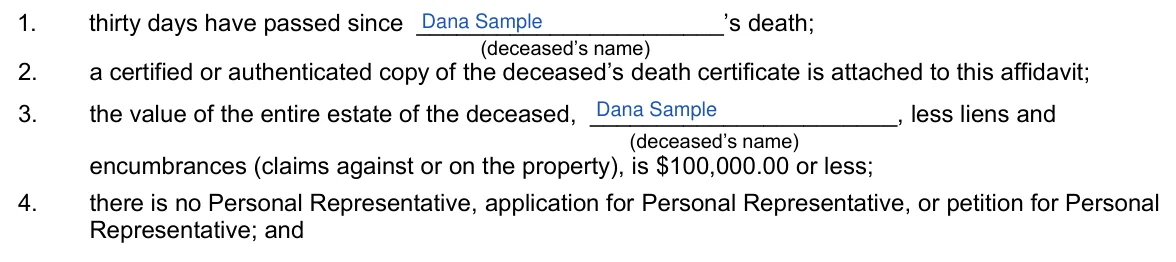



The affidavit procedure applies when no application or petition for the appointment of a personal representative is pending or has been granted in any jurisdiction. The estate's personal property must also be worth no more than one hundred thousand dollars ($100,000) after liens and encumbrances.[1]
For the small estate affidavit, Neb. Rev. Stat. § 30-24,125 sets the limit at one hundred thousand dollars ($100,000). That figure is the value of all personal property in the estate, wherever located, less liens and encumbrances.[1]
The amount is one hundred thousand dollars ($100,000) in personal property. You also wait thirty days after the death before you present the affidavit to the person who holds the property.[1]
General information, not legal or tax advice.
