
A Maine non-compete agreement is a written contract in which an employee promises not to compete with an employer, or use its confidential business information, after the job ends. Maine law enforces these agreements only to the extent that they are reasonable and no broader than necessary to protect the employer's legitimate business interests. An employer must also give notice before asking you to sign.[1] Create a free Maine non-compete agreement online or download the PDF template.
Last Updated: October 2026. This guide is reviewed and updated regularly to reflect current Maine law. If you notice an error or outdated information, please contact us.
Build Your Document
Answer a few simple questions to make your document in minutes
Save and Print
Save progress and finish on any device, download and print anytime
Sign and Use
Your valid, lawyer-approved document is ready
A non-compete agreement is a contract between a company and a worker, either an employee or an independent contractor. The worker agrees not to compete, or share confidential business information, for a stated period. Maine adds its own rules on notice, pay, and timing, covered below.
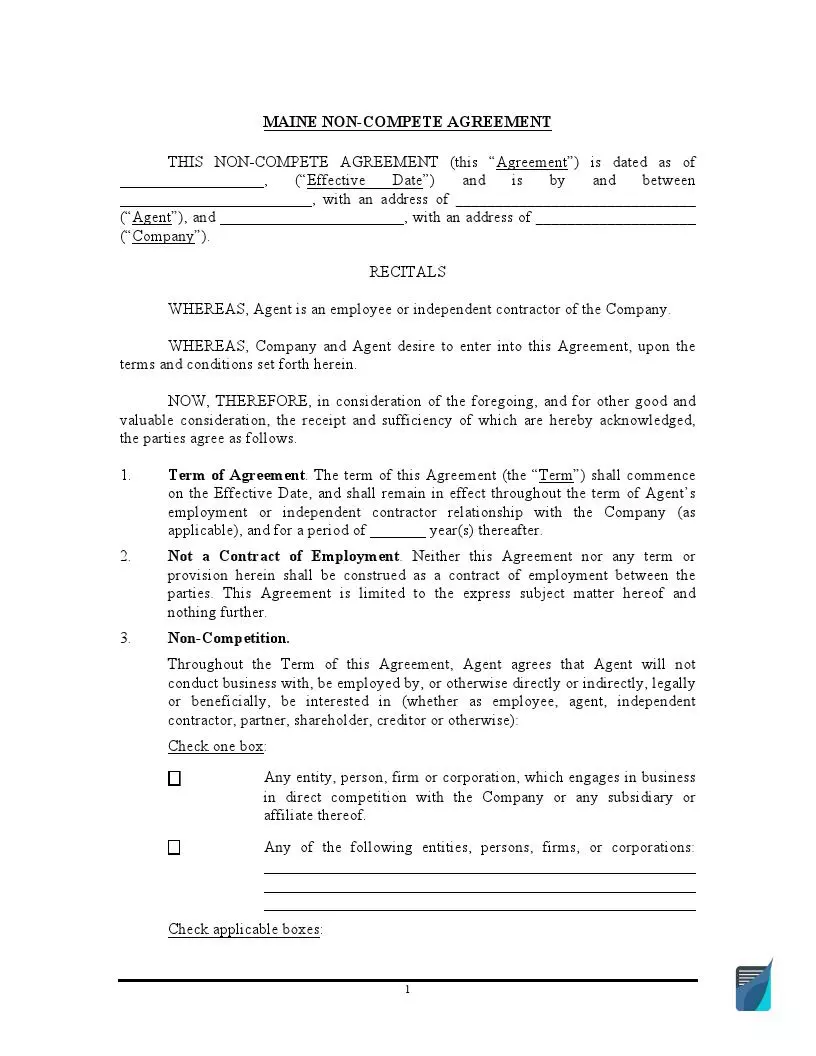
The FormsPal template puts the key terms of the employment restriction in one document, ready to sign. Review each term and fill in the details for your own situation. The agreement includes:
Working in another state? Use our non-compete agreement templates for other states. If the worker is not an employee, see the non-compete template for independent contractors. To protect private information, pair it with a confidentiality agreement.
Yes, Maine has a statute on non-compete agreements. Under Me. Rev. Stat. tit. 26, § 599-A, non-compete agreements are contrary to public policy. They are enforceable only to the extent that they are reasonable and no broader than necessary to protect the employer's legitimate business interests.[1]
The law applies to all noncompete agreements entered into or renewed after its effective date.[1]
A company hiring in Maine must tell you about a non-compete early. Before making a job offer that will require a noncompete agreement, the employer must disclose that one will be required. The employer must also notify the employee or prospective employee of the requirement. It must provide a copy of the agreement not less than 3 business days before requiring it to be signed.[1]
The delay gives you time to review the agreement and negotiate its terms, or the job itself, if you wish.[1]
An employer that violates the statute's prohibition or its notice and disclosure rules commits a civil violation. A fine of not less than $5,000 may be adjudged, which means it can be ordered against the employer.[1]
A non-compete does not start working the day you sign it. The terms of a noncompete agreement do not take effect until after one year of the employee's employment with the employer or a period of 6 months from the date the agreement was signed, whichever is later.[1]
This delay does not apply to an agreement between an employer and an allopathic or osteopathic physician licensed under Title 32, chapter 48 or chapter 36.[1]
Two examples show how the delay works:
Pay level matters. An employer may not require or permit an employee to enter into a noncompete agreement with the employer. This applies when the employee is earning wages at or below 400% of the federal poverty level.[1]
If your pay is close to that line, compare your wages with the current federal poverty guidelines before you sign any employment agreement.
Maine also bars non-competes for most employed veterinarians, meaning those who hold no ownership interest (Section 599-A(3)).[1]
A non-compete can limit where and for whom you work after the job ends, so check it carefully before you sign. Each of these mistakes is easy to make and easy to avoid:
Yes, but only within limits. Maine's statute says non-compete agreements are enforceable only to the extent that they are reasonable and no broader than necessary to protect the employer's legitimate business interests.[1]
It depends on how narrow the agreement is. The law treats non-compete agreements as contrary to public policy. It enforces them only to the extent that they are reasonable and no broader than necessary to protect the employer's legitimate business interests.[1]
The employer has two duties:
No. An employer may not require or permit an employee to enter into a noncompete agreement if the employee earns wages at or below 400% of the federal poverty level.[1]
The employer commits a civil violation. A fine of not less than $5,000 may be adjudged.[1]
General information, not legal or tax advice.

