
A Vermont bill of sale is a signed document that records the sale of a vehicle between a seller and a buyer. The Vermont DMV requires a bill of sale showing the complete chain of ownership.[2] Download our free template or fill it out online.
Last Updated: October 2026. This guide is reviewed and updated regularly to reflect current Vermont law. If you notice an error or outdated information, please contact us.
Build Your Document
Answer a few simple questions to make your document in minutes
Save and Print
Save progress and finish on any device, download and print anytime
Sign and Use
Your valid, lawyer-approved document is ready
| Document Name | Vermont Motor Vehicle Bill of Sale Form |
| Other Names | Vermont Car Bill of Sale, Vermont Automobile Bill of Sale |
| DMV | Vermont Department of Motor Vehicles |
| Bill of Sale Required? | Yes[2] |
| Avg. Time to Fill Out | 7 minutes |
| # of Fillable Fields | 64 |
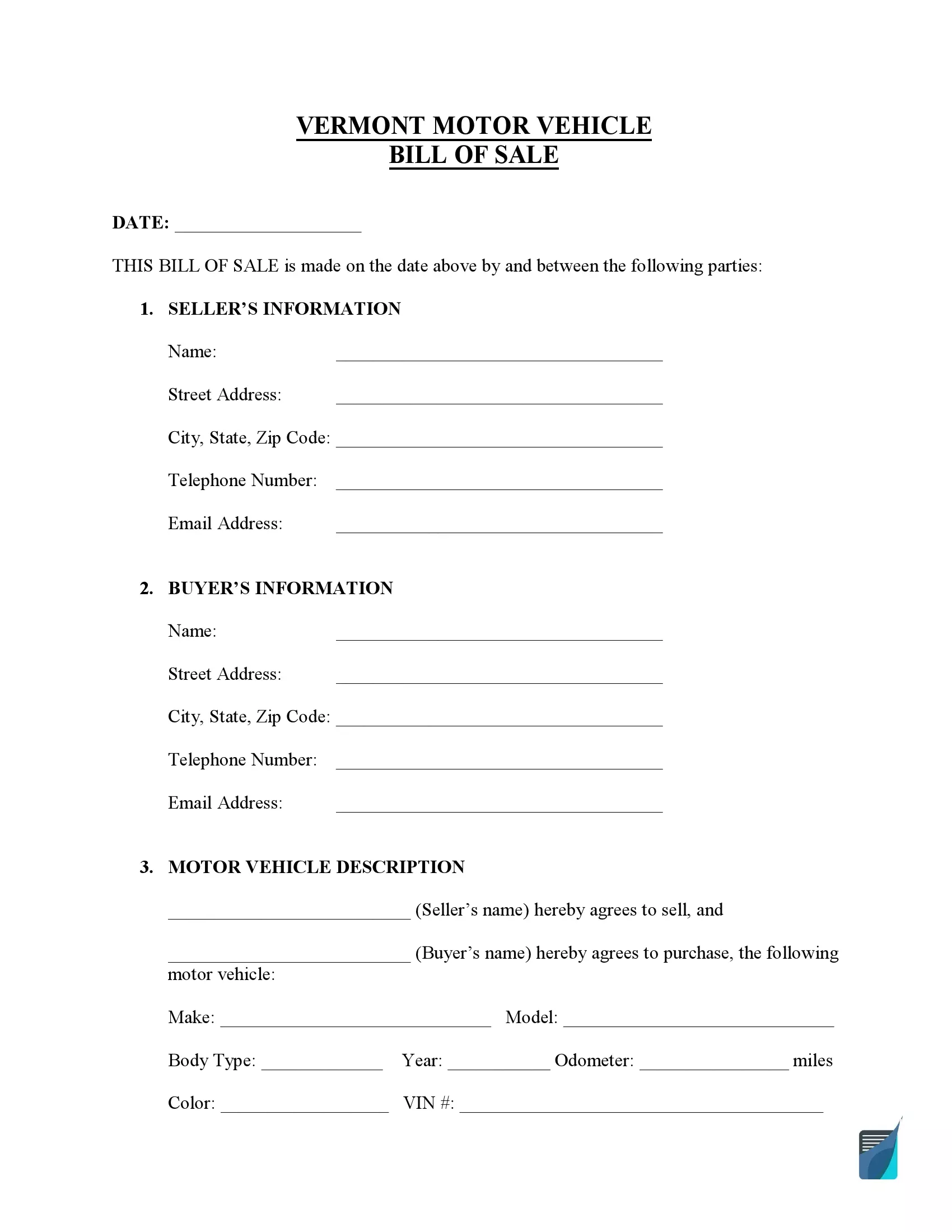
A Vermont bill of sale is a short document, but the DMV expects it to carry specific details. It says a bill of sale must contain enough information to identify the vehicle, and it names these details:[2]
Our template has a line for each of them, plus the buyer’s details, so one sheet covers the whole sale. A handwritten bill of sale is also valid, as long as it carries this information.[1]
Two more points matter. An odometer disclosure statement is required for vehicles of model year 2011 or newer, and all liens must be released.[2]
The Vermont DMV publishes Form VT-005, Bill of Sale and Odometer Disclosure Statement, to transfer ownership of a motor vehicle and state its current mileage.[4]
If the vehicle is salvage, salvage and rebuilt, or declared a total loss by the insurer, the salvage section of Form VT-005 must be completed, and the seller must disclose that status orally and in writing before the sale.[4]
FormsPal has bill of sale templates for Vermont, one for each of four kinds of private sales: a motor vehicle, a boat, a firearm and general items. Each card below says what the form records and lets you download a free PDF template. Pick the one that matches what you are selling.
Vermont bill of sale for a motor vehicle records the sale of a car, truck or other motor vehicle between a private seller and a buyer. It lists the seller, the buyer, the vehicle, the price and the date of sale.
| Alternative Name | Car Bill of Sale |
| Seller’s Signature | Signature line included |
| Buyer’s Signature | Signature line included |
| Notarization | Notary block included |
| Download | PDF Template |

A boat bill of sale in Vermont records the sale of a boat between a private seller and a buyer. It lists the boat, the seller, the buyer, the price and the date of sale. A Vermont motorboat registration runs for two years, with the fee set by the length of the boat.[6]
| Alternative Name | Vessel Bill of Sale |
| Seller’s Signature | Signature line included |
| Buyer’s Signature | Signature line included |
| Notarization | Not covered on this page |
| Download | PDF Template |

A firearm bill of sale records the sale of a gun between a private seller and a buyer. It lists the firearm, the seller, the buyer, the price and the date of sale. Most private gun sales in Vermont must go through a licensed dealer, who runs a background check (13 V.S.A. § 4019).[7]
| Alternative Name | Gun Bill of Sale |
| Seller’s Signature | Signature line included |
| Buyer’s Signature | Signature line included |
| Notarization | Not covered on this page |
| Download | PDF Template |

A general bill of sale covers private sales of items that do not need a specialized form. It has places for the parties’ contact details, the item description, the price and the signatures.
| Alternative Name | Generic Bill of Sale |
| Seller’s Signature | Signature line included |
| Buyer’s Signature | Signature line included |
| Notarization | Not covered on this page |
| Download | PDF Template |
The steps below follow our Vermont motor vehicle bill of sale template, from the date at the top to the acknowledgment on page 4. Fill in each part in the order the template shows it. You can create the form online, print the PDF and write it by hand, or fill in the PDF with our PDF editor. The screenshots carry their own step labels, which do not match the numbering in the text, so follow the text.
Step 1: Date
Write the date of the bill of sale on the DATE line at the top of page 1.
Step 2: Seller’s Information
In Section 1, fill in the seller’s name, street address, city, state, zip code, telephone number and email address.

Step 3: Buyer’s Information
In Section 2, enter the same five details for the buyer.

Step 4: Motor Vehicle Description
In Section 3, write the seller’s and buyer’s names in the two blanks. Then fill in these fields:


Step 5: Purchase Date, Price and Method
On page 2, in Section 4, enter the purchase date and the total purchase price in U.S. dollars. Then check one way the price is paid: all at once, trade-in with the buyer’s vehicle details, a deposit with a balance date, or a gift. Check one payment method (cash, check with the check number, cashier’s check or money order) and one taxes box.

Step 6: Miscellaneous Provisions
On page 3, read Section 5 before you sign. This part has nothing to fill in. It covers the seller’s ownership and no-liens confirmation, the as-is sale and the entire agreement.
Step 7: Signatures
In Section 6, the seller and the buyer each sign, date and print their name on their own line. The form also has a Witness line with a signature, date and printed name.

Step 8: Acknowledgment
Page 4 is an acknowledgment block. To have a notary complete it, sign before the notary. The notary fills in the county, date, name, title, signature and seal.
The bill of sale records the sale, but the title also has to pass to the buyer. Vermont law says what the seller must do when the vehicle is handed over:[3]
If an owner transfers the owner’s interest in a vehicle, other than by the creation of a security interest, the owner shall, at the time of delivery of the vehicle, execute an assignment and warranty of title to the transferee in the space provided on the certificate or as the Commissioner prescribes
In plain terms, three things go with the transfer:
If you only have a bill of sale and no title, read our guide to getting a vehicle title with a bill of sale.
VIN verification on Form VT-010 is required for a vehicle with salvage documentation from any state, a vehicle being titled under bond, or a vehicle registered in a foreign country, including Canada.[1]
The buyer also has to register the vehicle before driving it. An individual may not operate a motor vehicle on any highway unless it is registered, and a resident who moves into Vermont from another jurisdiction must register the vehicle within 60 days after moving in (23 V.S.A. § 301).[5]
Form VT-010 verifies the vehicle identification number (VIN) or hull identification number (HIN).

This form helps a person designate a representative to manage the matters regarding the vehicle.

Form VD-113, known as Application for Vessel Validation, is used if the vessel has been registered in another state.

Form VT-012 (Multiple Owners on Registration/Title Authorization) is designed to indicate more than two persons as registered and/or titled owners of the vessel.

The answers below rely on the Vermont DMV pages and the Vermont statute listed in the sources at the end of this page. Each answer marks the source it uses, and our template covers the parts you fill in yourself.
Yes. The Vermont DMV requires a bill of sale showing the complete chain of ownership.[2] Our template records the sale between you and the buyer.
The DMV says a bill of sale must contain enough information to identify the vehicle, including make, year, VIN, purchase price, mileage, the seller’s signature and the date of sale.[2] A bill of sale that leaves these out does not match what the DMV describes.
Vermont has no statute that requires a bill of sale to be notarized. The DMV’s list of what a bill of sale must contain names the seller’s signature and the date of sale, and a notary is not on it.[2] Our template includes an acknowledgment on page 4 for people who choose to have a notary sign as well.
Fill in the date, the seller, the buyer, the vehicle, the price and the seller’s signature.[2] When the vehicle is delivered, the seller also signs the assignment and warranty of title over to the buyer.[3] The steps above walk through our template part by part.
These points are easy to miss:[2]

Other Vermont Forms
General information, not legal or tax advice.
Unless noted otherwise, the sources below are published by the Vermont DMV and the Vermont Legislature.


