
Updated:
A vehicle promissory note is the buyer's written promise to pay later. The seller acts as lender, and the buyer repays the price in installments on agreed dates. It serves private sellers whose buyer cannot pay the full price up front.
This page gives you a free vehicle promissory note template to download as a PDF, or a builder that makes a custom note online. The seller is the “lender” and the buyer is the “borrower.” Below you will find what the note should say, how to fill out each blank, how it works with a bill of sale, and the interest rate caps written into several statutes.
Build Your Document
Answer a few simple questions to make your document in minutes
Save and Print
Save progress and finish on any device, download and print anytime
Sign and Use
Your valid, lawyer-approved document is ready
A bill of sale with a promissory note is a pair of documents for a car sold on credit: the bill of sale shows the car changed hands, and the promissory note holds the buyer's promise to pay the balance. A seller-financed car deal usually uses both.
A vehicle promissory note and a bill of sale do different jobs in the same car deal. The note lists the payment terms both parties agreed on. A bill of sale is the receipt for the vehicle itself, with the price, the vehicle description and the names of the buyer and the seller.
When the buyer pays part of the price now and the rest over time, the bill of sale can point to the note. Add a line such as “the payment is made through a promissory note dated (note date) and signed at (place of signing) between (party details).” The buyer and the seller sign the bill of sale when the car changes hands, and it names the note as the way the buyer pays the balance. When the car changes hands before the last payment, ask the motor vehicle title office how the seller is listed as lienholder on the title.
| Question | Vehicle promissory note | Bill of sale |
|---|---|---|
| What it shows | The buyer's promise to pay the balance | The transfer of the car from seller to buyer |
| Who signs | The borrower and the lender | The buyer and the seller |
| Main terms | Principal, rate, payment day, maturity date | Price, vehicle description, sale date |
| When it ends | When the last payment is made | It stays as proof of the sale |
A promissory note for a car sale fits any vehicle purchase where the buyer pays over time instead of all at once, and the seller wants the debt in writing. It works like a short loan agreement between two private people. Common situations include:
The seller gets a written promise of what the buyer owes, and the buyer knows how much to pay and when. Both sides sign the same page, so the terms are easy to confirm later.
A vehicle promissory note includes the parties, the amount owed, the interest rate, the vehicle, the repayment schedule and both signatures, so the buyer and the seller read the same terms in one place. Each item below matches a part of the form:

Before you fill out the note, gather the names and addresses of both parties, the money terms, the vehicle details from the car and its title, and your choice of a secured or unsecured loan. The borrower and the lender should agree on the numbers together.
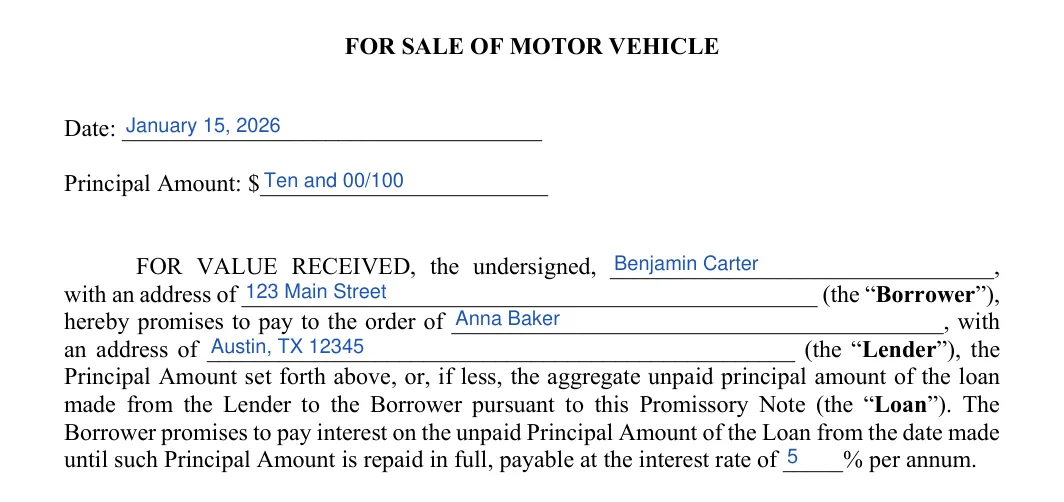
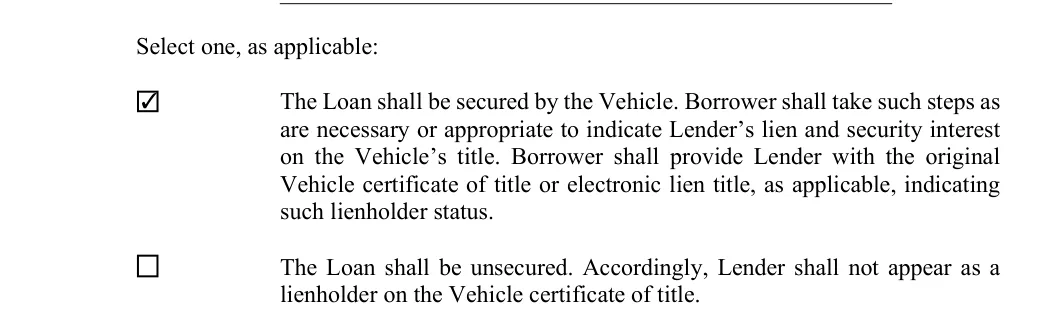
To fill out the vehicle promissory note, enter the date, the principal and the parties, describe the car, choose secured or unsecured, set the payment day and amount, add the maturity date, and have both parties sign. Download the PDF and fill it in on your screen with the online PDF editor, or print it and write in the blanks by hand.
The screenshots under each step show the FormsPal Vehicle Promissory Note template filled with sample entries in blue, so you can see where each answer goes. The names, addresses, dates and amounts are examples only.










A signed vehicle promissory note is the paper both parties go back to until the last payment. Check it, sign it, give each party a copy, then follow the payment plan it sets out.
A clear payment routine keeps the borrower and the lender on the same page from the first payment to the last. These habits help:
Some jurisdictions cap the interest rate on a car promissory note, and each cap comes with its own conditions and exceptions. The table lists each cap, its condition and the section that sets it.
These sections govern interest on loans and written agreements to pay money. Whether one of them reaches a private seller who lets the buyer pay for a car over time depends on its wording, and some jurisdictions set separate rates for retail installment contracts, so read the section for your jurisdiction before you set the rate.
The principal is the amount of money the buyer still owes on the vehicle. The rate is the cost of borrowing that money, shown as an annual percent.
Several of these sections count more than the stated rate as interest. In Colorado, interest under the cap means the sum of all charges a lender imposes as a condition of the credit (Colo. Rev. Stat. § 5-12-103). In the District of Columbia, interest includes any loan fee, origination fee, service and carrying charge or point (D.C. Code § 28-3311). New York counts as interest any and all amounts paid or payable to the lender for making the loan (N.Y. Banking Law § 14-a). The West Virginia cap includes points (W. Va. Code § 47-6-5). Where a section counts fees this way, add any fees in the note to the stated rate before you compare it with the cap.
| Jurisdiction | Cap on the interest rate, with its condition | Source |
|---|---|---|
| Arizona | Any rate the parties contract for in writing (loans other than medical debt); 10 percent a year when no rate is contracted for in writing. | Ariz. Rev. Stat. 44-1201(A)(2) |
| Colorado | A promissory note may stipulate a rate above 8 percent a year, but not over 45 percent a year. | Colo. Rev. Stat. § 5-12-103(1) |
| District of Columbia | Up to 24% a year, in an instrument in writing for payment of money at a future time. | D.C. Code § 28-3301 |
| Florida | A rate above 18 percent a year simple interest on a loan, advance of money or other obligation is usury; an obligation over $500,000 is held to the rate in s. 687.071 instead. | Fla. Stat. § 687.03 |
| Illinois | Up to 9% a year in a written contract, except as otherwise provided in Section 4.05. | 815 ILCS 205/4 |
| Kansas | Up to 15% a year, stipulated in the note, unless otherwise specifically authorized by law. | Kan. Stat. Ann. § 16-207 |
| Louisiana | Conventional interest up to 12 percent a year; the rate must be fixed in writing. | La. Rev. Stat. § 9:3500 |
| Michigan | Up to 7% a year, stipulated in writing. | Mich. Comp. Laws § 438.31 |
| Missouri | Up to 10 percent a year, agreed in writing; when the quarterly "market rate" (the long term US government bond index plus three points) is higher than 10 percent, up to that market rate, agreed in writing. | Mo. Rev. Stat. § 408.030 |
| Nebraska | Up to 16 percent a year on the unpaid principal balance, except as provided in section 45-101.04. | Neb. Rev. Stat. § 45-101.03 |
| Nevada | Any agreed rate, except as provided in subsection 2; the rate, any compounding and any other charges must be specified in writing. | Nev. Rev. Stat. 99.050(1); Nev. Rev. Stat. § 99.050 |
| New York | 16 percent a year is the maximum rate for section 5-501 of the general obligations law. | N.Y. Banking Law § 14-a |
| Ohio | Up to 8 percent a year stipulated in a promissory note, except as authorized in division (B), such as a note whose original principal exceeds $100,000. | Ohio Rev. Code Ann. § 1343.01 |
| South Dakota | No maximum rate between persons who set the rate by written agreement, unless a maximum is specifically established elsewhere in the code. | S.D. Codified Laws § 54-3-1.1 |
| Vermont | A loan secured by a motor vehicle: 18 percent a year for the current or previous model year, 20 percent for an older vehicle. A retail installment contract: 18 percent a year on the first $500 of the balance and 15 percent above $500. An installment loan not limited by those rules: 24 percent a year on the first $1,000 and 12 percent above $1,000, or 18 percent APR on the whole balance, whichever is higher. Otherwise 12 percent a year, except as specifically provided by law. | 9 V.S.A. § 41a |
| Virginia | Up to 12 percent a year on a loan, except as otherwise permitted by law. | Va. Code Ann. § 6.2-303 |
| West Virginia | Up to $8 per $100 a year, contracted in writing, points included. | W. Va. Code § 47-6-5 |
This table does not list every jurisdiction. It leaves out caps that depend on a federal index, the loan size or the kind of lender, and jurisdictions our sources do not cover; a jurisdiction missing here may still cap the rate, so read its own statute.
A car promissory note with no agreed rate can still carry interest once money is overdue, at a rate a statute fixes, as in Wyo. Stat. 40-14-106 and K.S.A. § 16-201(a).
| Jurisdiction | Rate when the parties agreed on none | Source |
|---|---|---|
| Kansas | 10% a year on money after it becomes due, when no other rate is agreed, except as provided in subsection (b). | K.S.A. § 16-201(a) |
| Massachusetts | Six dollars on each hundred for a year, if there is no agreement or provision of law for a different rate. | Mass. Gen. Laws ch. 107, § 3 |
| Virginia | The legal rate of interest is six percent a year. | Va. Code Ann. § 6.2-301(A) |
| Wyoming | 7% a year, if there is no agreement or provision of law for a different rate. | Wyo. Stat. 40-14-106 |
Some statutes tie the rate to the written note itself. Louisiana requires the conventional interest rate to be fixed in writing and admits no testimonial proof of it (La. Rev. Stat. § 9:3500). Nevada requires the parties to specify in writing the agreed rate, any compounding and any other charges or fees (Nev. Rev. Stat. § 99.050). The rate line at the top of the form is the place for it.
Yes, the vehicle promissory note on this page is free to download as a PDF or to build online. Fill it in on screen, or print it and write in the blanks by hand.
In a secured note the parties agree the vehicle backs the loan, and in an unsecured note it does not. The form has two boxes, one for a secured loan and one for an unsecured loan. Pick the box that matches the deal you made with the other party, and ask the motor vehicle title office how the seller is listed as lienholder on the title.
The 17-character VIN is printed in several places on the car. Look at:
Start with the total the buyer will repay, which is the principal plus any interest. Divide that total by how many months the payment plan runs. The result is a rough monthly amount that you and the other party can adjust together before you enter it on the form.
The maturity date is the day by which the whole loan, with any interest, is to be paid off. It sits on page 2 of the form, just before the State line and the signature blocks.
The buyer is the borrower. The buyer drives the vehicle away and repays the loan in installments. The seller is the lender. The seller is paid over time and signs the note too.
This page covers writing a promissory note for a car sale, not selling a note you already hold. Selling or handing over a signed note is a separate deal with its own terms, and this guide does not cover it, so get advice before you agree to one.
General information, not legal or tax advice.
