
Updated:
A New Hampshire bill of sale is a signed record of a sale. A town or city clerk requires one when a title-exempt vehicle comes from a private seller (N.H. RSA 261:148(II)).[2.1] This page offers vehicle, boat, firearm and general versions with filling steps.
Key facts
Build Your Document
Answer a few simple questions to make your document in minutes
Save and Print
Save progress and finish on any device, download and print anytime
Sign and Use
Your valid, lawyer-approved document is ready
| Document Name | New Hampshire Vehicle Bill of Sale Form |
| Other Names | New Hampshire Car Bill of Sale, New Hampshire Automobile Bill of Sale |
| DMV | New Hampshire Division of Motor Vehicles |
| Bill of Sale Required? | When you apply for a registration permit for a title-exempt vehicle bought from a private seller (N.H. RSA 261:148(II))[2.1] |
| Avg. Time to Fill Out | 15 minutes |
| # of Fillable Fields | 64 |
A New Hampshire bill of sale comes in a vehicle, boat, firearm or general version, each matched to the property that changes hands. Every version records the parties, the item and the terms of the sale. The vehicle version is the one a town or city clerk reads at registration.
New Hampshire bill of sale for motor vehicles records the sale of a car, truck, motorcycle or trailer between a buyer and a seller. Its fields cover most of the list a clerk checks when a title-exempt vehicle is registered; the year of manufacture and the number of cylinders, also on that list, are written in by hand (N.H. RSA 261:148(III)).
| Alternative Name | Car Bill of Sale |
| Seller’s Signature | Seller signs |
| Buyer’s Signature | Buyer signs |
| Notarization | Not on the RSA 261:148(III) list when the vehicle is title-exempt |
| Download | PDF Template |

New Hampshire boat bill of sale records the sale of a boat or other vessel between a buyer and a seller. The signed copy serves both sides as a record of the transfer. Check the current boat registration rules with the NH DMV before you buy or sell.
| Alternative Name | Vessel Bill of Sale |
| Seller’s Signature | Seller signs |
| Buyer’s Signature | Buyer signs |
| Notarization | Ask the receiving office |
| Download | PDF Template |

A New Hampshire bill of sale for a gun records a private sale of a firearm: who sold what, to whom and when. Each side keeps a signed copy as proof of the sale.
| Alternative Name | Gun Bill of Sale |
| Seller’s Signature | Seller signs |
| Buyer’s Signature | Buyer signs |
| Notarization | Ask the receiving party |
| Download | PDF Template |

The New Hampshire general bill of sale form records any sale of personal property between individuals. It lists the buyer and the seller, describes the item and states the terms of the sale.
| Alternative Name | Generic Bill of Sale |
| Seller’s Signature | Seller signs |
| Buyer’s Signature | Buyer signs |
| Notarization | Ask the receiving party |
| Download | PDF Template |
A New Hampshire bill of sale is required for a title-exempt vehicle bought from a private seller, when the buyer applies to the town or city clerk for a registration permit (N.H. RSA 261:148(II)).[2.1] The clerk takes it together with a current, government-issued photo ID when the vehicle is title-exempt (N.H. RSA 261:148(II)).
A dealer sale works differently. When the previous owner was a dealer, RSA 261:148(II) asks for a temporary registration certificate or an application for a certificate of title in place of a bill of sale.
A title-exempt vehicle, for the bill of sale rule of RSA 261:148(II), includes a trailer under 3,001 pounds, an implement of husbandry and any motor vehicle of model year 1999 or older, when its owner seeks a registration permit. The permit rule of RSA 261:148 does not apply to an OHRV, a snowmobile or a moped, even when one changes hands with a bill of sale.
A bill of sale does not transfer a title: when an owner transfers a titled vehicle, the owner signs an assignment and warranty of title to the buyer on the certificate at delivery (N.H. RSA 261:14(I)).[1] The owner then mails or delivers the certificate and the assignment to the buyer or to the department, unless the transfer only creates a security interest (N.H. RSA 261:14(I)).
A New Hampshire vehicle bill of sale must contain four items when it goes to a town or city clerk for a title-exempt vehicle (N.H. RSA 261:148(III)):[2.2]
The vehicle description in RSA 261:148(III) goes beyond make, model and VIN when the vehicle is title-exempt: it also names the model year, the year of manufacture, the type of body and the number of cylinders. A form with no line for the year of manufacture or the cylinders takes them next to the description.
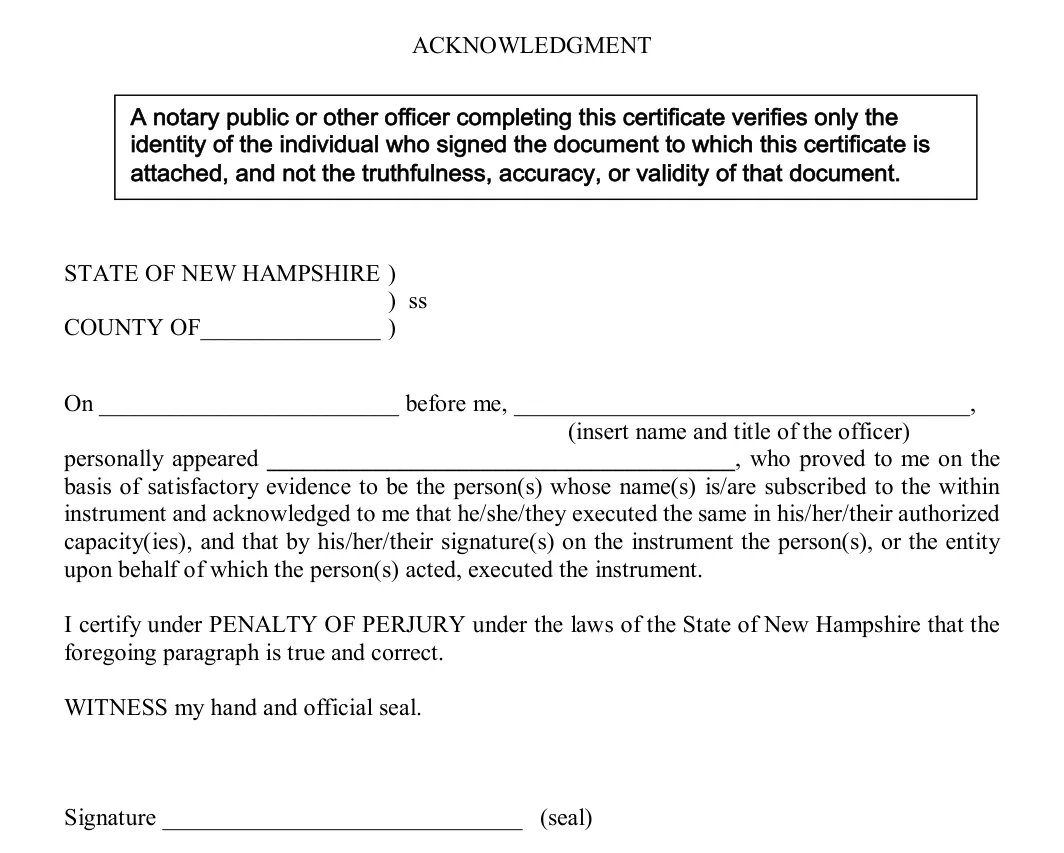
The contents list of RSA 261:148(III) does not include notarization when the document goes to a clerk for a title-exempt vehicle. The acknowledgment page on the vehicle form is there for parties who choose to have it notarized.
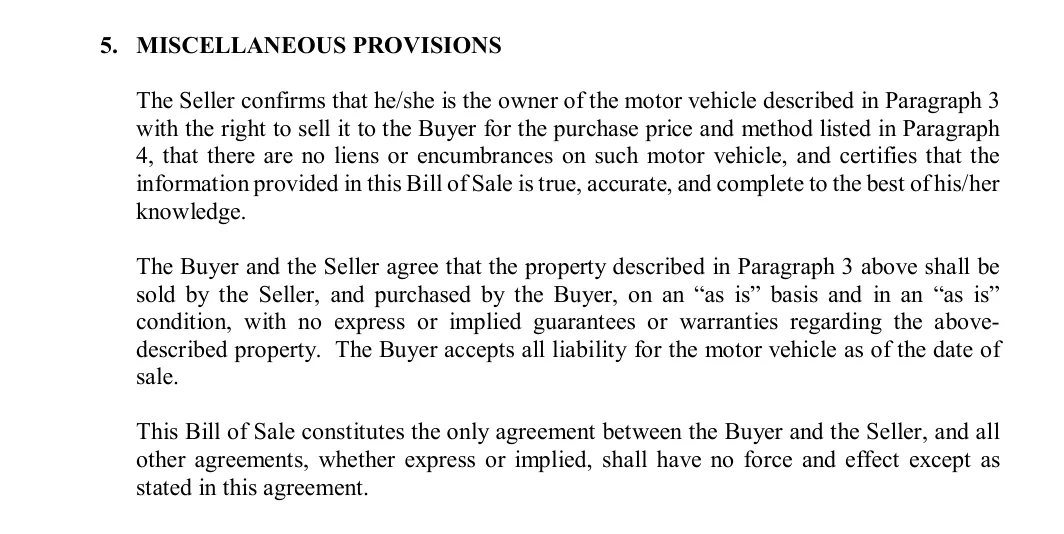
An as is clause in a New Hampshire bill of sale records that the buyer takes the vehicle in its present condition. The clause sits in the form's provisions with the paragraphs on ownership, liens and the entire agreement. Both sides accept it by signing the form.
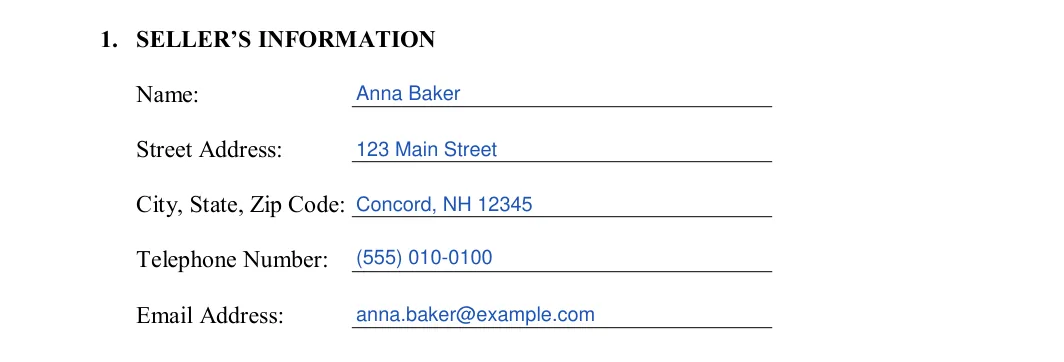
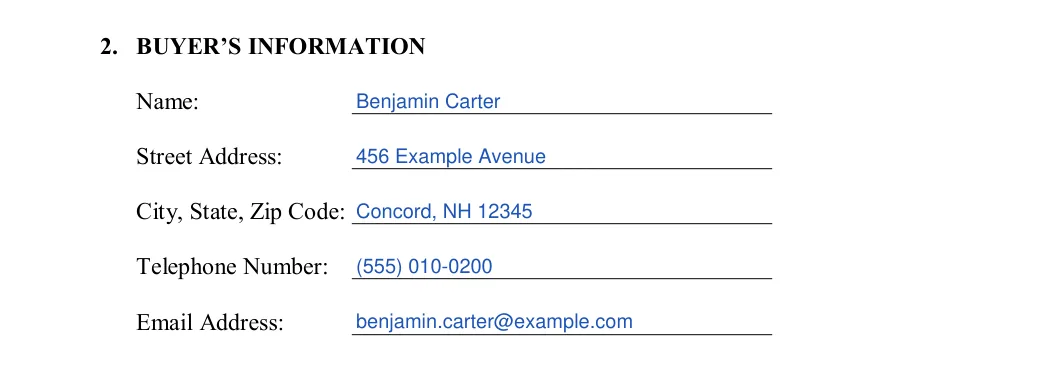
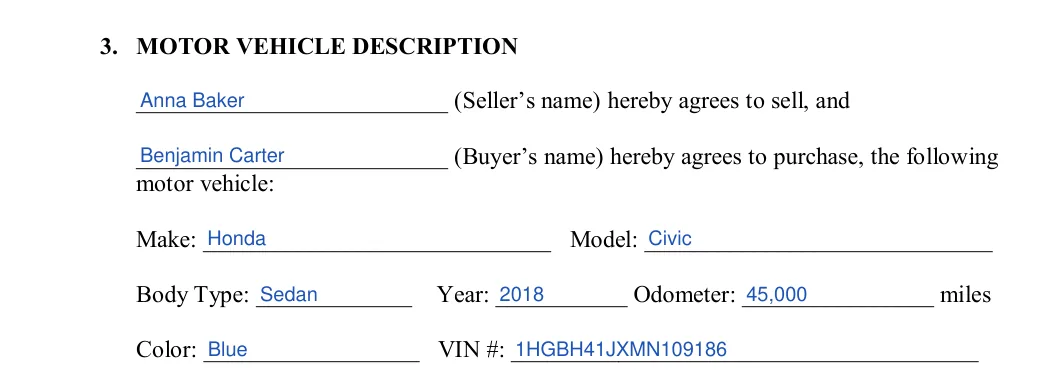
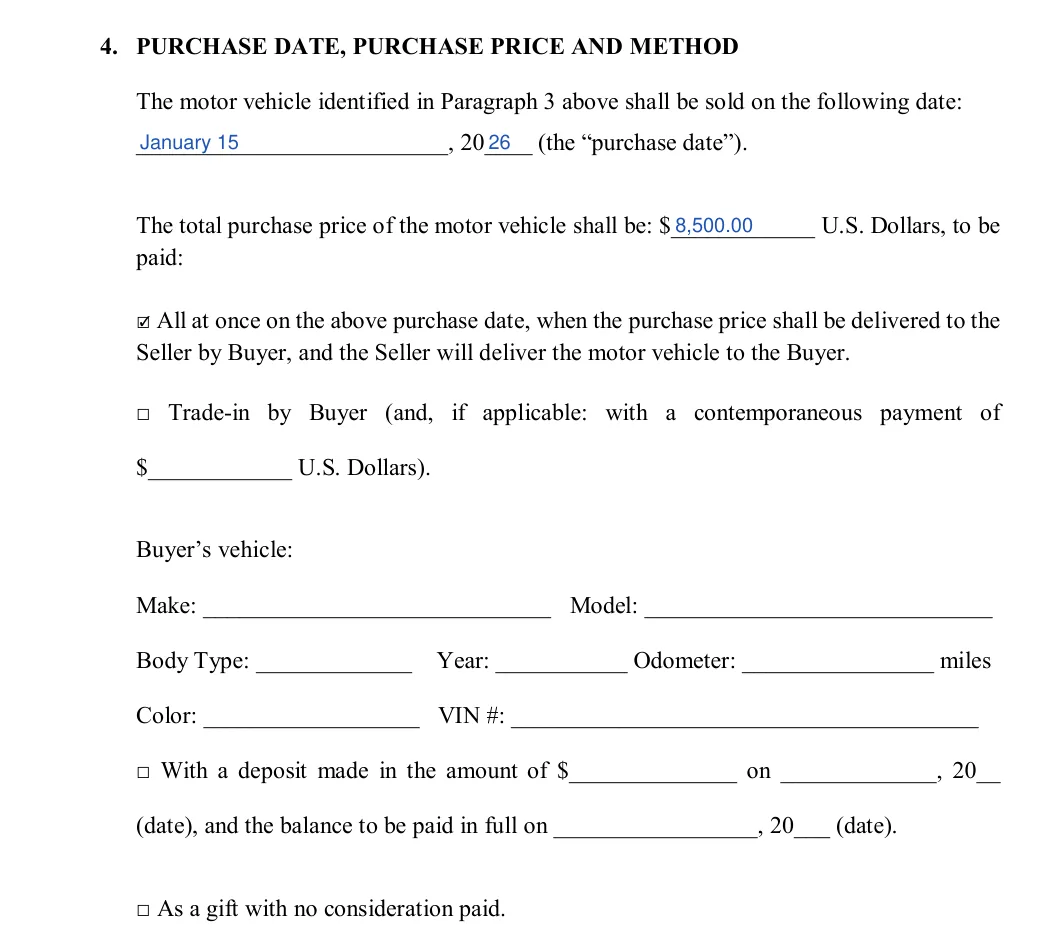
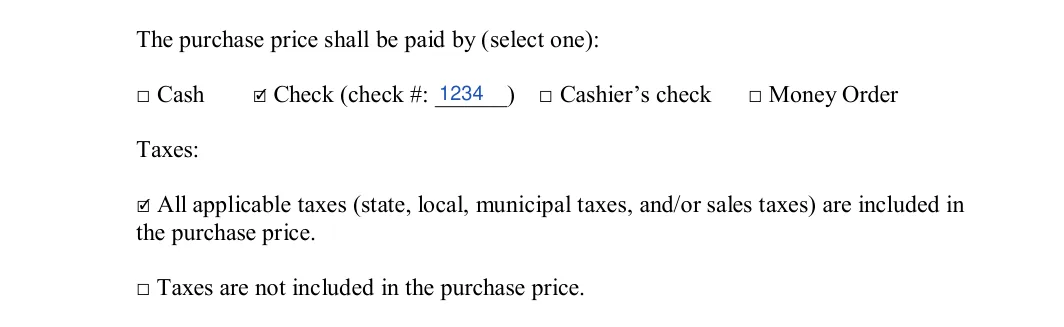
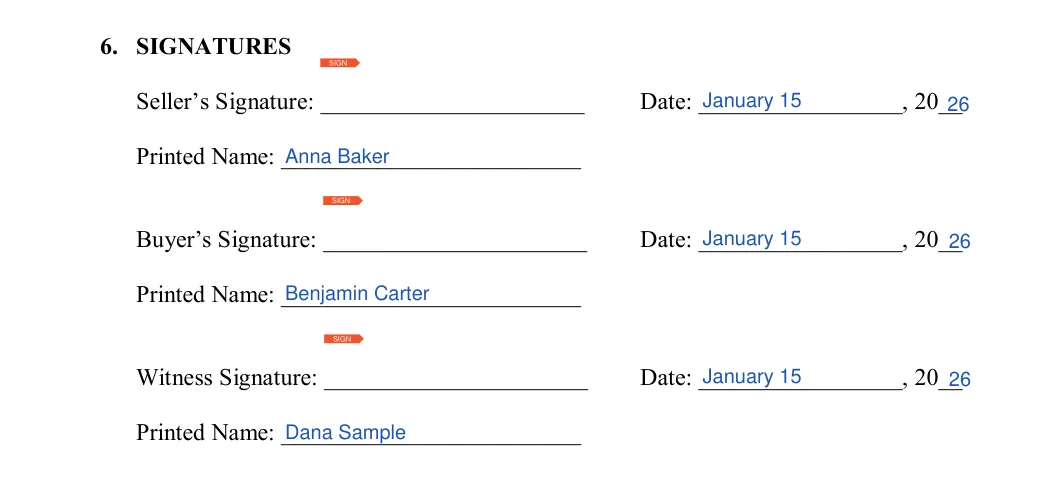
A New Hampshire vehicle bill of sale is filled out in the order of its numbered parts, from the date at the top of page 1 to the signatures on page 3 and the acknowledgment on page 4. Each person's full legal name and address go in every part that asks for them.
The screenshots under each step show the FormsPal New Hampshire motor vehicle bill of sale template filled with sample entries in blue, so you can see where each answer goes. The names, addresses, dates and amounts are examples only.
The motor vehicle form has six numbered parts and a notary acknowledgment page.

A New Hampshire registration starts at the town or city clerk, who issues a registration permit only when the owner presents a current, government-issued photo ID and the papers for the vehicle's kind (N.H. RSA 261:148(II)).[2.1]
Form TDMV 19A or Verification of Vehicle Identification is completed by an authorized agent to verify the vehicle identification number (VIN) by a visual inspection.

A motor vehicle power of attorney can transfer the right of signature to another person if the vehicle owner cannot be present during any transaction related to the vehicle.

Application for New Hampshire residents who want to receive a license for revolver/pistol carry.

These answers come from the New Hampshire statutes listed at the end of this page. For questions this page does not cover, check with your town or city clerk before you buy or sell a vehicle.
No registration permit is issued for a title-exempt car unless the owner presents a current, government-issued photo ID and a bill of sale from the previous owner (N.H. RSA 261:148(II)).[2.1] When a car has a title, the clerk needs the certificate of title or an application for one (N.H. RSA 261:148(II)). Ask your town or city clerk what else the office asks for.
A New Hampshire bill of sale comes from the seller at the time of the sale. The buyer and the seller fill it out together, and each keeps a signed copy. For a title-exempt vehicle, the seller adds a signature and an address, as RSA 261:148(III) asks when the document goes to a clerk.
The list in RSA 261:148(III) names the seller's signature and the buyer's name and address, not the buyer's signature, when the vehicle is title-exempt. The vehicle form still has a signature line for each side and one for a witness.
The contents list of RSA 261:148(III) does not include the price when the vehicle is title-exempt. The vehicle form records the price and the payment method anyway, so both sides hold the agreed terms in writing.
A trailer under 3,001 pounds is title-exempt, so its buyer presents the previous owner's bill of sale to the clerk when the trailer came from a private seller (N.H. RSA 261:148(II)). The statutes this page cites do not cover boats; ask the NH DMV which papers a boat registration needs.

Other New Hampshire Forms
General information, not legal or tax advice.
The numbered references in the text match the entries below. Each one points to a New Hampshire statute page that backs the statement it follows, so you can check the original wording yourself.


