
Updated:
An Arkansas bill of sale is a written record of a sale. For a vehicle, the Arkansas DFA asks for the VIN, date of sale, purchase amount and both signatures.[2] The bill of sale serves private buyers and sellers, especially when registering a car.
Key facts
Build Your Document
Answer a few simple questions to make your document in minutes
Save and Print
Save progress and finish on any device, download and print anytime
Sign and Use
Your valid, lawyer-approved document is ready
An Arkansas bill of sale is a signed record of a private sale: the document names the seller and the buyer, describes the property, and states the price and the date of the sale. Each kind of property, from a car or a boat to a firearm or furniture, has its own version of the form.
The bill of sale gives each party proof of what changed hands, for how much and on what day. For a vehicle, the bill of sale is also one of the papers the Arkansas DFA asks for at registration.[2]
A bill of sale records the sale, but it is not the vehicle's title. To register a bought vehicle, the DFA asks for the current title signed by seller and buyer and, as a separate paper, a bill of sale with the VIN, date of sale, purchase amount and both signatures (Arkansas DFA, Do You Have What You Need?).
The buyer therefore brings both papers to registration. The bill of sale adds what the title does not show: the price, the payment terms and the date the parties agreed on.
| Document Name | Arkansas Vehicle Bill of Sale Form |
| Other Names | Arkansas Car Bill of Sale, Arkansas Automobile Bill of Sale |
| DMV | Arkansas Department of Finance and Administration |
| Bill of Sale Required? | Yes, to register a purchased vehicle[2] |
| Avg. Time to Fill Out | 7 minutes |
| # of Fillable Fields | 17 |
Arkansas bill of sale forms come in five main types, based on the property involved: vehicle, trailer, boat, firearm, and general. The general form covers any personal property, such as furniture or equipment. The bill of sale hub lists the same types for the other states.
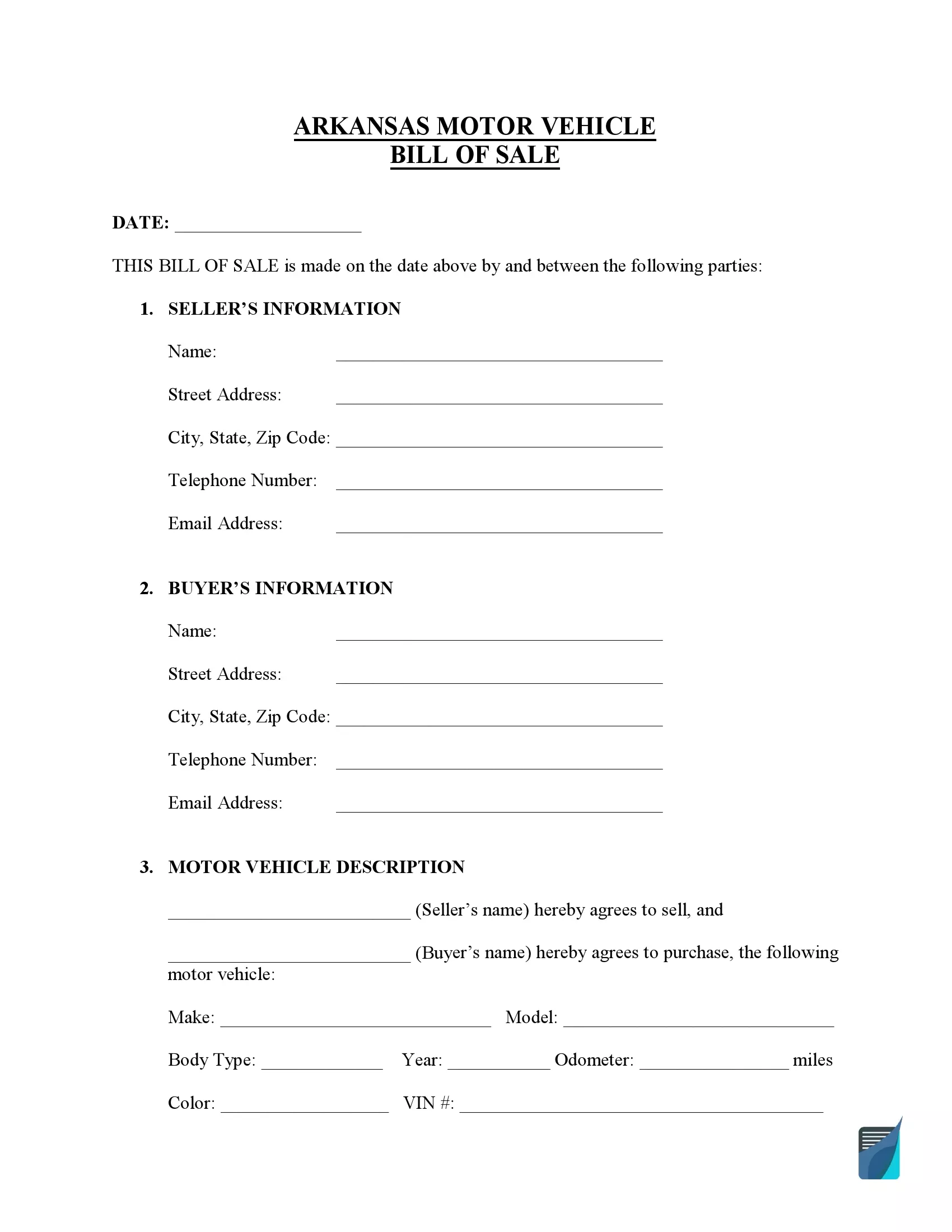
An Arkansas vehicle bill of sale records the private sale of a car, truck or other motor vehicle. Signed by both parties, it is the sale paper the DFA asks for when the buyer registers the vehicle.
| Alternative Name | Car Bill of Sale |
| Seller’s Signature | Required |
| Buyer’s Signature | Required |
| Notarization | Optional |
| Download | PDF Template |

An Arkansas trailer bill of sale records the transfer of a trailer to a new owner. This type of Arkansas bill of sale form applies to all trailer types, including dry van trailers, flatbed trailers, and refrigerated trailers.
| Alternative Name | Trailer Sale Agreement |
| Seller’s Signature | Required to register a trailer driven or moved on a highway[2][3] |
| Buyer’s Signature | Required to register a trailer driven or moved on a highway[2][3] |
| Notarization | Not on the DFA’s registration list[2] |
| Download | PDF Template |

An Arkansas vessel bill of sale records the sale of a boat. The Arkansas DFA accepts a bill of sale as proof of ownership when you register a motorboat. It must describe the boat, including the hull identification number, year, make and horsepower, state the amount of sale, and be dated and signed by both the buyer and the seller.[4]
| Alternative Name | Watercraft Bill of Sale |
| Seller’s Signature | Required |
| Buyer’s Signature | Required |
| Notarization | Usually optional |
| Download | PDF Template |

A firearm bill of sale records the transfer of a new or used gun between two private parties and gives both of them written proof of the deal.
| Alternative Name | Gun Bill of Sale |
| Seller’s Signature | Recommended |
| Buyer’s Signature | Recommended |
| Notarization | Usually optional |
| Download | PDF Template |

A general bill of sale records a private sale of any other personal property in Arkansas, such as furniture, tools or equipment.
| Alternative Name | Generic Bill of Sale |
| Seller’s Signature | Recommended |
| Buyer’s Signature | Recommended |
| Notarization | Usually optional |
| Download | PDF Template |
An Arkansas vehicle bill of sale needs four items for registration: the VIN, the date of sale, the purchase amount, and the signatures of the seller and the buyer (Arkansas DFA, Do You Have What You Need?).
Check that your form has all four items the DFA lists: the VIN, the date of sale, the purchase amount, and a signature from each party.
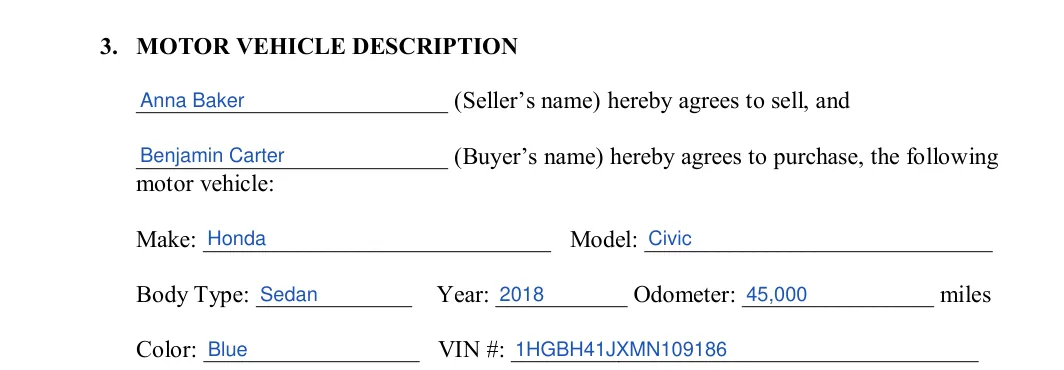
The bill of sale may hold more than those four items. Most forms also describe the vehicle by make, model, year, body type, color and odometer reading, which helps both parties match the paper to the vehicle.
The Arkansas vehicle bill of sale comes paired with an odometer disclosure statement on the DFA's motor vehicle forms page, so plan to complete both (Arkansas DFA Bill of Sale / Odometer).
Under the federal odometer rule, the seller must disclose the mileage for a vehicle of model year 2011 or newer until it is 20 years old (49 CFR § 580.17). Vehicles of model year 2010 and older are exempt. The disclosure goes on Form 10-313 or in the odometer space on the title.[5]
An Arkansas bill of sale does not need a notary for vehicle registration: notarization is not on the DFA's list, which names the VIN, date of sale, purchase amount and both signatures (Arkansas DFA, Do You Have What You Need?).
A notary stays an option for parties who want one. The vehicle form ends with an acknowledgment block for that case, covered in step 7 below.
Arkansas titling rules reach a motor vehicle, trailer, semitrailer or pole trailer when it is driven or moved upon a highway, except in the cases Ark. Code Ann. § 27-14-703 lists. The same section brings every mobile home under the chapter, subject to those exceptions.
An Arkansas vehicle bill of sale is filled out in seven steps that follow the form from top to bottom: the parties, the vehicle, the price, the terms, the signatures and an optional notary block.
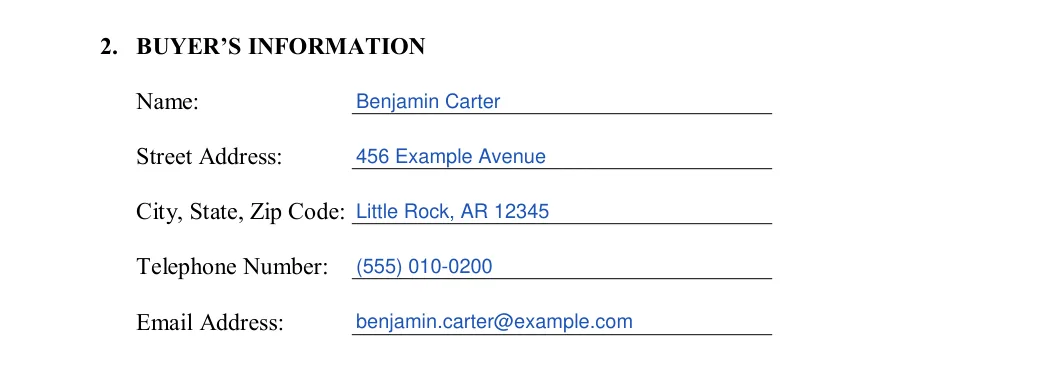
The screenshots under each step show the FormsPal Arkansas motor vehicle bill of sale template filled with sample entries in blue, so you can see where each answer goes. The names, addresses, dates and amounts are examples only.
This template goes by several names in Arkansas, including Arkansas Car Bill of Sale and Arkansas Automobile Bill of Sale. They all refer to the same form.
The first four steps of the form identify the seller, the buyer, the vehicle and the payment, so each party and the DFA can match the paper to the car.
Enter the date and the seller's details. Write the date at the top of the form, then the seller's:
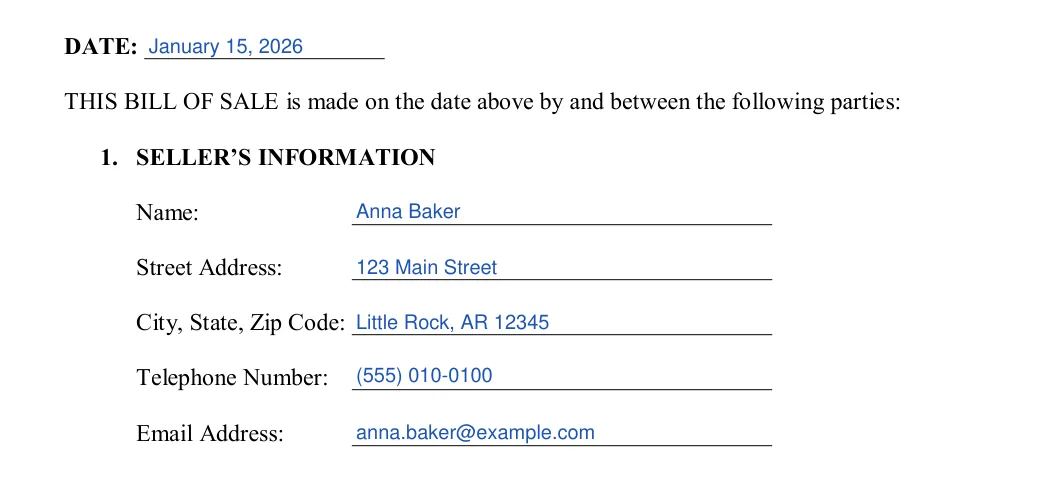
Enter the buyer's details. Write the same five details for the buyer: name, street address, city, state and zip code, telephone number and email address.
Describe the vehicle. Write both names in the agreement sentence, then the vehicle's:
Check the VIN against the title, since the DFA asks for it on the bill of sale.[2]
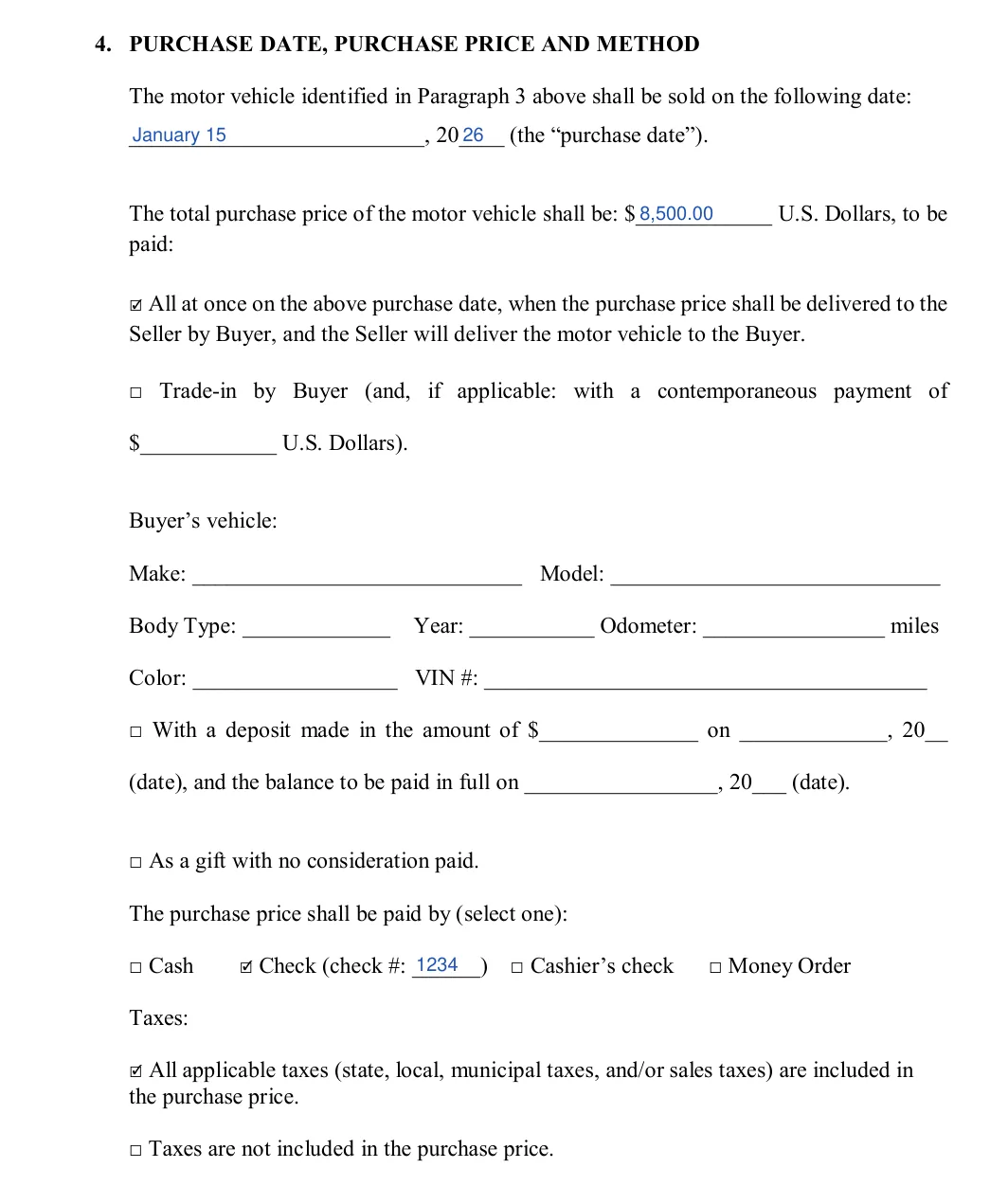
Enter the price and the payment terms. Write the purchase date and the total price in U.S. dollars. Tick how the buyer pays: all at once, with a trade-in, with a deposit, or as a gift. Tick the payment type and whether the price includes taxes.
The last three steps of the form confirm the terms and add the signatures the DFA asks for, the seller's and the buyer's, with a notary block at the end for parties who choose one.
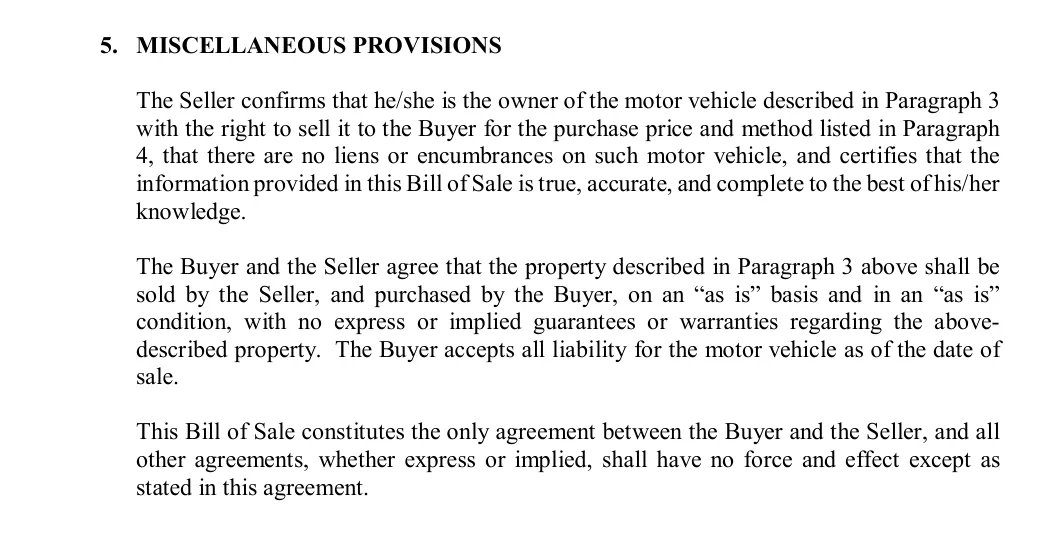
Read the miscellaneous provisions. This part has nothing to fill in. It holds the seller's confirmation of ownership and no liens, the as-is clause, and the entire-agreement clause.
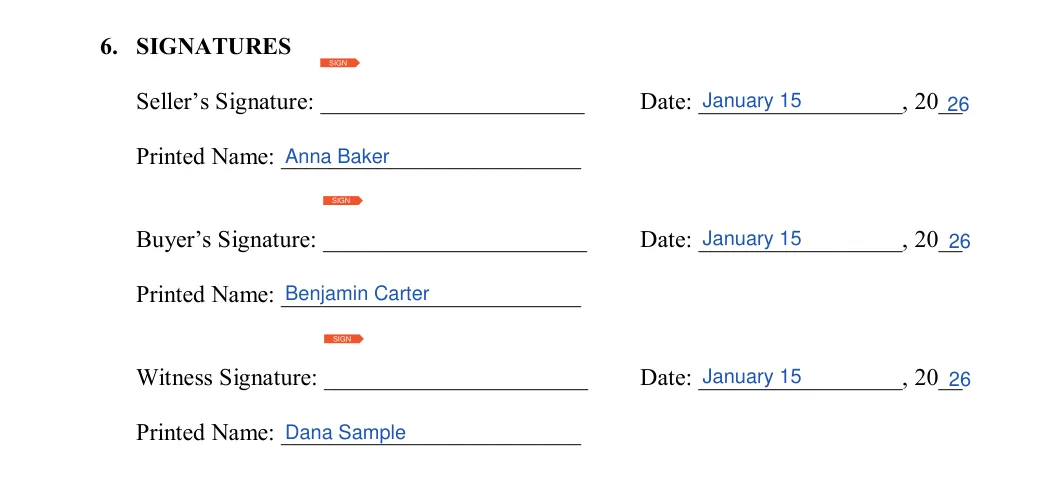
Sign and date the form. The seller signs first, prints a name and dates the line; the buyer does the same. Use the witness line only if you want a witness to sign. Give each party a signed copy to keep.
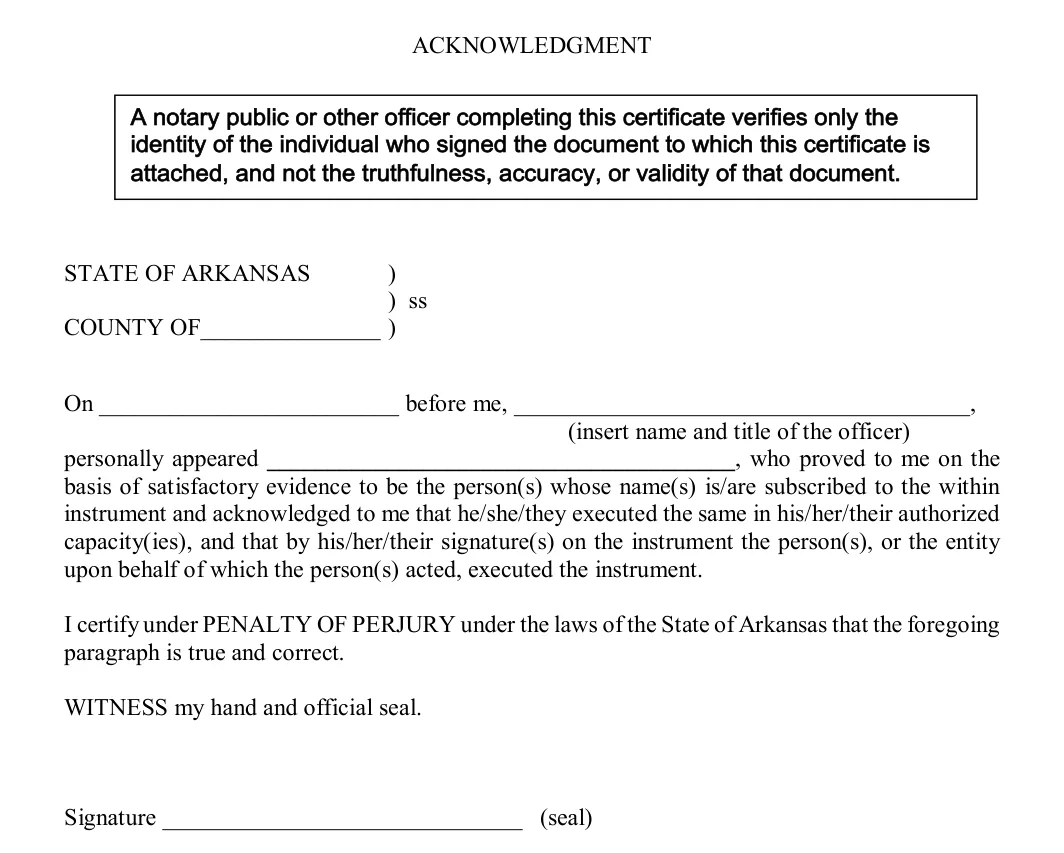
Add the notary acknowledgment if you choose one. Sign in front of the notary, then complete the county, date and signer name lines in the acknowledgment block on the last page.
The signed bill of sale is one of six items the DFA lists for registering a bought vehicle, and the buyer brings it together with the title, the county tax papers, proof of insurance and the fees.[2]
The other papers you need can depend on how you bought the vehicle, for example from a private seller or from a dealer. Check the DFA’s registration documents before you go, and bring the signed bill of sale. A motor vehicle power of attorney lets someone else handle the registration for you.
The bill of sale splits the paperwork between the two parties: the seller signs and hands over the papers, and the buyer signs, keeps a copy and registers the vehicle.
A trailer or a boat sold with the vehicle goes on its own form: the Arkansas trailer bill of sale or the Arkansas boat bill of sale. The vehicle bill of sale page covers the same document outside Arkansas.
The vehicle registration application is an official form accepted in the state of Arkansas.

The bill of sale records a vehicle sale. It is not the title: the DFA asks for the bill of sale and the current title signed by seller and buyer at registration (Arkansas DFA; Do You Have What You Need?).

The odometer disclosure statement records the mileage for a vehicle that needs a disclosure; vehicles of model year 2010 and older are exempt (49 CFR § 580.17). In Arkansas, it’s merged with the Bill of Sale form.

Having a power of attorney form allows a trusted person to conduct any vehicle-related operations on behalf of the title owner.

Application for watercraft is used to register and title your vessel.

Application for a concealed gun carry license or its renewal. For Arkansas residents only.

Request for a new gun license in case the previous one was lost or destroyed.

The answers below cover the questions buyers and sellers ask most about an Arkansas bill of sale, each pointing to the state source it rests on.
Notarization is not on the DFA’s list. So a missing notary does not by itself put a bill of sale outside what the state asks for. The items that matter are the VIN, the date, the amount, and a signature from each party.[2]
A private car sale in Arkansas uses three papers: two from the DFA's registration list (Arkansas DFA, Do You Have What You Need?) and one from its motor vehicle forms page.
The Arkansas Department of Finance and Administration, listed as the DMV in the table above, publishes the Vehicle Bill of Sale/Odometer Disclosure Statement (Form 10-313).[6] It may be reproduced as long as its format and language are not changed. The DFA's forms list also holds a Bill of Sale (Credit for Vehicle Sold), shown under Relevant Official Forms above.
The Arkansas DFA accepts a bill of sale as proof of ownership when you register a motorboat.[4] The boat bill of sale describes the boat by its hull identification number, year, make and horsepower, and shows the amount, the date and both signatures.
An as-is clause says the buyer takes the vehicle in its present condition, with no promise from the seller about how it runs. The vehicle form prints the clause in its miscellaneous provisions, next to the seller's statement that the vehicle carries no liens.
Each side should keep a personal copy of the signed form. The buyer brings the bill of sale, with the signed title, to the State Revenue Office at registration.

Other Arkansas Forms
General information, not legal or tax advice.

