
Updated:
Get Form Now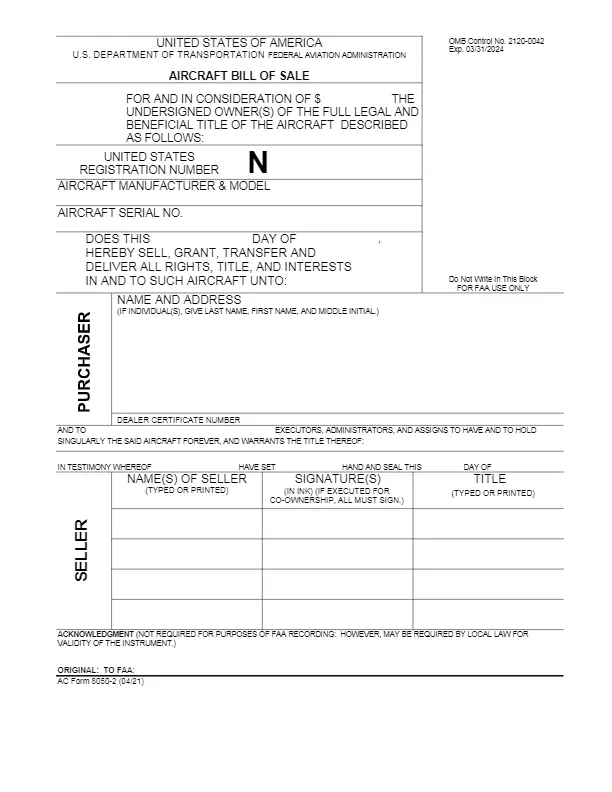
AC Form 8050-2 is the FAA bill of sale for an aircraft. The seller signs it to transfer an aircraft, named by N-Number and serial number, to a buyer.
This page covers what the form asks for, how a sale runs, how to fill out each field and what happens after the seller signs.
Key facts
AC Form 8050-2 is the Federal Aviation Administration's one-page bill of sale that shows an aircraft passed from a named seller to a named buyer for a stated consideration on a stated date.
The aircraft bill of sale is the transfer paper itself. The price talks, the deposit and the inspection belong to the parties' purchase agreement, while the bill of sale carries only the facts of the transfer.
| Document Name | Aircraft Bill of Sale Form |
| Other Names | FAA Bill of Sale, AC Form 8050-2 |
| Issued By | Federal Aviation Administration (FAA) |
| Avg. Time to Fill Out | 10 minutes |
| # of Fillable Fields | 22 |
| Available Formats | Adobe PDF |
The FAA's 8050 series holds the aircraft registration forms, and only AC Form 8050-2 is the bill of sale; the others apply for, show or secure the registration. The table sorts the forms searchers most often confuse with it.
| Form | Title | What it does in a sale |
|---|---|---|
| AC 8050-2 | Aircraft Bill of Sale | Transfers the aircraft from seller to buyer |
| AC 8050-1 | Aircraft Registration Application | Asks the FAA to register the aircraft in the buyer's name |
| AC 8050-3 | Certificate of Aircraft Registration | The registration certificate the FAA issues to the owner |
| AC 8050-98 | Aircraft Security Agreement | Covers a lender's security interest when the purchase is financed |
| AC 8050-88 | Affidavit of Ownership | Shows ownership of an amateur-built or other non-type certificated aircraft |
| AC 8050-5 | Dealers Aircraft Registration Certificate Application | Used by aircraft dealers, not by private buyers |
A private sale usually uses two of them together: the seller signs AC Form 8050-2, and the buyer sends it with AC Form 8050-1.
The FAA bill of sale asks for five groups of facts: the consideration, the aircraft's description, the date, the purchaser and the sellers with their signatures. Each group has its own block on the form.
The consideration line holds what the buyer gives the seller for ownership of the aircraft. Consideration is usually the purchase price of the aircraft, written as an amount.
The description block identifies the aircraft by three entries:
The purchaser block holds the buyer's full name and address. A dealer certificate number goes in its own box only when an aircraft dealer takes part in the sale; otherwise the box stays blank.
The seller block holds each seller's signature, the date of signing, the printed name and, for a company seller, the signer's title. All the sellers must sign the bill of sale in ink, and the form must be prepared in duplicate.
Please note that the seller’s name must match the one on the existing registration. Don’t initialize names, for instance, Samuel to Sam.
The FAA reads the signed form as the buyer's evidence that ownership moved from the last registered owner.
The form also serves both parties after the sale. The seller has a dated paper showing when the aircraft left their hands, and the buyer has the receipt for the deal to keep with the logbooks.
A different document fits in three cases. A financed purchase adds a security agreement for the lender. An amateur-built aircraft with no earlier owner is shown by an affidavit of ownership. The deposit, the inspection and the refund terms go into a purchase agreement, which comes before the bill of sale. For other kinds of property, see our bill of sale forms.
An aircraft sale runs in six steps, from the price talk to the FAA registration, and the bill of sale is signed near the end. The list follows the usual order.
Agree on the price and the deposit.

Settle the price and the deposit amount with the seller. Decide whether the deposit is refundable and, if so, under which conditions.
Write down the terms of the deal.

Put the terms on paper: the sale date, both parties' names and postal addresses, the aircraft's make, model, registration number and serial number, the purchase price, the delivery date and the deposit amount.
Set the refund terms and the inspection window.

Name how long the buyer has to inspect the aircraft and whether the deposit comes back if the inspection turns up a problem.
Inspect the aircraft.

Hire a mechanic to inspect the aircraft within the agreed window. A larger aircraft takes longer to inspect than a small one.
Close the sale.

Pay the balance, then have the seller sign AC Form 8050-2 and deliver the aircraft on the agreed date.
Register the aircraft with the FAA.

Send AC Form 8050-1, the aircraft registration application, to the FAA with the signed bill of sale. When new owners apply for registration, they must show how the plane’s ownership moved from the last registered aircraft owner down to them.
AC Form 8050-2 is filled out top to bottom in five blocks, and every entry is checked against the aircraft's current registration before anyone signs. Use the same order as the form.
Enter the consideration.

Write the amount the buyer pays for the aircraft in the first block.
Describe the aircraft.

Copy the N-Number, the manufacturer and model, and the serial number from the registration certificate, one character at a time.
Enter the date of the transfer.

Write the day, the month and the year the aircraft changes hands.
Fill in the purchaser.

Enter the buyer's full name (last name, first name and middle initial), street address, city, ZIP code and the rest of the address. Add the dealer certificate number only if a dealer takes part, and leave it blank otherwise. Choose "his", "her" or "their" in front of the words "executors, administrators, and assigns".
Sign as the seller.

Have each seller sign in ink, date the signature, and type or print the name and, for a company, the title. Make two originals.
The signed bill of sale travels with the registration application: one original goes to the FAA attached to AC Form 8050-1 and the buyer keeps the other. A seller who wants a copy for their own files makes one before handing the papers over.
Payment changes hands when the seller signs. A bank wire transfer protects the seller better than a check, which can bounce, and an escrow service can hold the funds until both sides are ready. A seller who works through a broker or dealer signs an agreement with that firm before the sale closes.
The handover closes the seller's side of the sale. The seller's checklist:
The second copy of AC Form 8050-1 serves as temporary authority to operate without registration under 14 CFR 47.31, once the application, the bill of sale and the fee have gone to the FAA Aircraft Registry. Under 14 CFR 47.31, the buyer carries that copy in the aircraft only when the aircraft was last registered in the United States.
The temporary authority under 14 CFR 47.31 covers operation within the United States only.
Under 14 CFR 47.31, the second copy gives no temporary authority when no registration number is assigned at the time of the application. Under 14 CFR 47.31, the temporary authority is also not available for an application received when 12 months have passed since the FAA received the first application after the last registered owner transferred the aircraft.
Most problems with the FAA bill of sale come from a mismatch with the current registration or a blank field. Check the form for these slips before the seller signs:
Yes, AC Form 8050-2 is the FAA's own aircraft bill of sale. People also call it the FAA bill of sale, the airplane bill of sale or simply 8050-2.
AC Form 8050-2 can be downloaded on the FAA's site. Alternatively, you can get it on AOPA’s website.
No, the signature lines of AC Form 8050-2 are for the sellers. The buyer signs the registration application, AC Form 8050-1, instead.
Consideration is what the buyer gives the seller in exchange for the aircraft. In a sale it is usually the purchase price.
The words extend the transfer to the purchaser's successors. On the form, pick "his", "her" or "their" in front of them to match the purchaser.
AC Form 8050-2 transfers the aircraft, and AC Form 8050-1 applies to register it in the buyer's name. The buyer sends both to the FAA together.
General information, not legal or tax advice.
